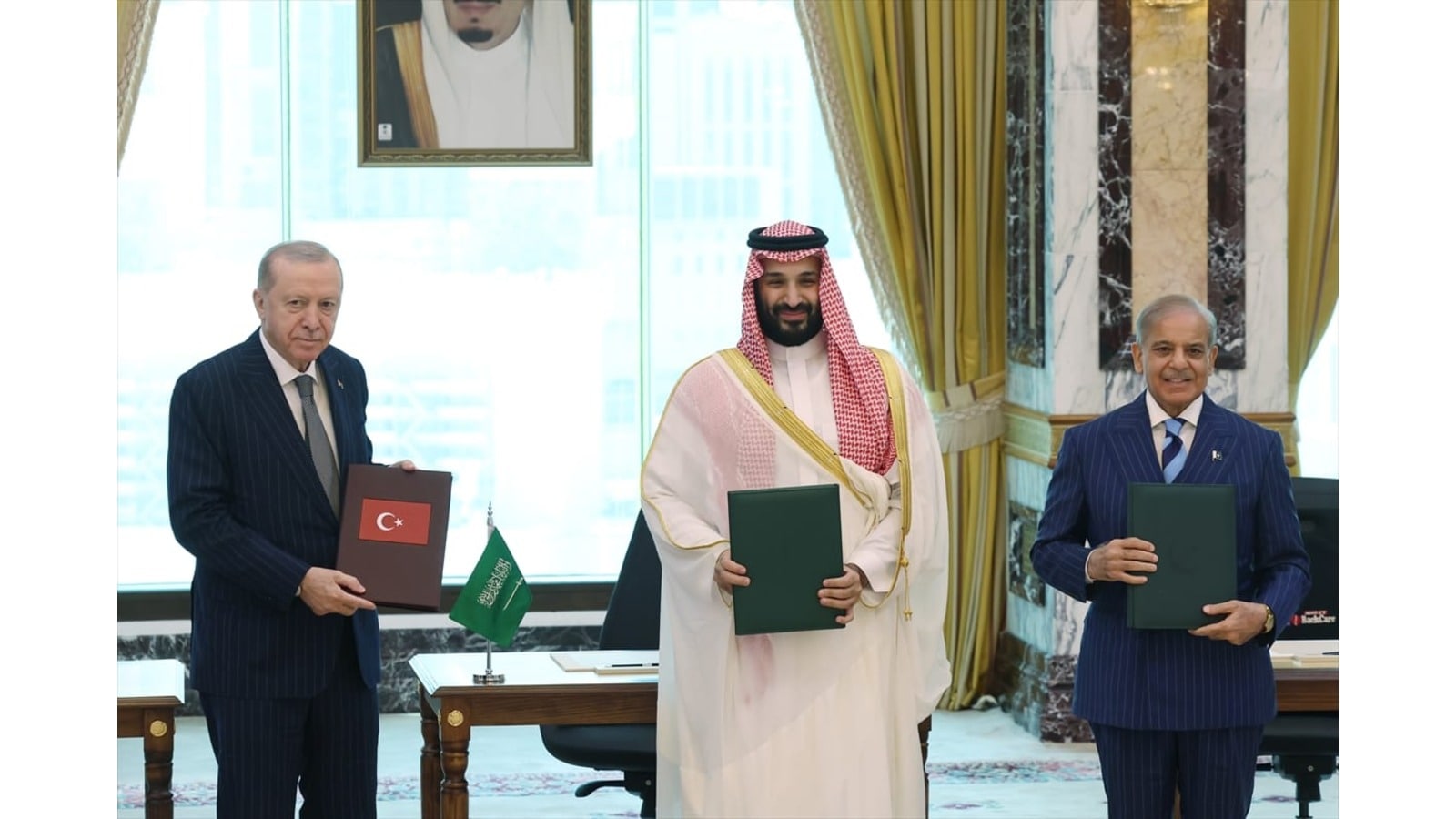
Ink dries on parchment. Generals shake hands beneath glittering chandeliers. In quiet rooms across three distinct nations, maps are redrawn not with ink, but with solemn vows. Saudi Arabia, Turkiye, and Pakistan have forged a new reality. An attack on one is now officially declared an attack on all.
Consider the sheer geographic weight of this alignment. Three military powerhouses, bridging the Middle East, the Mediterranean, and South Asia, have drawn a circle around their collective sovereignty.
Generations of diplomats watched alliances fracture under the weight of competing ambitions. Borders shifted. Treaties dissolved like salt in water. Yet, history occasionally bends toward unexpected convergence.
Imagine standing on a cold morning in Islamabad, watching jet fighters cut through the haze. Picture an officer in Ankara looking across the Bosporus, calculating the shifting tides of regional security. Envision a strategist in Riyadh reviewing radar telemetry beneath the desert stars. These moments are no longer isolated. They belong to a shared architecture.
Security is rarely about the weapons themselves. It is about psychology. Deterrence works when an adversary calculates the cost and simply walks away.
Think of a bridge built over a roaring river. One plank can snap. Two planks can strain. But three massive pillars, anchored deep into bedrock, alter the physics of the entire structure. That is what this defense pact attempts to achieve. It signals to external actors that pushing against one nation means pushing against the collective mass of all three.
Critics will point to the complexities. Logistics differ. Doctrines clash. Language barriers exist between command centers. These are real hurdles. But history shows that shared necessity often forces cooperation where diplomacy stalls.
Think back to the Cold War. Think of the web of security guarantees that shaped the twentieth century. Alliances are rarely born out of sudden affection. They are forged in the crucible of changing geopolitical winds. When global superpowers pivot and regional uncertainties multiply, middle powers look to one another for stability.
What does this mean for the streets of Lahore, the ports of Karachi, the soaring towers of Riyadh, and the historic alleys of Istanbul?
Day to day, life continues unchanged. Markets open. Children walk to school. Tea is poured. But the invisible roof overhead has been reinforced.
Power respects power. When nations with millions of active personnel, advanced defense industrial bases, and critical geostrategic choke points align their doctrines, the calculus of war changes. Peace is rarely preserved by wishing for it. Peace is preserved by making conflict too expensive to contemplate.
The ink is dry. The hands have shaken. Now comes the hard part. Translating words on paper into interoperable armies, synchronized defenses, and unshakeable trust.
The horizon remains uncertain. Storms always gather on the edges of empires and republics alike. But tonight, the wind blows against a wall built of three stones, cemented together by mutual survival.