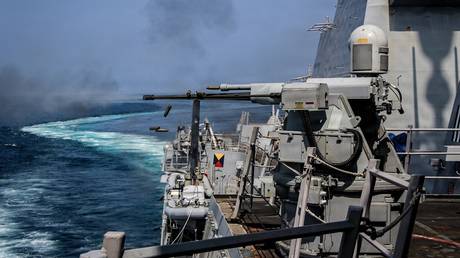
The Gulf of Oman is currently the most dangerous stretch of water on the planet. If you've been following the news out of Tehran lately, you've likely heard the grim prediction from Maj. Gen. Mohsen Rezaei. He basically told the US Navy to pack up and leave before the Gulf of Oman turns into a "graveyard" for American ships.
It’s easy to dismiss this as just another round of fiery rhetoric from the Islamic Republic. We’ve heard it all before, right? But the context in May 2026 is fundamentally different. This isn't a routine shouting match. We’re currently in the middle of a high-stakes naval blockade that the Trump administration launched back in April. When you combine a literal "act of war" like a blockade with Iran’s new long-range missile tech, that "graveyard" comment starts to sound less like a slogan and more like a tactical forecast.
The blockade that changed everything
On April 13, 2026, the US military shifted from passive monitoring to active enforcement. Under the command of Admiral Brad Cooper at CENTCOM, the US Navy began intercepting any vessel heading to or from Iranian ports. They’re calling it an "impartial" enforcement, but let’s be real. It’s a chokehold on Iran’s economy.
Just a few days ago, on May 8, US F/A-18 Super Hornets from the USS George H.W. Bush fired precision munitions into the smokestacks of two Iranian-flagged tankers. They didn't sink them, but they disabled them. That’s a massive escalation. It shows the US is willing to use kinetic force to stop commercial traffic. For Tehran, this isn't a diplomatic disagreement. It’s a siege.
Rezaei’s warning is a direct response to this "Project Freedom" initiative. While Washington frames the operation as a humanitarian effort to guide stranded ships, Iran sees it as piracy. Rezaei isn't just a random official; he’s a former IRGC commander and an adviser to Supreme Leader Mojtaba Khamenei. When he says Iran’s patience is running out, he’s signaling that the IRGC is ready to move from shadow play to direct engagement.
Why the Gulf of Oman is a death trap
Most people focus on the Strait of Hormuz because it’s narrow. It’s the classic chokepoint. But the Gulf of Oman is where the real disaster would happen for a modern carrier strike group. Here’s why.
Iran has spent the last five years diversifying its "anti-access/area denial" (A2/AD) capabilities. They aren't just relying on swarm boats anymore. They’ve moved their most dangerous assets deep into the mountains along the coast, stretching from Bandar Abbas all the way to the Pakistani border.
- The Abu Mahdi Missile: This is the big one. It’s a cruise missile with a range of over 1,000 kilometers. It uses AI-assisted navigation to hug the sea surface and evade radar. In the past, the US Navy could sit safely in the Arabian Sea, well out of reach of Iranian coastal batteries. Not anymore. The Abu Mahdi pushes the danger zone hundreds of miles out into the open ocean.
- Saturation Swarms: While the US has gotten good at picking off individual targets, Iran’s strategy is built on "saturation." They can launch hundreds of drones and fast-attack craft simultaneously. Even the best Aegis defense system has a limit. If you throw 300 targets at a destroyer, a few are going to get through.
- Submerged Threats: We often forget about Iran’s midget submarines. In the relatively shallow, murky waters of the Gulf of Oman, these small subs are incredibly hard to track. They don't need to sink a carrier; they just need to hit a rudder or a propeller to turn a billion-dollar ship into a sitting duck.
Washington's gamble is hitting a wall
President Trump has been leaning hard on the "Clock is Ticking" narrative. He’s betting that the blockade will force Tehran back to the table for a new non-nuclear deal. He recently posted an image on social media showing Iran surrounded by hostile forces, essentially telling them they’re alone.
But the data shows the blockade isn't a total seal. Lloyd’s List reported that dozens of Iranian vessels have successfully bypassed the American net. On April 20 alone, 11 tankers managed to slip out of the Gulf of Oman. If the blockade isn't 100% effective, it becomes a high-cost, high-risk game of whack-a-mole.
The US is burning through millions of dollars in operational costs every day. Meanwhile, Iran is using the blockade to justify its military build-up to the domestic audience. It’s the perfect propaganda tool for the regime. They can blame every economic woe—from price hikes to fuel shortages—on "American piracy."
What actually happens if someone pulls the trigger
If a US ship sinks an Iranian vessel or vice versa, the Gulf of Oman won't just be a graveyard for ships. It'll be a graveyard for the global economy.
We’re talking about a waterway that handles a massive chunk of the world's daily oil supply. Even the threat of a full-scale naval war has sent insurance premiums for tankers into the stratosphere. If the IRGC decides to follow through on Rezaei’s threat, they won't just target the US Navy. They’ll target the infrastructure. They’ve already warned that if their ports aren't safe, "no port in the Persian Gulf will be safe."
That’s a thinly veiled threat to the UAE and Saudi Arabia. It’s an attempt to break the regional coalition supporting the US. If Iran can convince its neighbors that hosting US bases makes them a target, the American position in the Middle East starts to crumble from the inside.
Your next steps to stay informed
This situation is moving fast. You shouldn't just wait for the evening news to catch up. Here’s how you can track the real risks in the Gulf of Oman right now.
- Watch the Tanker Tracks: Use maritime tracking sites like MarineTraffic or Lloyd’s List. Look for "dark" tankers—ships that turn off their transponders. That’s where the friction usually starts.
- Monitor CENTCOM Statements: Don't just read the headlines. Read the actual press releases from US Central Command. They often include specific details about the types of weapons used and the location of interceptions.
- Follow Regional Analysts: Keep an eye on the Islamabad-based mediators. Pakistan is the primary backchannel right now. If the talks in Islamabad officially collapse, that’s your signal that a kinetic "graveyard" scenario is becoming likely.
The reality is that neither side wants a total war, but both sides are behaving like it’s inevitable. When you have high-tech warships and "suicide" drone swarms operating in the same small bathtub, the margin for error is zero. Iran's "graveyard" comment isn't just a threat—it's a description of what happens when diplomacy fails and the missiles start flying.