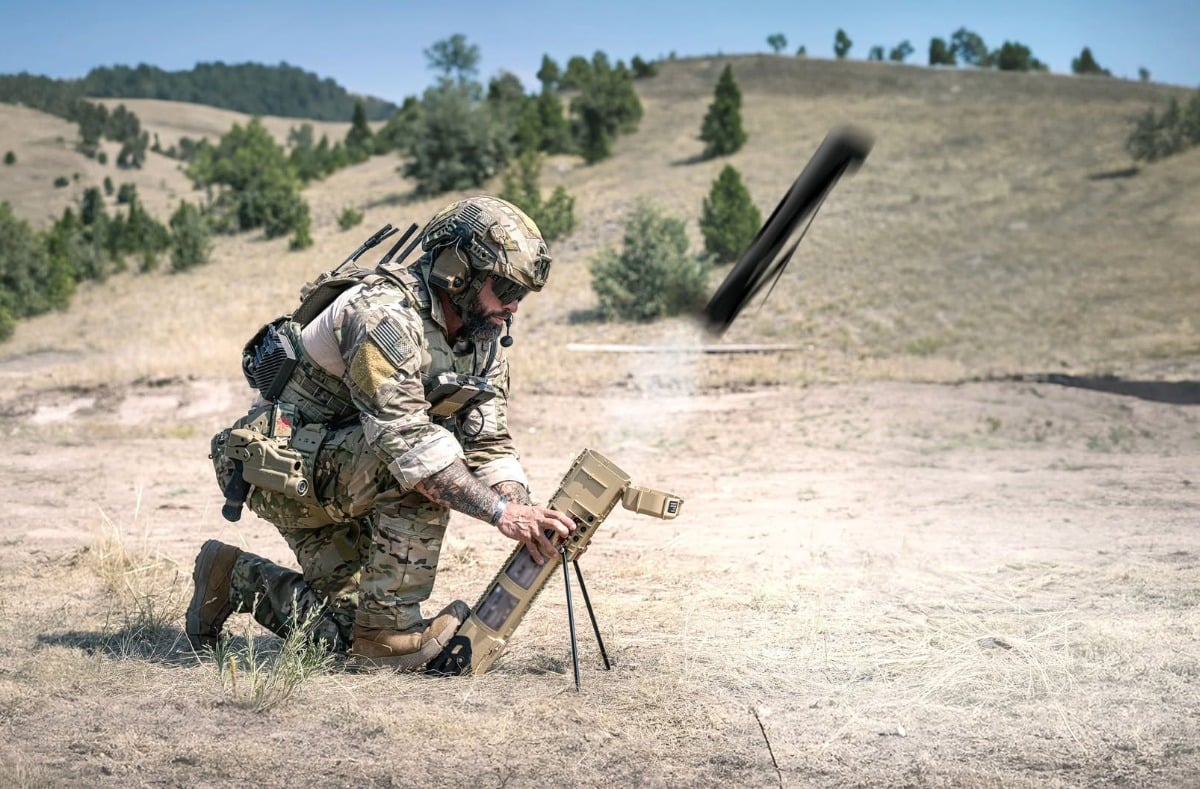
A whiteboard sits in a windowless room in Arlington, Virginia. On it, engineers have sketched a series of looping lines that resemble the hunting patterns of a bird of prey. For years, this was the quiet reality of AeroVironment. They built small, clever things. They built the Switchblade, a loitering munition that can hover in the air like a ghost before making a final, definitive choice. They were a boutique shop for a highly specific kind of future.
That boutique era is officially over.
When a company nearly doubles its size in a single year, something fundamental shifts in its DNA. AeroVironment recently closed its 2026 fiscal year with a staggering $1.98 billion in revenue. To financial analysts reading a balance sheet, it looks like a triumph of corporate scaling, a near-miss of the mythic $2 billion milestone driven by a ravenous appetite for acquisitions. But behind the cold spreadsheets lies a deeper, messier story about what happens when the technology of tomorrow is dragged into the industrial reality of today.
To understand the weight of $2 billion, consider a hypothetical technician on the assembly floor. Let us call her Sarah. For years, Sarah assembled components for lightweight, man-portable systems. Her work was delicate, almost artisan. But over the last twenty-four months, the nature of her days has changed. The orders are no longer coming in batches of dozens; they are coming in waves. The world has watched the shifting frontlines in Europe and realized that the sky is no longer a safe haven. It is a battlespace filled with cheap, autonomous eyes.
Sarah is no longer just building tools. She is part of a massive, grinding industrial machine trying to keep pace with a geopolitical panic.
The explosive top-line growth, featuring a 133% revenue surge to $641.6 million in the final quarter alone, was not entirely organic. It was bought. By absorbing BlueHalo and Empirical Systems Aerospace, AeroVironment bought its way into the big leagues of defense contracting. They did not just acquire companies; they acquired complexity. They stepped out of the niche of small drones and into the complex, expensive worlds of counter-drone missiles, space technologies, and directed energy.
But growth has a gravity all its own.
Look closely at the numbers and the tension becomes obvious. While revenue soared, the company posted a massive GAAP net loss of $265.1 million for the full year. Why? Because buying your way to the top requires taking on immense weight. The company had to digest $240.7 million in goodwill impairments and heavy amortization costs, largely tied to the termination of the military's SCAR program.
It is the corporate equivalent of a sudden, painful growth spurt. The bones stretch before the muscles can support them.
Consider what happens next on the balance sheet. The gross margin percentage slipped from 36% down to 32%. This is the hidden friction of shifting from a pure hardware manufacturer to a services provider. When you buy a company like BlueHalo, you inherit thousands of billable human hours, complex integration contracts, and thin-margin services. The hardware side remains incredibly lucrative, but the services side drags at the ankles of profitability.
It is a vulnerability that corporate leadership openly acknowledges. They are bleeding cash in one room while stacking mountains of orders in another.
Yet, the demand is relentless. The company’s funded backlog has swollen to $1.2 billion. The book-to-bill ratio stands at 1.4, a clear mathematical indicator that the world wants these systems faster than the factory floors can physically assemble them. The pent-up demand has forced a shift in strategy. The company is planning to pour 12% to 14% of its revenue directly into capital expenditures for fiscal year 2027.
They are building bigger factories because the world has become a more dangerous place.
The strategy is no longer about inventing the cleverest drone in the sky. It is about manufacturing capacity. It is about securing supply chains for specialized antennas and ensuring that the Freedom Eagle-1 counter-UAS missile can be stamped out by the thousands. The company’s guidance for 2027 projects revenues pushing even higher, between $2.125 billion and $2.225 billion.
But numbers mask the true human cost of this transition. For every engineer dreaming up autonomous flight algorithms, there are now hundreds of workers managing the unglamorous logistics of large-scale military procurement. The romanticism of the tech startup has been entirely replaced by the cold realities of industrial defense infrastructure.
The whiteboards in Arlington are no longer covered just in elegant aerodynamic curves. They are covered in factory floor layouts, shipping schedules, and margin calculations. AeroVironment has successfully scaled the mountain to become a titan, but it has left its quiet, innovative youth behind on the valley floor.