Walk into any room filled with people and look closely. You will see a chaotic symphony of human variation. The woman by the window has deep brown eyes that almost look black in the dim light. The man laughing near the door has a shock of bright red hair. A child in the corner rolls their tongue into a perfect tube while trying to whistle, an effortless trick that their frustrated parent cannot replicate.
We tend to take these differences for granted. We call them traits. We attribute them to family resemblances, shrug, and move on. But if you strip away the skin, the muscle, and the bone, down to the microscopic architecture of our cells, you find a relentless, invisible lottery that has been running since the dawn of life.
Every single thing that makes you physically distinct comes down to a single biological concept. It is a word that sounds clinical, almost cold, when uttered in a high school biology classroom.
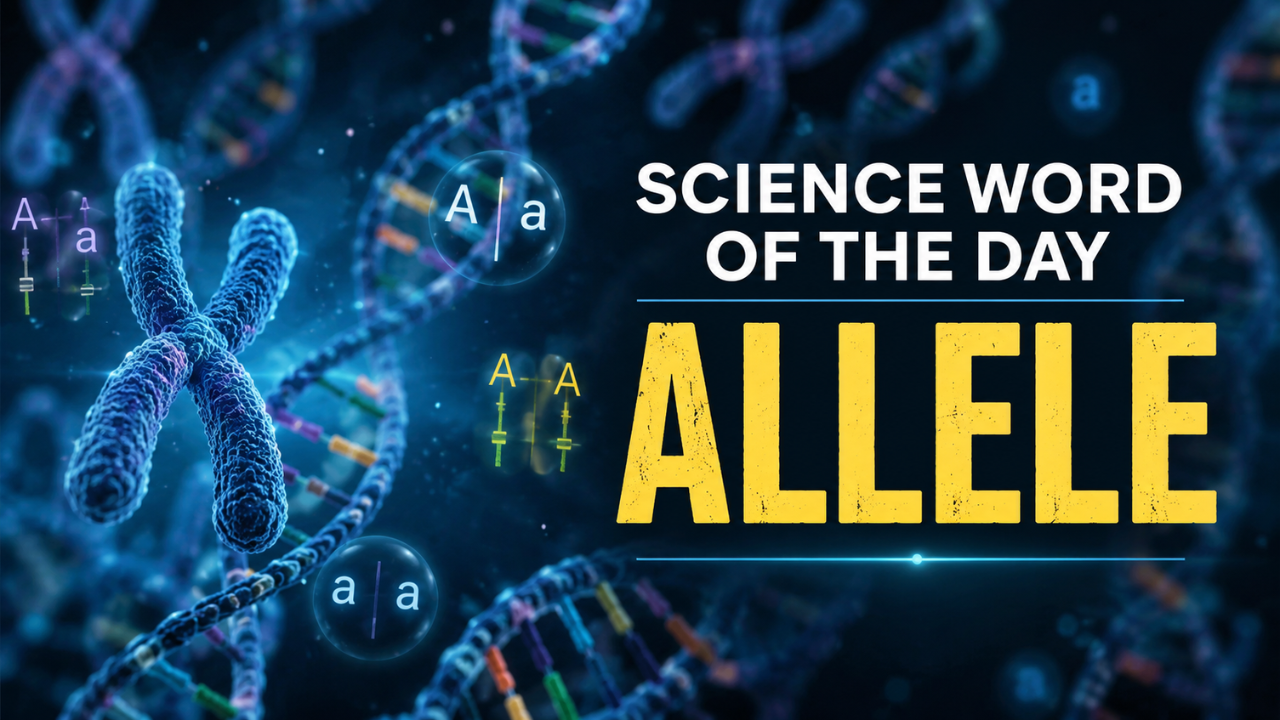
Allele.
It is pronounced uh-leel. It sounds like a whisper, but it holds the weight of your entire physical existence. To understand what an allele actually is, and why it dictates everything from the color of your hair to your vulnerability to fatal diseases, we have to look past the textbooks. We have to look at how a single, overlooked scientist changed how we view humanity forever.
The Recipe Book and the Variations
Let us use a metaphor to understand the machinery at work. Think of your body as a magnificent, sprawling mansion. To build this mansion, you need a master blueprint. That blueprint is your DNA.
Within that massive blueprint, there are individual chapters dedicated to specific features—how to build the front door, what color to paint the shutters, or how high to pitch the roof. In your body, these chapters are called genes. You have a gene that determines eye color, a gene that determines blood type, and genes that dictate how your body processes sugar.
But a blueprint only tells you what to build, not the specific style. That is where alleles come in. An allele is simply a alternative version of a gene.
If the gene is "eye color," the alleles are the specific instructions for "blue," "brown," or "green." If the gene is "blood type," the alleles are "A," "B," or "O." You do not just inherit a gene; you inherit a specific flavor of that gene from each of your parents.
Imagine two chefs trying to cook the same family recipe for tomato soup. One chef insists on adding a pinch of red pepper flakes for heat. The other prefers a spoonful of sugar for sweetness. The dish is still tomato soup, but the final flavor is entirely different based on those subtle choices. Alleles are those subtle choices in the recipe of you.
The Monk in the Garden
We take this knowledge for granted today. We look at a child with their mother's dimples and their father's nose and we understand the math of inheritance. But for most of human history, this was an absolute mystery. People believed in "blending inheritance"—the idea that a child’s traits were simply a smooth, inseparable mix of their parents' traits, like stirring red and white paint together to get pink.
Then came William Bateson.
He was a British biologist working at the turn of the twentieth century. Bateson was deeply frustrated by the vague, hand-waving explanations of heredity common in his day. He knew there was a hard, mathematical truth beneath the surface of human biology.
While investigating the laws of heredity, Bateson realized that science lacked the vocabulary to describe the phenomena he was witnessing. In 1902, he introduced the term "allelemorph"—which was later shortened to allele. The word derives from the Greek phrase allélón, meaning "each other," and morphé, meaning "form." It literally means forms that belong to each other.
Bateson did not discover these variations in a high-tech lab with glowing screens. He championed the rediscovered work of Gregor Mendel, an Austrian monk who spent years meticulously breeding pea plants in a quiet monastery garden. Mendel had noticed that when he crossed tall pea plants with short ones, the offspring weren't medium-sized. They were tall. But when he bred those offspring together, the short trait mysteriously reappeared in the next generation.
The traits weren't blending like paint. They were maintaining their individual identities, hiding in the background like secrets waiting for the right moment to be told. Bateson gave those secrets a name.
The Rules of Dominance and the Silent Partners
To understand why some traits hide while others dominate, consider a hypothetical person named Sarah.
Sarah has striking green eyes. Her mother has blue eyes, and her father has brown eyes. How did Sarah end up with green?
Every human being inherits two alleles for every gene—one from their mother and one from their father. This pair of alleles is what scientists call a genotype. The physical manifestation of that genotype—the actual color of Sarah's eyes—is called a phenotype.
Sometimes, the two alleles you inherit are identical. If you get a blue-eye allele from your mother and a blue-eye allele from your father, you are homozygous for that trait. Your eyes will be blue.
But what happens when the alleles disagree? If you inherit a brown-eye allele from one parent and a blue-eye allele from the other, you are heterozygous. In this matchup, the alleles do not compromise. They fight.
Certain alleles are dominant, while others are recessive. The brown-eye allele is a bully; it is dominant. The blue-eye allele is quiet; it is recessive. If you have one of each, the brown allele completely masks the blue one. You will have brown eyes.
But that blue allele does not vanish. It sits quietly in your genetic code, a silent partner, completely invisible to the outside world. You can pass that silent allele down to your children. If your partner also passes down a silent blue allele, your child will suddenly flash bright blue eyes, seemingly out of nowhere.
It is not magic. It is just the recessive allele finally getting its turn in the spotlight.
The High Stakes of the Genetic Lottery
This is pleasant enough when we are discussing eye color or whether your earlobes are attached or free-hanging. But the lottery of alleles is not always benevolent. Sometimes, the stakes are life and death.
Consider cystic fibrosis, a devastating genetic disorder that causes severe damage to the lungs and digestive system. The disease is governed by a single gene. The normal allele tells the body how to manage salt and water in cells. The mutated allele gets the instructions wrong, leading to a buildup of thick, sticky mucus.
Because the mutated allele is recessive, a person can carry one copy of it their entire life without ever knowing it. They breathe easily. They run. They live. They are healthy carriers.
But if two carriers meet and decide to have a child, the math of alleles becomes terrifying. There is a twenty-five percent chance that their child will inherit the mutated allele from both parents. Without a dominant, healthy allele to override the mistake, the child will be born with cystic fibrosis.
On the other side of the coin lies Huntington’s disease, a progressive brain disorder that causes uncontrolled movements, emotional problems, and loss of thinking ability. Huntington’s is caused by a dominant allele. It does not hide. If you inherit just one copy of this mutated allele from a single parent, it does not matter how healthy your other parent's allele is. The disease will eventually claim you, usually in the prime of your life.
There is an eerie, clinical coldness to looking at a punnett square—the simple grid doctors use to calculate these percentages. A cross of capital and lowercase letters determines whether a family will face a lifetime of medical heartbreak or catch a breath of relief.
The Shape of Medicine Today
Understanding alleles has shifted medicine away from a model of reactive guesswork toward a future of pinpoint precision.
Look at how doctors treat blood transfusions. For centuries, pumping blood from one human into another was a gamble that frequently ended in agonizing death. We didn't understand why. Today, we know it comes down to the three alleles that determine blood type: A, B, and O.
The A and B alleles are codominant, meaning they can live together and share the stage, while O is recessive. If you have type O blood, your body does not recognize the A or B markers. If a doctor gives you type A blood, your immune system views it as a hostile foreign invasion and attacks. By mapping these alleles, we transformed blood transfusion from a lethal experiment into a routine, lifesaving procedure.
We are seeing this exact same logic play out in modern cancer treatments. Two people can have the exact same type of lung cancer, yet one responds beautifully to a specific drug while the other derives no benefit at all.
The difference isn't the cancer; it is the patient's alleles. Subtle variations in their genetic code dictate how quickly their liver metabolizes medication, or how their immune system interacts with a tumor. Doctors no longer just treat the disease; they treat the specific genetic profile written by the patient's alleles.
The Mirror
It is easy to feel small when contemplating this truth. It can feel as though we are merely flesh-and-blood puppets being jerked around by strings of ancient, uncaring code. You did not choose the alleles that gave you your height, your hairline, or your predisposition to anxiety.
But there is another way to view it.
You are a walking archive. The alleles inside you right now have survived ice ages, plagues, wars, and migration across continents. They have been passed down from hand to hand, generation to generation, in an unbroken chain stretching back to the origin of our species.
The next time you look in the mirror, look past the surface. Look at the specific curve of your jaw, or the way your hair curls when it rains. You are looking at a highly specific, beautifully improbable combination of biological choices that has never occurred in exactly this way before, and will never occur again.