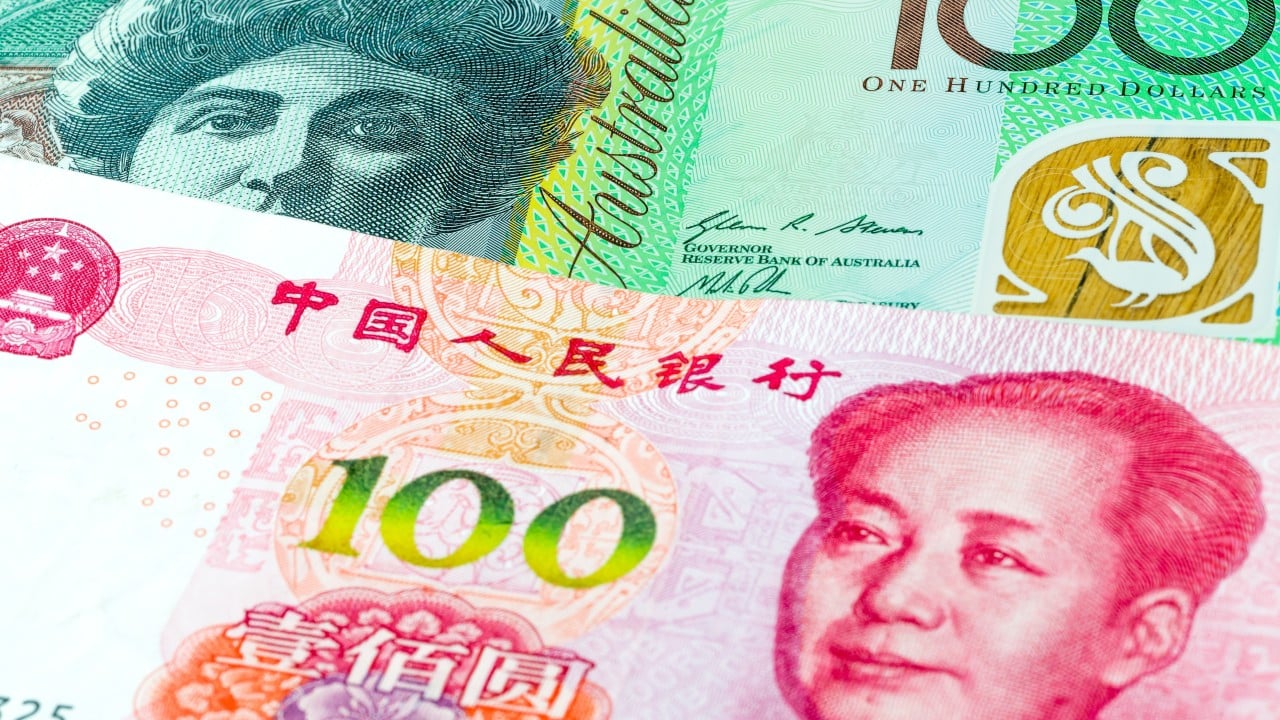
The Distance Between Iron And Ink
Elena sits in a corner booth of a cafe in Balmain, watching the morning ferry carve a white scar across the grey water of Sydney Harbor. Her coffee is cold. Between her thumb and forefinger, she holds a printed statement from her mortgage lender, a cruel piece of paper notifying her that the variable rate is climbing yet again.
Six thousand miles away, in a sprawling office building in Beijing, a bureaucrat stamps a document approving a new round of municipal stimulus. You might also find this connected story useful: The Cross Border Capital Squeeze The Mechanics of China Offshore Insurance Tax Enforcement.
Elena does not know that bureaucrat's name. She does not speak Mandarin. Yet that stamp just added eighty dollars to her weekly grocery bill.
We tend to think of currency exchange rates as abstract weather patterns, numbers flickering on a Bloomberg terminal watched only by stressed men in expensive suits. We talk about the Australian dollar as if it were a creature of our own making, tethered solely to local interest rates set by the Reserve Bank in Martin Place or the sunny optimism of our domestic job reports. But look closer. Look at the red dirt of the Pilbara, where massive yellow trucks the size of two-story houses dump millions of tons of iron ore into the bellies of cargo ships facing north. As discussed in detailed reports by The Economist, the effects are widespread.
For decades, Australia ran on a simple, comforting equation. China built cities; we dug up the ingredients. They poured concrete; we cashed the checks. When their economy surged, our currency climbed right along with it, buying us cheap imported electronics, affordable European holidays, and a quiet sense of invulnerability.
Now, the math has fractured. And the central question haunting dinner tables from Perth to Brisbane is whether Beijing still holds the magic key to lift our currency out of its doldrums, or if that door has rusted shut forever.
The Weight Of The Middle Kingdom
To understand why a currency dips while its biggest customer buys more dirt than ever, you have to abandon the textbooks and look at the scaffolding of modern trade.
Imagine you own a bakery in a small town. For years, the town's richest resident bought three hundred loaves of bread from you every single morning. You expanded your kitchen. You hired your cousin. You bought a delivery van. You tied your entire livelihood to that single buyer.
China is that buyer, and Australia is the bakery.
When Beijing sneezes with a property sector slump, our dollar catches a cold. When Beijing promises a massive financial rescue package, our currency jolts upward on the futures exchange in a spasm of collective hope. Traders in Sydney and Singapore hold their breath every time the National Bureau of Statistics in Beijing releases quarterly GDP figures, parsing every decimal point for signs of life.
Here is the mechanical truth behind the theater. When Chinese steel mills roar, demand for Australian iron ore and metallurgical coal spikes. To buy those commodities, Chinese steel producers must convert their yuan into US dollars, and then into Australian dollars, or settle transactions that fundamentally drive up the global value of our currency. It is a hydraulic system of immense scale.
Yet, something has fundamentally changed in the plumbing.
For the past few years, Beijing has tried to engineer a delicate economic transition. They want to move away from debt-fueled property booms—the kind that require endless mountains of Australian iron ore—and toward high-tech manufacturing, green energy, and domestic consumption. They are trying to build electric vehicles and semiconductor chips instead of endless rows of apartment towers in ghost cities.
Consider what happens next. The volume of our exports might hold steady, but the emotional and financial multiplier effect of that trade begins to shrink. The old correlation between Chinese growth and Australian currency strength is fraying at the edges.
The Illusion Of Control
Can Beijing simply wave a wand and rescue the Australian dollar whenever it suits them?
The short answer is no. And the long answer is far more uncomfortable.
Monetary policy is not a remote control. When the People's Bank of China cuts interest rates or injects liquidity into its banking system, it is trying to solve domestic crises: local government debt, youth unemployment, a sluggish housing market. They are looking inward, not outward. If they accidentally pump enough stimulus into their economy to reignite heavy construction, our dollar gets a temporary adrenaline shot. But that is a byproduct, not a deliberate act of charity.
No one in Beijing wakes up worrying about Elena's mortgage in Balmain.
Markets often mistake coincidence for design. When an announcement drops from Beijing promising fiscal stimulus, algorithmic trading bots sweep across financial markets in milliseconds, bidding up Australian mining stocks and pushing the currency higher before the ink on the press release has even dried. It is a Pavlovian response born of decades of historical conditioning.
We are addicted to the bounce.
Whenever the Australian dollar sags below sixty-five US cents, the national commentary turns into an anxious vigil. Exporters cheer because their foreign earnings look glorious when converted back into local currency. Holidaymakers weep because a trip to Tokyo or London suddenly costs a king's ransom. Importers groan as the cost of shipping containerized goods from overseas eats away at their margins.
And all the while, the invisible hand of a foreign government dictates the rhythm of everyday life in a country that prides itself on fierce, rugged independence.
Living In The Backdraft
Elena finishes her coffee, leaves exact change on the saucer, and walks out into the sharp morning air. She passes a real estate agency window, her eyes lingering on listings she knows she can no longer afford.
The truth is that the fate of the Australian dollar is no longer just about China's willingness to lift us up. It is about our own failure to diversify our economic engine. We built a wonderfully prosperous nation on the back of a lucky country cliché, digging holes and selling the contents to the highest bidder, while letting our manufacturing, technology, and value-added industries wither in the shade of the mining boom.
When we ask if Beijing has the power to lift our currency, we are asking the wrong question entirely.
The real question is why we handed them the remote control in the first place.
The ferry pulls away from the wharf, churning the dark water into foam, heading toward the open sea where the cargo ships wait, heavy with red earth, bound for a horizon they cannot control.