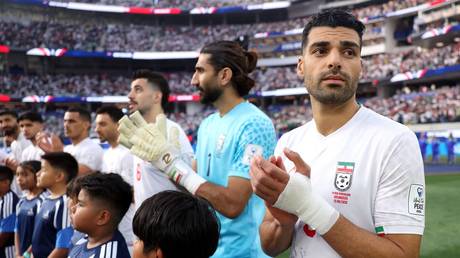
The final whistle had barely echoed through the rafters of SoFi Stadium on Monday night when the real directive arrived in the Iranian locker room. It did not come from the referee, nor did it come from FIFA. It came from Washington. Fresh off a grueling 2-2 draw against New Zealand, a match played under the shadow of a wider geopolitical conflict, the Iranian national football team was ordered to bypass their hotel, skip their standard post-match physical recovery, and immediately board an 11:00 PM flight back to Tijuana, Mexico.
The United States, acting as a co-host for the 2026 FIFA World Cup, has effectively placed the Iranian team under an unprecedented sporting deportation regime. According to White House World Cup task force director Andrew Giuliani, the squad is permitted to cross the border exactly twenty-four hours before kickoff and must vanish from American soil the moment the match wraps up. While FIFA promised an inclusive global celebration, the reality on the ground has morphed into an administrative war of attrition. Iran is being forced to contest the biggest tournament on earth via a series of frantic, same-day cross-border flights, entirely upending the biological and tactical requirements of elite athletic competition.
The Weaponization of the Match Day Minus One Rule
Elite international football is a game of marginal gains. Teams spend millions on hyperbaric chambers, tailored nutritional regimes, and scientific sleep tracking to ensure peak performance. For Team Melli, the recovery protocol consists of an immigration line and a midnight tarmac.
The logistical framework imposed on Iran is built around a rigid interpretation of "Match Day Minus One" entry. United States immigration officials have restricted the team’s visas to a window that allows entry only the morning before a game, with an explicit expiration set for the evening of the match.
This is not a mere bureaucratic inconvenience. It is a structural handicap.
When a squad plays ninety minutes of high-intensity football, the subsequent six hours are vital for metabolic recovery. Lactate clearance, rehydration, and soft-tissue treatment cannot occur on a cramped charter flight traveling over the Mexican border.
Iran manager Amir Ghalenoei did not hide his fury following the forced evacuation from Los Angeles. He pointed out that his staff had prepared a full overnight recovery plan in Southern California, fully expecting standard tournament treatment, only to be intercepted by federal authorities post-match. The team was forced to pack their gear and travel 140 miles back to their makeshift camp in Tijuana without a single massage or ice bath.
The Broken Promises of Zurich
FIFA President Gianni Infantino has spent years preaching that football remains separate from global politics. Yet, the governing body's silence regarding the treatment of Iran exposes the empty nature of that rhetoric.
Infantino reportedly visited the Iranian dressing room following Monday’s draw, offering platitudes and vague promises of assistance to team captain Mehdi Taremi. But the reality is that FIFA surrendered its sovereignty over this tournament the moment it allowed a host nation to dictate visa terms based on active geopolitical conflicts. Prior to the tournament, FIFA shrugged off the situation, with Infantino noting that the body could not influence external geopolitical circumstances.
That defense rings hollow when looked at alongside historical precedent.
When nations bid to host a World Cup, they sign legally binding hosting agreements. These documents explicitly state that the host country must guarantee entry to all qualifying teams, staff, and accredited media, regardless of diplomatic relations. By allowing the United States to implement a drive-by visa policy, FIFA has set a dangerous precedent. The tournament is no longer an open global festival; it is a restricted event where the host nation holds the power to structurally sabotage its political adversaries on the pitch.
A Training Camp Exiled to Tijuana
The immediate departure rule is only the latest barrier erected against the Iranian delegation. The team’s entire preparation phase has been systematically dismantled by administrative roadblocks.
Originally, Iran had arranged to base its training camp in Tucson, Arizona. The climate, altitude, and facilities were chosen to prepare the squad for the physical demands of the North American summer. That plan was terminated when the United States government denied entry visas to eleven key members of the official delegation, including the president of the Iranian football federation.
Forced to pivot, the team set up their base in Tijuana, just south of the California border. The shift from a controlled, high-end athletic facility in Arizona to a hastily arranged camp in a Mexican border town has severely impacted their preparation.
The physical toll of this arrangement was clear during their arrival in Los Angeles for the opening match. On Sunday, the team bus spent two hours trapped in border traffic, turning a routine fifteen-minute transit from the airport to the hotel into an exhausting ordeal.
Furthermore, the domestic sporting environment in Iran has been non-existent for months. Following a series of military airstrikes in February involving the U.S., Israel, and Tehran, the domestic Iranian league was suspended indefinitely. Several players in Ghalenoei’s squad had not played a competitive minute of football in nearly four months before stepping onto the pitch at SoFi Stadium.
Despite these setbacks, the team managed to secure a point against New Zealand. However, their next test is a match against a rested Belgium side in Los Angeles, followed by a flight to Seattle to face Egypt on June 26.
The Mirage of Sanction Exemptions
Defenders of the current U.S. policy argue that national security concerns and active diplomatic freezes justify these extreme measures. They point out that Iran was allowed to enter the country to play, which technically fulfills the basic requirement of hosting.
This argument ignores the reality of elite sport.
Allowing a team to enter a country like cargo, unloads them for ninety minutes, and shippping them back across the border immediately after the whistle is not sportsmanship. It is an administrative blockade designed to ensure failure.
The bureaucratic hurdles even extend to individual player equipment and administrative renewals. On Tuesday, team officials had to scramble when it was revealed that winger Mehdi Torabi’s single-entry visa had technically expired the moment he crossed back into Mexico. While the State Department quickly issued a multiple-entry replacement after an emergency appeal, the incident shows how thin the margin of error is for this squad. One clerical oversight at a border checkpoint could result in a key player missing a match entirely.
The Myth of the Neutral Pitch
The concept of the World Cup as a neutral arena has been completely dismantled. While teams like Belgium, Egypt, and New Zealand enjoy luxury training bases, seamless domestic travel, and extensive recovery windows inside the host nation, Iran is being treated as an administrative security threat.
The sporting world has seen political boycotts and outright bans before, such as Yugoslavia in 1992 or Russia in 2022. Those decisions, while controversial, were clear-cut. What is happening in 2026 is far more insidious. Iran has not been banned; instead, they have been subjected to an administrative framework designed to exhaust them physically and mentally.
The tournament continues, and Team Melli will continue to catch midnight flights out of California and Washington. They will perform because that is what international athletes do. But no one should look at Group G and believe they are watching a fair competition. The United States has weaponized its borders, FIFA has abandoned its own rulebook, and the Iranian national team is left to run on a treadmill that moves faster with every single match.