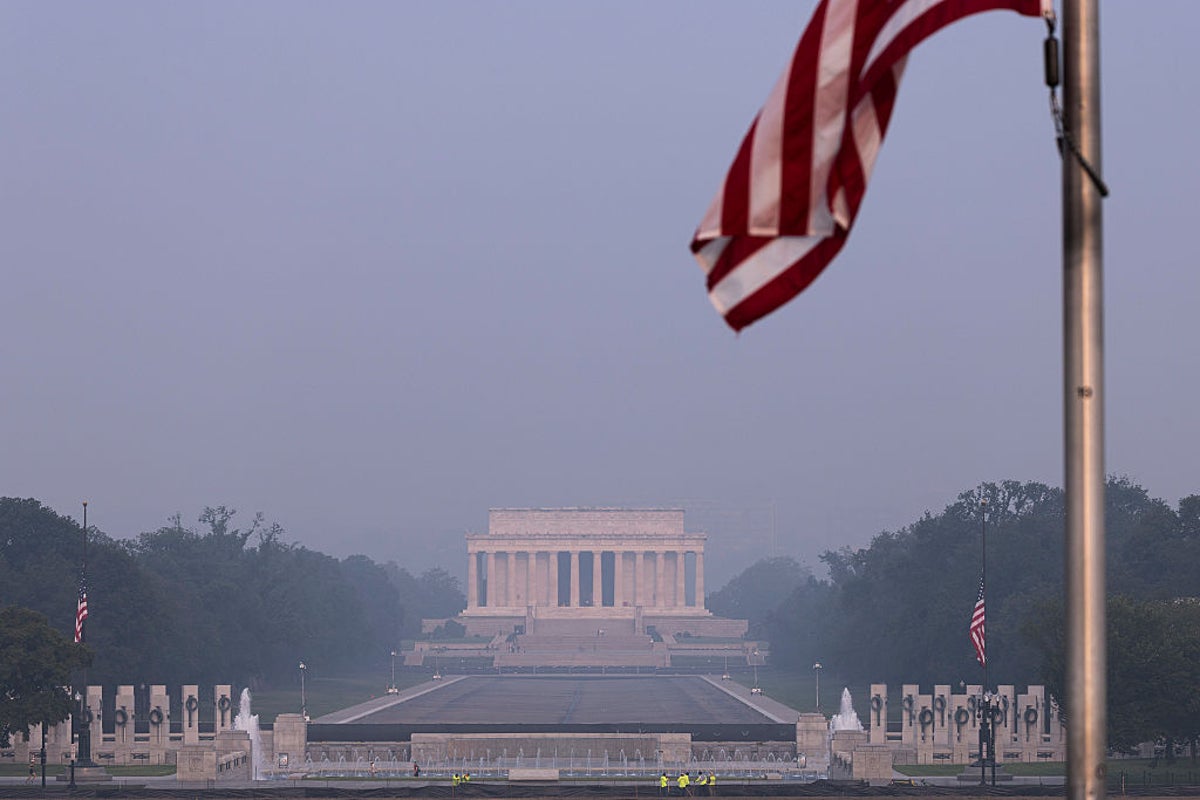
The political theater surrounding North American air quality has reached a bizarre altitude. When political leaders point fingers across the northern border, accusing a neighbor of poisoning skies and threatening punitive economic measures over drifting particulate matter, they reveal a profound misunderstanding of how the planet actually functions. Smoke does not carry a passport, and atmospheric currents do not stop for customs enforcement.
To understand why millions of Americans from the Midwest to the Atlantic seaboard find themselves choking beneath hazy, saffron-colored skies, one must look past the rhetoric of border checkpoints and examine the empirical reality of a warming continent. The assertion that a foreign government can simply sweep or log its way out of an ecological crisis defies basic environmental science.
The Anatomy of a Continental Conflagration
When thousands of fires erupt simultaneously across Canada's remote boreal expanses, the immediate impulse among certain political circles is to diagnose a failure of localized management. This argument claims that dense woodlands could be systematically thinned or cleared to prevent combustion.
Such a proposal collapses under the weight of geography. Much of the Canadian boreal forest is entirely roadless, sprawling across millions of square miles of muskeg and rugged terrain where human intervention is logistically impossible on the scale required. You cannot deploy ground crews to rake millions of acres of remote wilderness.
Furthermore, the primary ignition source for the vast majority of these immense northern blazes is not human error, but lightning striking dry timber. What turns a localized spark into a continent-spanning catastrophe is the dryness of the fuel.
The Thermodynamic Reality
Climate attribution science offers a clear window into the mechanics of modern fire seasons. Higher baseline temperatures dry out soil and vegetation long before lightning strikes. Snowpacks melt weeks earlier than they did decades ago, lengthening the window during which forests remain vulnerable to combustion.
When the atmosphere holds more heat, it acts as a giant sponge, sucking moisture out of living trees and dead organic matter alike. Peer-reviewed data shows that human-caused greenhouse gas emissions have more than doubled the probability of severe, high-intensity fire weather across northern ecosystems.
The atmosphere operates as a closed system. Carbon dioxide emitted anywhere on Earth disperses globally, accumulating over generations. The United States holds the distinction of being the largest historical contributor to cumulative atmospheric carbon. To demand financial reparations or levy tariffs on a neighbor because prevailing winds carry combustion byproducts south ignores the origin of the thermal energy driving the flames.
The Convenience of Misdirection
Pointing outward is an old political reflex. When citizens experience declining public health, respiratory irritation, and ruined outdoor commerce due to particulate pollution, leaders face intense pressure to provide a simple villain. Naming a foreign state and threatening sanctions provides a convenient narrative target.
It substitutes diplomatic hostility for hard physical adaptation. It allows politicians to bypass uncomfortable conversations about domestic energy policy, fossil fuel dependency, and the long-term failure to invest in grid resilience or widespread indoor air filtration infrastructure.
The smoke moves both ways across the border. During severe seasons, fires raging in the American West send dense palls of particulate matter northward into Canadian provinces. Neither nation possesses an exclusive monopoly on wildfires, because neither nation operates outside the global climate system.
The Path Ahead Without Illusions
Pretending that trade policy can alter wind patterns or extinguish crown fires in sub-arctic timberlands accomplishes nothing of substance. Real mitigation requires a fundamental reckoning with the speed at which ecosystems are transforming.
Communities must transition toward hardened infrastructure, community-level fire breaks, advanced early-warning radar, and robust indoor clean-air sanctuaries for vulnerable populations. Pretending that a neighboring nation can simply turn off the smoke through administrative compliance is a dangerous distraction from the physical changes reshaping the continent.
The wind will continue to blow from the north when the barometric pressure dictates it, carrying the physical consequences of a warmer world across lines drawn on maps that the atmosphere refuses to recognize.
CNN-News18 Trump Blames Canada for Wildfire Smoke, Threatens Tariffs
This segment covers the political friction and economic threats exchanged over cross-border wildfire smoke.