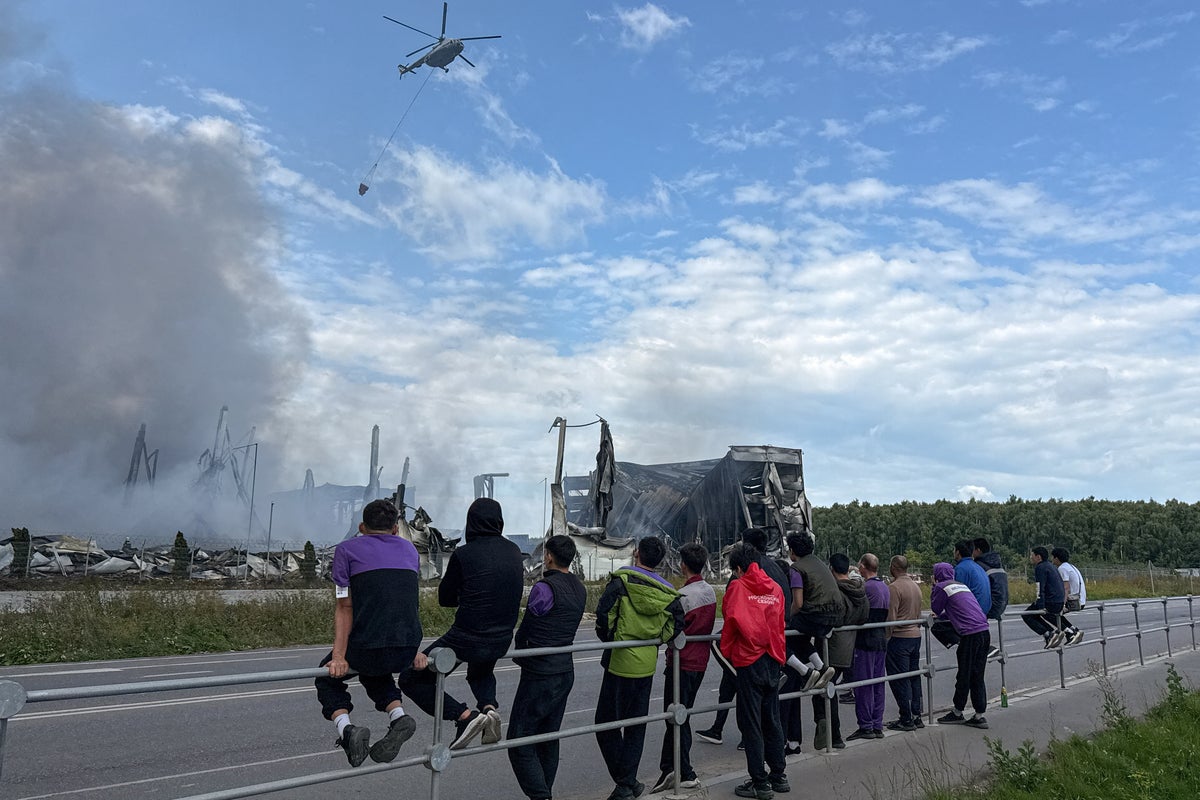
The logistics hub outside St. Petersburg was supposed to be untouchable. Built with concrete panels meant to withstand industrial accidents and automated sorting systems imported from European suppliers before the sanctions took hold, the sprawling distribution center served as the commercial heart of domestic e-commerce in Russia.
Then came the predawn explosions.
When a swarm of long-range Ukrainian strike drones impacted the facility, they did not just shatter glass and twist steel beams. They targeted the physical backbone of modern Russian retail consumption. By reducing the massive distribution center to a smoking ruin, the attack signaled a sharp escalation in a hidden economic war. Warehouses are no longer neutral commercial zones. They are frontline infrastructure.
The Anatomy of a Logistics Collapse
Modern retail operates on razor-thin margins and absolute predictability. When you order a household appliance or winter clothing through domestic digital storefronts, you trigger a complex cascade of inventory management, automated conveyor belts, and regional distribution routes.
Take the facility struck in the Leningrad region. Operating under the umbrella of Wildberries—often dubbed the Russian Amazon—the complex processed hundreds of thousands of orders daily. Its destruction rippled outward within hours. Independent merchants lost entire inventories stored on-site. Regional delivery timelines stretched from two days to three weeks.
We are witnessing the weaponization of supply chain fragility. For months, military planners on both sides focused on oil depots, electrical substations, and ammunition dumps. Shifting the targeting matrix toward commercial e-commerce hubs changes the economic calculus of the conflict entirely.
Why Distribution Centers Become Targets
Militarily, attacking a massive warehouse serves two distinct purposes. First, it disrupts the commercial flow that keeps the domestic civilian population insulated from the realities of wartime economics. Second, these massive facilities often sit adjacent to heavy transport rail lines and highway junctions that dual-purpose military logistics rely upon.
A warehouse is never just a warehouse. It is a concentrated node of economic value. When you burn down a million-square-foot fulfillment center, you destroy:
- Millions of dollars in consumer goods that cannot be easily replaced under strict import bans.
- Specialized warehouse management software and hardware components that require Western microchips.
- Employment stability for thousands of local logistics workers, triggering localized economic panic.
The strike on the Wildberries hub exposed the vulnerability of mega-warehouses. Centralized efficiency always creates a single point of failure. When companies consolidate their entire regional inventory into one massive concrete box to save on operational costs, they also create a magnificent target for aerial munitions.
The Technology of Asymmetric Disruption
The drones used in these long-range strikes are marvels of low-cost engineering. Eschewing expensive military-grade avionics, these fixed-wing aircraft often rely on modified commercial drone frames, fiberglass bodies, and civilian GPS guidance systems augmented with inertial navigation to resist electronic jamming.
Building a multi-million-dollar distribution center takes three years of architectural planning, zoning approval, and heavy construction. Building a drone capable of burning it down takes a few weeks in a makeshift workshop and costs less than a luxury car. That asymmetry defines the modern battlespace.
Electronic warfare units deployed by the Russian military attempted to deflect the incoming swarm, yet saturation tactics frequently overwhelm localized defense radiowaves. When twenty drones approach a single target from different azimuths, point defense systems face impossible mathematical choices.
The Insurance and Financial Fallout
Beyond the immediate fireball lies a tangled web of financial liabilities. Most commercial real estate insurance policies exclude acts of war, meaning the private investors backing these logistics giants absorb the full shock of the loss.
Foreign investment in Russian retail infrastructure vanished long ago, but domestic capital now faces an existential crisis. If fulfillment centers can be incinerated at will, who will finance the next generation of logistics hubs? The answer is simple: nobody. Expansion grinds to a halt. Companies retreat to smaller, decentralized, and harder-to-find storage yards, sacrificing efficiency for sheer survival.
This operational downgrade compounds over time. Slower deliveries mean higher inventory holding costs. Higher holding costs mean inflated consumer prices. The inflationary pressure trickles down to everyday households, turning a military strike into a persistent economic tax on the civilian population.
The Strategic Shift in Urban Warfare
We have moved far past the era where war was confined to trenches in rural fields. Today, the front line runs through corporate servers, automated sorting floors, and suburban industrial parks.
The destruction of the St. Petersburg hub forces supply chain managers to rethink geographic concentration. For two decades, global retail followed a relentless trend toward consolidation. Bigger warehouses, fewer locations, wider coverage zones. That model worked brilliantly during peacetime. In an era of long-range precision munitions, that exact strategy acts as an engraved invitation for destruction.
Logistics firms across Eastern Europe are scrambling to adapt. Some are moving high-value inventory underground into repurposed Cold War bunkers. Others are splitting large fulfillment inventories into dozens of anonymous, unmarked mini-warehouses scattered through residential areas—a tactic that raises severe legal and safety questions but offers better physical security against aerial surveillance.
As the conflict grinds forward, the line between civilian commerce and military necessity continues to dissolve. Every factory floor, every distribution grid, and every automated sorting belt is scrutinized through a crosshair. The burning ruins of the giant e-commerce hub stand as a grim monument to a new reality where no supply chain is too big to fail, and no warehouse is too civilian to burn.


.jpg)
