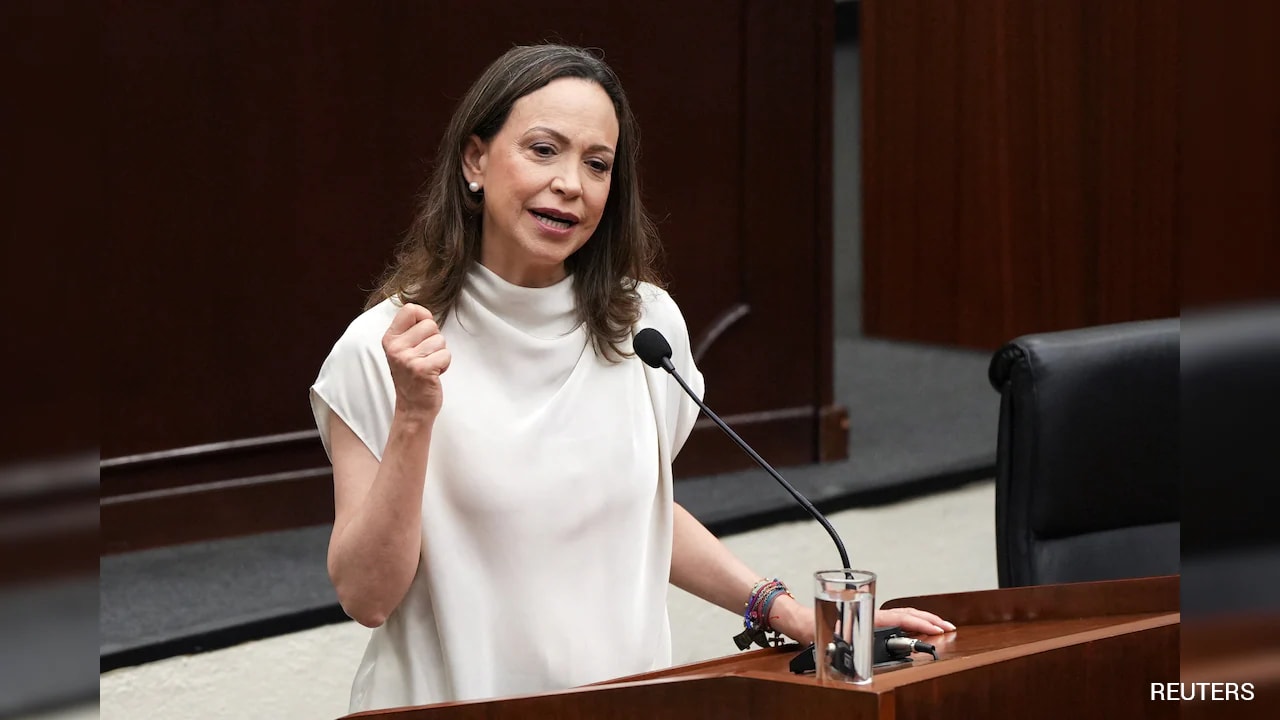
Venezuela's Unitary Democratic Platform formally reaffirmed Nobel Peace Prize laureate María Corina Machado as its leader in October 2026, days before she ended nearly a year of exile and stepped back onto Venezuelan soil.
That vote was no coronation. It was a high-stakes survival maneuver by fractured parties trying to reclaim political leverage after Nicolás Maduro was seized in a U.S. special forces operation in January 2026 and acting President Delcy Rodríguez consolidated power with Washington's backing. For years, opposition factions bickered over tactics, boycotts, and primaries. Now they face a sharper threat: being sidelined while oil contracts, military ties, and transitional talks are negotiated over their heads.
Anyone reading a surface dispatch about opposition parties picking a Nobel laureate as their leader misses the real power struggle. Real power in Caracas does not come from party resolutions alone. It comes from controlling street momentum, shaping electoral timelines, and forcing an entrenched Chavista security apparatus to reckon with a leader who has refused to disappear.
Why Parties Turned Back to Machado After Exile
For decades, Venezuela's traditional opposition parties—names like Democratic Action, Justice First, A New Era, and Popular Will—relied on institutional bargaining, coalition horse-trading, and external diplomatic pressure. Time and again, those strategies ran straight into disqualifications, court bans, and fractured voter trust.
Machado built her influence by challenging that playbook. Leading Vente Venezuela, she won the opposition's 2023 primary despite a 15-year ban from holding public office, backed Edmundo González Urrutia when she was blocked from running, and earned the 2025 Nobel Peace Prize for her push toward a democratic transition. Even after leaving Venezuela in late 2025 following her Nobel recognition, her name remained the clearest rallying point for voters exhausted by shortages, blackouts, and political arrests.
When Unitary Democratic Platform members met in Caracas on October 18, 2026, to recognize and support Machado's leadership, they were acknowledging a simple political arithmetic. Without her moral authority and street appeal, opposition parties risked looking like spectators to a deal already in motion.
The move also carried a quiet admission of weakness. Several opposition figures had already split over whether to engage directly in reconciliation talks encouraged by U.S. officials and Rodríguez's administration. Re-anchoring around Machado was an effort to stop that drift before the coalition dissolved into competing factions chasing scraps of influence.
The Oil Deal and Washington's Double Track
No serious analysis of Venezuelan opposition politics can ignore what changed in 2026 after Maduro's capture and indictment in New York. Many Venezuelans assumed the removal of Maduro would immediately hand the political initiative to the democratic movement that claimed victory in the disputed 2024 election.
Instead, Washington pursued a pragmatic, transactional track. Acting President Rodríguez replaced top military commanders, released hundreds of political prisoners under amnesty measures, and opened up energy and diplomatic channels with the Trump administration. For U.S. policymakers focused on energy supply, sanctions relief, and security arrangements, Rodríguez proved to be an immediate counterpart with control over state machinery and the armed forces.
That arrangement creates a sharp tension for Machado and the opposition alliance.
- Energy over ballots. Critics and many ordinary Venezuelans worry that prioritizing oil production, contract renegotiations, and bilateral security agreements delays the hard work of setting a firm date for free and fair presidential elections.
- Transparency doubts. Following her return, Machado questioned energy agreements reached without sufficient public scrutiny, insisting that legitimate long-term partnerships require transparency and democratic accountability rather than opaque backroom deals.
- Diplomatic tightrope. Machado has repeatedly thanked President Donald Trump for actions that removed Maduro while pressing Washington to keep democratic elections at the center of any transition.
A political coalition that relies solely on foreign sympathy is always vulnerable when foreign capitals prioritize stability or barrels of crude over ballot boxes.
That reality explains why the opposition's reaffirmation of Machado is both a shield and a gamble. It gives Venezuelans an unmistakable voice outside Rodríguez's circle. At the same time, it puts Machado in the difficult position of challenging deals involving powerful commercial and geopolitical actors while trying not to alienate a U.S. administration whose leverage shapes every move in Caracas.
Street Power Versus Institutional Reality
Returning to Venezuela after nearly a year abroad changed the texture of opposition politics overnight. Crowds greeted Machado in cities like Barquisimeto and Caracas with chants of freedom, and Vente Venezuela called for nationwide demonstrations demanding safe passage, prisoner releases, restored political rights, and a clear electoral calendar.
Yet enthusiasm on the street does not automatically translate into control over state institutions. Rodríguez's administration still commands the security apparatus, state agencies, and key economic levers, even as power outages and economic strain fuel public anger across the country.
Consider a hypothetical scenario during a nationwide protest over delayed elections. Suppose thousands of citizens march peacefully in major cities, while localized clashes or supply disruptions flare up in a few provinces. If the interim authorities use selective arrests or security deployments to keep demonstrations contained, opposition leaders face a painful choice: escalate confrontation and risk new crackdowns against activists who only recently left prison, or step back and risk looking unable to force concessions.
That dilemma is already visible in how Machado's team has paced her re-entry. After an improvised, high-emotion arrival that caught organizers off guard, her allies shifted toward a more measured rollout—rebuilding security teams whose members had recently been jailed and planning broader outreach to build a national transition agreement.
| Dimension | Opposition Coalition Under Machado | Interim Authorities Under Rodríguez |
|---|---|---|
| Primary Source of Legitimacy | Popular mandate claims, 2025 Nobel Peace Prize, mass mobilization | De facto executive control, military loyalty, state institutions |
| Main Leverage | Street pressure, moral authority, international democratic backing | Control of state apparatus, oil and diplomatic negotiations |
| Core Vulnerability | Internal party divisions and lack of state enforcement power | Public frustration over economic hardship, blackouts, and missing election dates |
| Immediate Objective | Firm election timeline, prisoner releases, lifted bans, clean transition | Regime survival, economic stabilization, managed external ties |
What Could Break This Coalition Apart
Unity born of desperation is notoriously brittle. Even with opposition parties rallying behind Machado, three fault lines could test their cohesion in the months ahead.
First, negotiation fatigue and tactical splits remain a constant risk. Some opposition politicians have participated in talks framed by U.S. officials as reconciliation steps toward eventual elections, while Machado and her inner circle have drawn sharp lines against legitimacy for unapproved deals or indefinite delays. If talks drag on without a concrete vote on the calendar, pressure will mount on every party leader to decide whether to stay at the table or walk away.
Second, economic and social grievances move faster than party manifestos. Venezuelans dealing with inflation, fragile wages, and recurring blackouts care deeply about daily survival. An opposition that speaks eloquently about constitutional norms and oil governance must also connect those issues to jobs, electricity, and household stability if it wants sustained momentum outside major urban centers.
Third, security and political rights remain unresolved flashpoints. Activists and families of detainees have repeatedly warned that partial releases and talk of reform mean little while political prisoners remain behind bars, administrative bans linger, and exiles face uncertainty when returning home.
The Real Test Ahead for Venezuelan Democracy
Choosing María Corina Machado as leader does not hand Venezuela's opposition the keys to Miraflores Palace. What it does is draw a clear line between managed stability from above and democratic legitimacy earned through open elections.
For the opposition, the hard work starts now: turning symbolic unity and Nobel prestige into disciplined organization across every state, holding firm on transparent rules without letting the country spiral into chaos, and forcing every backroom bargain to answer to Venezuelan voters. Watch whether a firm election date actually lands on the calendar—because without a credible vote, every declaration of unity is just prologue.