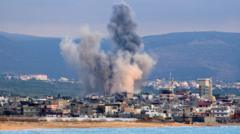
The Israeli military’s heavy bombardment of Tyre follows an expansive evacuation order that has effectively emptied the historic southern Lebanese hub, signaling a profound shift in the mechanics of the border war. Western headlines routinely frame these developments as routine tactical strikes preceded by humanitarian warnings. The operational reality on the ground is far more complex. The systemic evacuation of an entire ancient maritime center represents a calculated geographic re-engineering designed to decouple local populations from tactical infrastructure. This strategy forces a mass civilian exodus while systematically dismantling the socioeconomic fabric of southern Lebanon.
By focusing almost exclusively on the immediate kinetic exchange—the rockets fired, the buildings pancaked, the smoke plumes rising near UNESCO World Heritage sites—the broader geopolitical calculus is completely missed. The eviction of Tyre is not merely a localized hunt for weapon caches. It is an intentional execution of a buffer-zone doctrine that aims to render the territory south of the Litani River completely uninhabitable for anyone who could provide material or logistical support to paramilitary networks.
The Geography of Depopulation
To understand why Tyre is being hollowed out, one must look at the geography of the modern Levant conflict. For decades, the coastal city served as a vital sanctuary. It was a diverse, economically resilient urban center that absorbed tens of thousands of internally displaced persons from more vulnerable border villages. When the Israeli Defense Forces issued sweeping red-zone maps via social media, ordering immediate movement north of the Awali River, they did not just displace residents. They dismantled the primary civilian anchor of the entire region.
Disaster management officials in Tyre report that the city’s population, which hovered around 50,000, plummeted to a fraction of that within hours of the warnings. Those left behind are primarily the elderly, the disabled, and emergency workers whose capacity to operate has been crippled by proximity strikes. The logistical reality of moving tens of thousands of people along a single coastal highway toward Sidon and Beirut under the threat of drone strikes is chaotic. The financial and physical toll on families carrying whatever they can fit into their vehicles creates a permanent class of urban displaced.
This is not accidental fallout. By depopulating major municipal centers, military planners seek to create a sterile combat environment. Without a civilian population, any movement within the designated zones is classified as hostile, simplifying target verification rules of engagement for drone operators and artillery crews. This systematic clearing transforms vibrant, multi-layered urban spaces into empty, high-risk militarized zones.
The Friction of Joint International Mechanisms
A major overlooked factor in the current escalation is the breakdown of the international mechanisms intended to de-escalate friction between state armies and non-state actors. Following the truce efforts and subsequent military incursions, a five-member joint oversight committee—chaired by the United States and including representatives from France, Israel, Lebanon, and the United Nations Interim Force in Lebanon (UNIFIL)—was tasked with managing border friction and ensuring humanitarian access.
The system is failing under the weight of kinetic reality.
In nearby towns like Akka, residential structures have been completely flattened, leaving civilians and rescue workers trapped beneath concrete debris. Civil defense units attempting to clear the wreckage and retrieve survivors have found themselves repeatedly blocked. They are forced to wait for bureaucratic clearance from the joint oversight mechanism while the window for saving lives rapidly closes. The institutional paralysis reveals a stark truth. International safety guarantees and joint de-confliction channels are being subordinated to immediate military objectives, rendering them ineffective during active hostilities.
The Attack on Healthcare Ecosystems
The tactical framework of these operations extends directly into the destruction of local health infrastructure. International humanitarian law explicitly protects medical facilities, yet the functional survival of these systems in southern Lebanon is being systematically compromised.
- Hiram Hospital: Multiple airstrikes in the immediate vicinity of this critical facility injured dozens of medical staff, severely limiting its operational capacity during a mass-casualty crisis.
- Nabatieh Civil Defense Center: A direct strike eliminated heavy rescue machinery, firefighting equipment, and transport vehicles, freezing the region’s emergency response capability.
- Peripheral Clinics: Dozens of localized health outposts have been abandoned due to their inclusion in mandatory evacuation zones, cutting off chronic care for the remaining population.
When a hospital or a rescue center is damaged or isolated by nearby operations, the surrounding geographic zone loses its viability for human habitation. You do not need to bomb every house to empty a town. You only need to destroy the water, the electricity, and the emergency medical access.
The Fiber Optic Technology Reshaping the Frontline
While state military doctrine relies on overwhelming air power and systematic depopulation, the defensive and offensive responses from non-state actors have evolved beyond traditional guerrilla warfare. The persistent use of advanced technological assets has prevented a clean military breakthrough along the border.
The most significant technological development in this conflict is the deployment of fiber-optic guided drones. Standard commercial and military drones rely on radio frequency signals or satellite links for remote operation. These signals are highly vulnerable to electronic warfare, GPS jamming, and localized spoofing—countermeasures that state militaries deploy across combat zones. Fiber-optic drones bypass this defense entirely. They unspool a micro-thin thread of glass fiber-optic cable behind them as they fly, establishing a physical, un-jammable data link between the operator and the vehicle.
This technology allows operators to navigate low to the ground, utilizing terrain contouring to avoid radar detection, and strike military positions with absolute precision, unaffected by electronic interference. The deployment of these un-jammable assets has inflicted steady casualties on armored units and forward command posts, frustrating efforts to establish a secure buffer zone without absorbing continuous losses. The technological asymmetry has pushed military command to intensify air campaigns, using heavier ordnance to obliterate potential launch sites, drone assembly workshops, and underground fiber-relay nodes hidden within urban topographies.
Precedent and the Myth of the Temporary Buffer Zone
Historical analysis suggests that the concept of a temporary security strip or a brief tactical evacuation is a dangerous fiction. The region has seen this design implemented before, most notably during the protracted conflicts of 1978 and 1982, which led to an occupation that lasted until the turn of the century.
The current assertion by state officials that these operations are targeted actions designed to remove direct threats and secure northern border communities ignores the inherent mission creep of border warfare. When an army enters foreign territory to establish a security perimeter, that perimeter must constantly expand to protect troops from longer-range threats. What begins as a five-kilometer buffer zone inevitably pushes to ten kilometers, then to the Litani River, and eventually to the Zahrani River, as command structures chase the shifting launch points of the adversary.
| Military Phase | Declared Geographic Objective | Actual Operational Footprint | Humanitarian Impact |
|---|---|---|---|
| Early Incursion | Immediate border ridge (1-3 km) | Destruction of forward observation posts and tunnels | Displacement of immediate border villages |
| Mid-Campaign Expansion | Area south of the Litani River | Deep artillery barrages and systematic demolition | Mass exodus from Tyre, Nabatieh, and regional hubs |
| Current Escalation | Expansion to the Zahrani River line | Waves of strikes across eastern Bekaa and major coastal cities | Over 1 million citizens internally displaced nationwide |
This shifting boundary creates a self-perpetuating loop of displacement and destruction. The longer the territory remains a designated combat zone, the less likely it is that the displaced population will ever return to intact communities.
The strategy of ordering thousands to flee under the premise of short-term safety measures obscures the long-term geopolitical reality. The continuous expansion of these combat zones, combined with the comprehensive leveling of municipal infrastructure and the gridlock of international oversight, is fundamentally redefining the borders of the Levant. Tyre is not merely experiencing a temporary evacuation. It is witnessing the permanent, violent restructuring of southern Lebanon’s demographic and physical landscape.