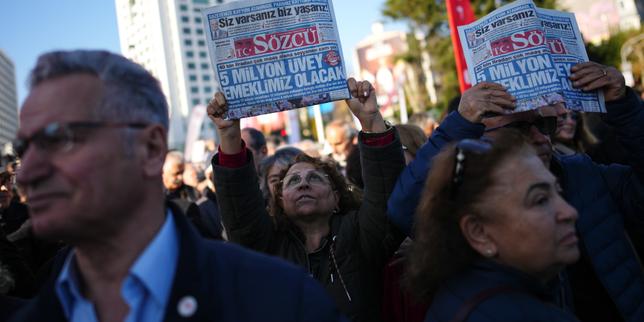
Thousands of demonstrators flooded the streets of Istanbul to protest a calculated legal maneuver that allows the Turkish state to seize control of independent broadcasters and newspapers. By appointing state-backed trustees to manage private media companies under the guise of anti-terrorism and financial irregularity investigations, authorities are systematically dismantling the few remaining platforms capable of scrutinizing government policy. This is not merely a clash over street protests or isolated editorial disputes. It represents an institutional blueprint for neutralizing press freedom without formally banning journalism.
The Anatomy of a State Trusteeship
To understand why thousands of citizens risked tear gas and detention in Istanbul, you have to look at the legal weapon at the center of the crisis. In Turkish commercial and criminal law, a trusteeship—known locally as a kayyım—was originally designed as a neutral administrative safeguard. If a corporation went bankrupt or its owners faced severe criminal charges, a court could appoint temporary administrators to keep the lights on and protect creditors until a verdict was reached.
Over the past decade, that administrative mechanism evolved into a blunt political instrument.
When prosecutors open an investigation into a media conglomerate, they rarely wait for a conviction before acting. Instead, they petition criminal peace judgeships to declare the company's management compromised. Within hours, state-appointed bureaucrats walk through the front doors of a television station or newspaper, accompanied by riot police. Editorial boards are dissolved on the spot. Journalists who spent years investigating public tenders or judicial corruption find their keycards deactivated before the evening broadcast airs.
The brilliance of the trusteeship model, from an authoritarian standpoint, lies in its superficial legality. The state does not have to pass a law abolishing the opposition press. The mastheads remain intact. The television frequencies keep broadcasting. To a casual observer flipping through channels, the media environment looks pluralistic and active. Yet behind the scenes, the editorial line shifts overnight from fierce scrutiny to docile compliance.
How the Financial Squeeze Precedes the Seizure
A hostile takeover rarely begins with police raids. Long before trustees arrive at a newsroom, the target outlet is subjected to a quiet, methodical campaign of financial attrition. Independent media outlets in Turkey operate in an economic environment heavily skewed by state regulatory bodies.
The Press Advertising Agency (BİK) controls the distribution of lucrative public announcements and state-funded advertisements. For regional newspapers and mid-sized national dailies, these funds are the difference between solvency and collapse. Regulatory bodies routinely suspend public advertising funds to critical outlets over minor infractions, such as publishing an article deemed harmful to public morality or failing to meet arbitrary bureaucratic filing standards.
Simultaneously, the Radio and Television Supreme Council (RTÜK) wields punitive authority over broadcast media. Whenever an opposition channel airs commentary critical of state economic policy, disaster response, or judicial independence, RTÜK can impose massive administrative fines or suspend broadcasts for up to five days. Five days without airtime means five days without commercial revenue, while fixed operational costs continue to pile up.
Private corporations, acutely aware that advertising on opposition networks invites tax audits and exclusion from lucrative state infrastructure contracts, quietly pull their marketing budgets. By the time prosecutors allege financial mismanagement or suspect funding sources to justify a trusteeship, the media outlet has often been artificially pushed to the brink of insolvency by the very state apparatus now claiming to rescue it.
Why the Istanbul Protests Mark a Breaking Point
Street demonstrations in Istanbul over press freedom are not entirely new, yet the recent mobilization carries a distinct urgency. For years, public outrage over media crackdowns remained fragmented along ideological lines. Secular nationalists rarely marched for Kurdish outlets; conservative critics seldom defended left-wing publications. The state successfully exploited these fractures, picking off independent voices one group at a time while the broader public remained divided.
That divide is eroding. As inflation and economic instability have touched nearly every household in Turkey, independent journalism has become less of an abstract democratic ideal and more of a practical necessity. Citizens rely on non-state broadcasters to report accurate consumer price figures, expose local municipal failures, and cover labor strikes that state-aligned conglomerates ignore entirely.
When the state moves to place major opposition networks under trusteeship, ordinary citizens recognize the direct consequence. Without independent reporting, official economic data goes unchallenged. Environmental disasters, workplace safety failures, and public health crises disappear from the evening news. The protests in Istanbul brought together union workers, retirees, university students, and opposition lawmakers precisely because the loss of independent media directly impairs the public's ability to navigate daily economic reality.
The Myth of the Neutral Administrator
Defenders of the trusteeship system argue that court-appointed administrators are non-partisan professionals tasked solely with preserving corporate assets during ongoing legal proceedings. In practice, the record tells a starkly different story.
Consider what happens to a media company's valuation once a trustee takes over. In previous high-profile seizures—such as the takeovers of major media groups like Koza İpek or Feza Publications in the mid-2010s—state-appointed administrators immediately fired veteran editors, dismantled investigative desks, and replaced critical programming with pro-government commentary and lifestyle shows.
Readership and viewership plummeted almost instantaneously. Circulation numbers collapsed by more than eighty percent within weeks of the takeovers. Advertising revenue dried up completely as audiences abandoned the newly sanitized broadcasts. Far from preserving corporate value for creditors or shareholders, the trusteeships hollowed out profitable media enterprises until they were either liquidated or sold off at steep discounts to business conglomerates closely aligned with the ruling establishment.
A hypothetical scenario illustrates the inherent contradiction in this model. Imagine a specialized financial newspaper whose entire market value rests on its reputation for exposing corporate fraud and government mismanagement. If a court appoints a state bureaucrat to run that paper, and the bureaucrat immediately bans all investigative reporting to protect state interests, the asset loses its core commercial value. The trustee is no longer managing a business; they are liquidating a brand while keeping the shell open for political messaging.
The Architecture of Media Consolidation
To grasp the full weight of what is happening in Istanbul, you must look at the broader ownership structure of the Turkish media sector. Over the past two decades, the country's largest television networks, newspapers, and distribution channels have been systematically consolidated into the hands of a small circle of massive industrial conglomerates.
These conglomerates do not make their primary profits from journalism. Media divisions frequently operate at a financial loss. Instead, the parent companies generate billions of dollars through state-awarded construction contracts, energy concessions, mining licenses, and telecommunications infrastructure.
Owning a major television network or national daily serves as a form of political insurance. By ensuring that their media outlets echo official talking points and suppress unfavorable stories, these conglomerates secure favorable treatment in public tenders and regulatory approvals. State-owned banks have even extended massive, low-interest loans to facilitate the acquisition of major media groups by pro-government businesspeople, effectively using public funds to privatize the nation's information ecosystem into friendly hands.
Against this backdrop, the few remaining independent outlets represent a structural anomaly. They are typically owned by smaller, specialized media entrepreneurs, funded by international press grants, or supported by digital subscriptions. Because their parent companies do not depend on billion-dollar highway or airport contracts, the state cannot coerce them through public tender leverage.
When traditional financial leverage fails to bring an outlet to heel, the trusteeship becomes the ultimate fallback option. It bypasses the need for a friendly buyout by simply installing state managers by judicial decree.
Digital Migration and Its Limits
Whenever traditional broadcast and print outlets face state takeover, observers inevitably point to the internet as an unbreakable sanctuary for free expression. Independent Turkish journalists have indeed migrated in droves to YouTube, X, Substack, and independent news portals. Several exiled or sidelined anchors regularly draw hundreds of thousands of live viewers to their daily digital broadcasts, rivaling the ratings of traditional cable news networks.
Yet assuming that digital platforms can fully replace terrestrial television and print infrastructure is a dangerous miscalculation.
First, digital reach in Turkey remains uneven across demographics. While younger, urban populations in Istanbul, Ankara, and Izmir consume news primarily through mobile devices, millions of older citizens and residents in rural provinces still rely heavily on free-to-air satellite television. Controlling the primary television frequencies means controlling the narrative for a massive segment of the electorate.
Second, the state has steadily expanded its legal jurisdiction over the digital sphere. Sweeping social media legislation forces major tech platforms to appoint local representatives in Turkey, comply with rapid content-removal orders, and hand over user data upon court request. Failure to comply triggers bandwidth throttling—a technical measure that slows platform access by up to ninety percent, rendering video streaming impossible.
Furthermore, the Disinformation Law, enacted to criminalize the public dissemination of "false or misleading information" capable of disturbing public order, hangs over every independent digital journalist. Because the statute defines misleading information vaguely, any reporter publishing leaked documents or questioning official statistics faces the immediate threat of pre-trial detention.
Digital journalism provides a vital lifeline, but it operates under constant siege. Without institutional backing, legal defense teams, and commercial ad networks—precisely the infrastructure that physical media companies provide—individual digital journalists are far more vulnerable to targeted harassment and financial ruin.
The Geopolitical Cost of a Silenced Press
The crackdown on opposition media does not occur in a diplomatic vacuum. Turkey occupies a critical geopolitical position, straddling Europe and the Middle East while maintaining membership in NATO and formal candidacy status with the European Union.
Every time riot police disperse journalists in Istanbul or courts hand private broadcasters over to state trustees, the repercussions ripple through international capitals. European Parliament rapporteurs and international press freedom watchdogs routinely cite media trusteeships as definitive evidence of democratic backsliding. This erosion of institutional credibility complicates foreign direct investment, as international corporations rely on a free press and an independent judiciary to assess market risk and enforce contracts.
Yet foreign diplomatic condemnation has proven remarkably ineffective at halting the practice. Strategic realities—ranging from regional security cooperation to migration management—frequently prompt Western governments to prioritize transactional stability over democratic norms. Aware that geopolitical leverage shields them from severe economic sanctions, domestic authorities treat external criticism as predictable background noise.
What Comes After the Street Protests
The demonstrators who gathered in Istanbul understand that street protests alone rarely reverse a court-ordered trusteeship. Once state administrators occupy an editorial floor, the legal appeals process drags on for years through higher courts that rarely overturn politically sensitive rulings. By the time a supreme court or an international human rights tribunal rules that a seizure violated constitutional property rights or freedom of expression, the media outlet has long since been gutted, its audience dispersed, and its journalists driven into unemployment or exile.
Real resistance to media consolidation is increasingly shifting toward structural adaptation rather than relying solely on traditional corporate ownership.
Independent outlets are experimenting with decentralized funding models, aggressively building direct reader-subscription bases to reduce reliance on vulnerable advertising markets. Journalists are forming worker-owned media cooperatives where editorial control is legally separated from commercial assets, making it significantly harder for prosecutors to justify seizing an entire enterprise over the alleged actions of a single executive.
At the same time, civil society organizations and bar associations are mounting coordinated constitutional challenges, documenting every procedural violation during trusteeship appointments to build an undeniable evidentiary record for future judicial reform.
The battle unfolding in Istanbul is a sobering case study in how modern democracies erode. Press freedom rarely dies in a single dramatic coup; it is dismantled through administrative decrees, tax audits, regulatory fines, and court-appointed trustees who quietly rewrite the editorial line while the cameras keep rolling.