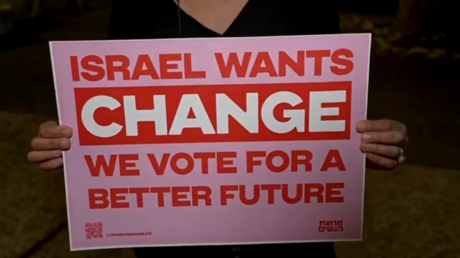
Tens of thousands of Israelis flooded Tel Aviv's Hostages Square just three days before the October 27, 2026 legislative election, transforming a routine pre-vote rally into a direct referendum on Prime Minister Benjamin Netanyahu's survival. Organized by the October Council—a coalition of families of attack victims and hostages—the demonstration demanded an independent state commission of inquiry into the security failures surrounding the October 7 Hamas attack, while rejecting Netanyahu's counter-proposal for a politically appointed panel.
To casual observers watching wire clips of protesters wearing Pinocchio masks in central Tel Aviv, the gathering looked like another chapter in Israel's familiar cycle of street unrest. It was not. That rally exposed the exact fault lines that would, seventy-two hours later, strip Netanyahu's governing coalition of eleven seats, hand opposition leader Gadi Eisenkot a mandate to form a government, and trigger a post-election crisis over allegations of state interference in Arab voting.
The Anatomy of the October 24 Mobilization
Street protests in Israel carry a distinct operational weight that standard polling frequently misses. While pre-election surveys ahead of the October 27 vote accurately predicted that neither major bloc would secure an outright 61-seat majority in the 120-seat Knesset, the October 24 demonstration revealed the organizational muscle behind the anti-Netanyahu camp.
According to Agence France-Presse reports from the ground, the mobilization was spearheaded not by traditional party machinery, but by civil society groups led by the October Council. Their core grievance centered on institutional accountability. For years following the October 7 attack, civil society advocates and opposition lawmakers pressed for a formal, independent state commission of inquiry. Netanyahu's government resisted that demand, offering instead a hybrid "political" commission split evenly between coalition and opposition appointees. Opposition leaders, including Yashar party head Gadi Eisenkot and Together party leader Naftali Bennett, flatly rejected the compromise and vowed to boycott any panel selected by politicians.
The demonstration functioned as a force multiplier for two distinct electoral mechanics:
- Consolidating the Center-Right Defectors: By framing the election around institutional accountability and mandatory military service rather than traditional left-right ideology, organizers gave disaffected right-leaning voters a nationalist rationale to abandon Likud.
- Neutralizing Coalition Fatigue: The outgoing 25th Knesset was the first Israeli legislature since 1988 to complete a full four-year term without early dissolution. That longevity, achieved despite massive protests over judicial reform and recurring coalition crises over ultra-Orthodox military conscription, had bred a sense of inevitability around Netanyahu's rule. Seeing tens of thousands fill central Tel Aviv shattered that aura right before ballots were cast.
Yet street energy in Tel Aviv has historically suffered from an echo-chamber problem. Critics of the protest movement and analysts examining voting patterns pointed out a stubborn geographical reality. Even as Tel Aviv erupted in anti-government demonstrations, Netanyahu's core base in peripheral towns and communities directly impacted by the war remained largely intact. As reporting by +972 Magazine noted following the vote, residents in several war-devastated areas continued to identify deeply with Likud despite economic strain and security trauma.
Why the Ballot Box Reflected the Street—And Where It Didn't
When Israelis went to the polls on October 27, turnout surged to 77.98 percent, up 7.35 percentage points from the previous cycle. The results confirmed that the pre-election protests had tapped into real electoral anger, though the outcome fell short of a clean sweep for either side.
| Party | Leader | Vote Share | Knesset Seats | Seat Change |
|---|---|---|---|---|
| Likud | Benjamin Netanyahu | 20.51% | 27 | -9 |
| Yashar | Gadi Eisenkot | 16.05% | 21 | New |
| Together | Naftali Bennett | 9.35% | 12 | -12 |
| Joint List | Yousef Jabareen | 8.80% | 11 | +6 |
| Democrats | Yair Golan | 6.44% | 8 | +4 |
| Ra'am | Mansour Abbas | 5.93% | 8 | +3 |
| Yisrael Beiteinu | Avigdor Lieberman | 5.93% | 7 | +1 |
| Otzma Yehudit | Itamar Ben-Gvir | 5.74% | 7 | +1 |
| United Torah Judaism | Ya'akov Asher | 5.49% | 7 | 0 |
| Shas | Aryeh Deri | 5.26% | 6 | -5 |
| RZP–Zehut | Bezalel Smotrich | 5.11% | 6 | -1 |
Likud remained the single largest party in the 26th Knesset with 27 seats, but it bled nine mandates compared to its previous standing. Combined with heavy losses by its ultra-Orthodox ally Shas—which dropped five seats amid fierce national debate over Haredi military conscription—Netanyahu's outgoing coalition lost eleven seats overall.
Meanwhile, Gadi Eisenkot's newly formed Yashar party captured 21 seats, positioning the former military chief as the primary challenger. However, the decisive mathematical shift did not come from Jewish opposition parties, which netted only two additional seats overall. It came from Israel's Arab minority. Driven by exceptionally high turnout in Arab communities, the Joint List surged by six seats to reach 11, while Mansour Abbas's Ra'am gained three seats to reach eight. Together, Arab factions gained nine mandates, effectively denying Netanyahu's bloc any path to a governing majority.
The Conscription Impasse and Economic Friction
Beneath the headline battles over October 7 accountability, two structural pressures hollowed out the incumbent coalition's support during the final stretch of the campaign.
The first was the Haredi military draft. Following years of multi-front conflict, the exemption of ultra-Orthodox men from mandatory military service became unsustainable for large segments of the Israeli public. Eisenkot campaigned explicitly on ending blanket exemptions and integrating the ultra-Orthodox into the draft. This issue wedged a permanent crack between Likud's secular, military-serving nationalist voters and its ultra-Orthodox coalition partners, UTJ and Shas, who held 13 seats between them after the vote.
The second pressure was economic anxiety compounded by diplomatic friction. Four days before the election, Netanyahu sparked market jitters by publicly warning Israelis to get used to the idea that American military aid might not continue. Simultaneously, international sanctions targeting goods from West Bank settlements—imposed by Britain and several other nations in response to settlement expansion and settler violence—weighed on trade sentiment. Bank of Israel Governor Amir Yaron felt compelled to intervene publicly, clarifying that cryptocurrency was not a viable mechanism to bypass international sanctions and urging policymakers to preserve ties with major trading partners.
To counter rising cost-of-living frustration, Netanyahu recruited former Finance Ministry budget chief Shaul Meridor to draft a plan aimed at dismantling food monopolies and cutting import barriers. Yet for many voters marching in Tel Aviv, late-stage economic promises could not offset years of institutional strain.
Post-Election Fallout and Allegations of State Interference
If the October 24 protesters feared Netanyahu would refuse to relinquish power quietly, subsequent events validated their worst anxieties. On November 8, Israeli President Isaac Herzog tasked Gadi Eisenkot with forming the next government. Rather than conceding defeat, Netanyahu alleged that the October 27 election had been stolen, claims formally rejected by Israel's Central Elections Committee on November 4.
The confrontation escalated dramatically in mid-November following an investigative report by Israel's Channel 12. According to the broadcast, aides to Netanyahu passed tips to police shortly before the vote that resulted in the Election Day arrests of Arab party workers. The report further alleged that the head of the Shin Bet domestic security agency—a Netanyahu appointee—attempted to wiretap five Arab members of parliament.
The revelations triggered an immediate political firestorm. Eisenkot, who had been fending off pressure from Netanyahu to enter a Likud-led unity government, severed any possibility of cooperation. Speaking after the Channel 12 broadcast, Eisenkot declared that Netanyahu could not remain at the helm of the government "for even one more minute," warning against dragging the country into yet another election cycle under his leadership. Opposition lawmakers subsequently secured the election of a new Knesset speaker, stripping Likud of procedural control over the parliamentary floor.
The Fragile Math of a Post-Netanyahu Coalition
Protesters in Hostages Square succeeded in breaking Netanyahu's parliamentary majority, yet ousting a prime minister is mechanically simpler than governing without him.
To assemble a 61-seat majority in the 26th Knesset, Eisenkot must bridge ideological chasms that rival the divisions between Likud and the street demonstrators. Combining Yashar (21), Together (12), the Democrats (8), and Yisrael Beiteinu (7) yields only 48 seats. Even with Ra'am's eight seats—which previously participated in the 2021–2022 Bennett-Lapid governing coalition—the bloc reaches 56 mandates, five short of a majority.
Closing that five-seat gap requires either external parliamentary support from the predominantly Arab Joint List (11 seats) or peeling away ultra-Orthodox factions like Shas (6 seats). Both paths carry severe political hazards. Relying on the Joint List invites relentless nationalist attacks from Likud and Itamar Ben-Gvir's Otzma Yehudit, which Netanyahu previewed by accusing Eisenkot of seeking a "Palestinian-backed coalition". Conversely, bringing ultra-Orthodox parties into the fold would force Eisenkot to dilute the very military conscription reforms that powered his campaign.
Street protests in Tel Aviv proved capable of ending an era of uninterrupted coalition rule, but the arithmetic of the 26th Knesset leaves Israel's next government dependent on the exact sectarian and ideological compromises that voters took to the streets to escape.
For coverage of the pre-election demonstrations in central Tel Aviv, watch Tens of thousands rally against Netanyahu ahead of Israeli election, which shows protesters gathering at Hostages Square ahead of the vote.