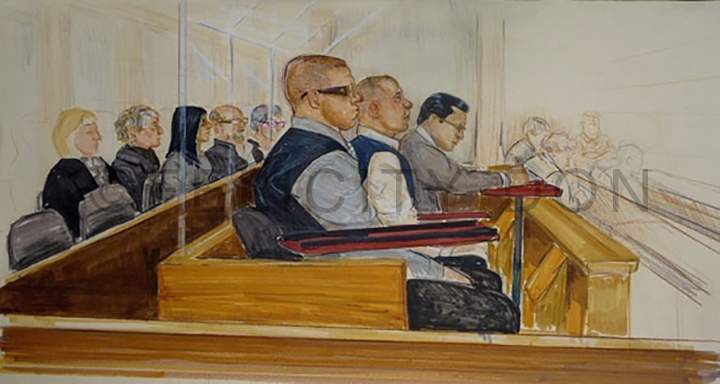
Nearly two decades after the most notorious gangland execution in Canadian history shocked the public, the courtroom door has finally slammed shut on Cody Haevischer's exhaustive bids for freedom. B.C. Supreme Court Justice Martha Devlin rejected an application for a stay of proceedings, confirming that the Red Scorpions gangster will serve his life sentence for six counts of first-degree murder and conspiracy. Yet, the resolution of this specific chapter exposes a troubling reality about modern criminal litigation. The legal system can become bogged down for years by systemic abuse-of-process claims brought by offenders who slaughtered the defenseless.
The October 2007 massacre at Surrey's Balmoral Tower left six men dead, including two entirely innocent bystanders caught in a brutal turf war over the British Columbia drug trade. Christopher Mohan, a young man who lived down the hall, walked into the hallway and stumbled upon an execution. Ed Schellenberg, a fireplace repairman, was simply doing his job. Since the 2014 convictions of Haevischer and fellow gang member Matthew Johnston, the path to finality has been obstructed by persistent legal maneuvers. The defense spent years weaponizing allegations of police misconduct and harsh pretrial custody conditions, attempting to trade state transgressions for absolute freedom.
The Weight of State Misconduct Claims
Criminal defense strategies frequently pivot toward institutional accountability when direct evidence of innocence is absent. In this case, the defense pointed to serious flaws in how authorities handled the investigation and managed the accused behind bars. Justice Devlin acknowledged that certain aspects of Haevischer's incarceration—specifically prolonged periods in solitary confinement—crossed constitutional boundaries and breached his Charter rights.
A constitutional violation does not automatically translate into a get-out-of-jail-free card for a mass murderer. Under Canadian jurisprudence, a stay of proceedings remains the ultimate remedy, reserved strictly for the "clearest of cases" where the state's conduct compromises trial fairness beyond repair or irreparably damages the integrity of the justice system. Justice Devlin sifted through a mountain of claims, dismissing the vast majority as meritless. She noted that Haevischer routinely blamed his current psychological trauma entirely on corrections officers while ignoring the obvious compounding stressors of facing a high-stakes murder trial, ongoing gang threats, and unrelated personal disputes.
The legal journey required intervention from the highest court in the country. In a previous ruling, the Supreme Court of Canada established that trial judges cannot simply dismiss abuse-of-process applications out of hand just because the underlying crimes are horrific, unless the applications are manifestly frivolous. That ruling triggered an evidentiary hearing that consumed months of court time, public resources, and emotional energy.
The Toll on the Families of Victims
While perpetrators exploit procedural safeguards to challenge their convictions, families of the victims endure a perpetual cycle of trauma. Eileen Mohan, mother of the late Christopher Mohan, has spent nearly twenty years attending court hearings, listening to legal arguments, and watching the men responsible try to dismantle their own verdicts.
Outside the courtroom following Justice Devlin's ruling, Mohan expressed a mixture of profound relief and exhaustion. The contrast between the daily reality of the victims and the appeals of the convicted remains stark. Killers breathe recirculated prison air, speak with visitors, and access legal aid funded by taxpayers to mount elaborate challenges. The victims remain buried, their futures permanently erased by a calculated display of gang violence.
The ruling injects a measure of certainty into a judicial process that many feared had become trapped in an endless loop of appeals. Johnston died in pretrial custody while litigation was ongoing, and now Haevischer's primary legal lifeline has snapped. Still, the saga illustrates how protracted criminal proceedings test the resilience of public confidence in the courts.
As the courtroom emptied and the gallery members embraced outside, the enduring legacy of the Surrey Six murders solidified not merely as a landmark prosecution of organized crime, but as a grueling test of endurance for a justice system constantly balancing the constitutional rights of the guilty against the public's right to finality and justice