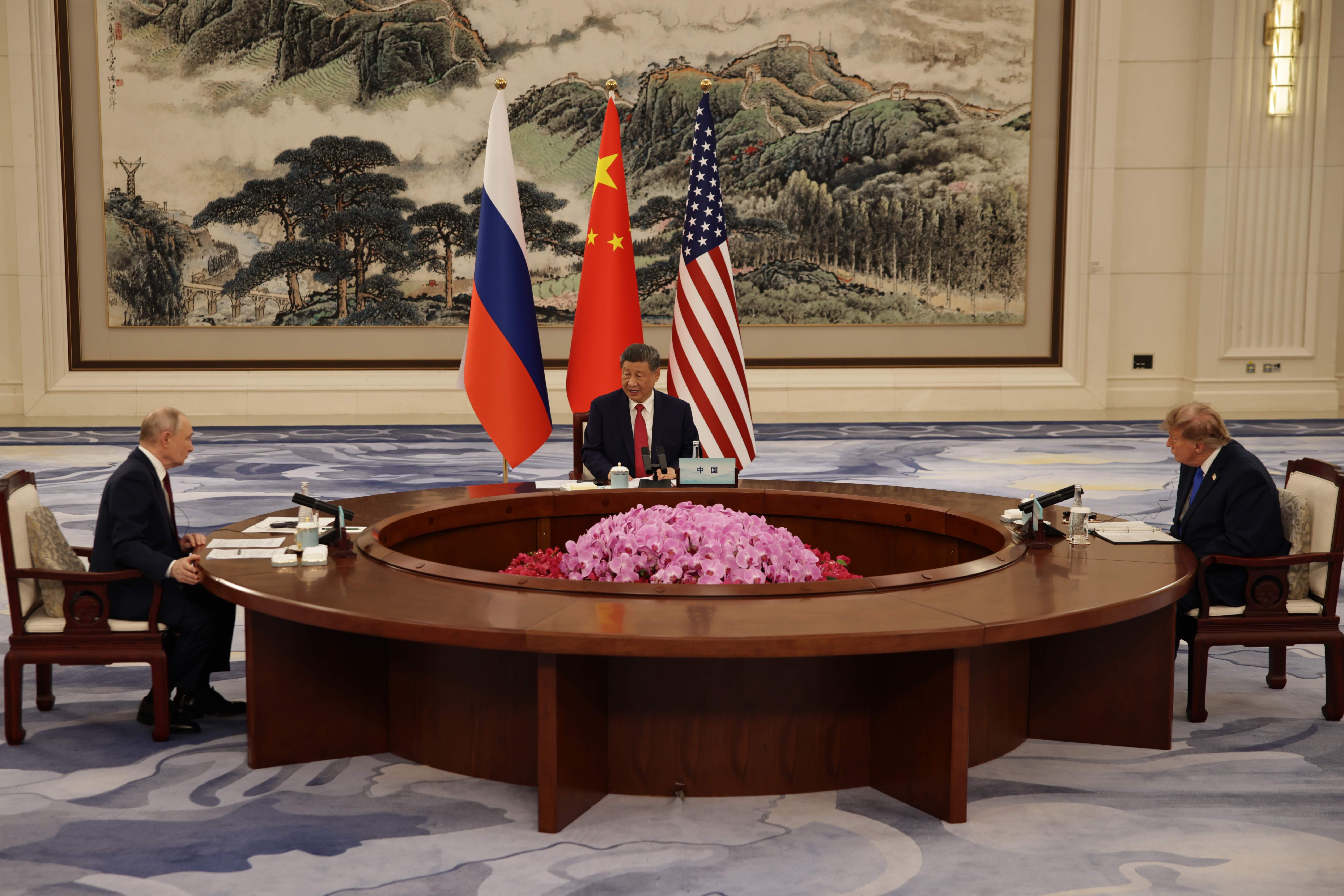
The historic November 19, 2026 trilateral meeting in Shenzhen between Donald Trump, Xi Jinping, and Vladimir Putin was not a breakthrough peace conference. It was a calculated exercise in geopolitical theater that handed immediate diplomatic victories to Moscow and Beijing while leaving the world's most volatile conflicts completely untouched.
In 90 minutes behind closed doors on the margins of the APEC leaders' gathering, the heads of the world's three most powerful militaries produced a four-point communiqué so vague it avoided mentioning the wars in Ukraine and Iran entirely. Instead, the U.S.-Russia-China Heads of State Declaration toward Peace targeted the International Criminal Court, endorsed expanded refined petroleum production, and offered noncommittal pledges on United Nations reform and nuclear risk reduction.
The real story of the Shenzhen summit lies in what was left off the page, and why two autocrats successfully exploited an American president's appetite for grand optics to rewrite international norms without firing a shot.
The Anatomy of a Hollow Communiqué
Treaties bind nations. Political declarations buy time.
Under international law, specifically the 1969 Vienna Convention on the Law of Treaties, a document's title does not determine whether it creates enforceable obligations. What matters is intent, ratification mechanisms, dispute-settlement procedures, and clear performance mandates. The Shenzhen text contains none of these. Even the ordering of the nations in the official title changed depending on which capital published the text—Washington listed the United States first, while Beijing's Ministry of Foreign Affairs placed China at the front.
When you strip away the diplomatic varnish, the four points of the Shenzhen declaration function less as a blueprint for global stability and more as a wishlist for Moscow and Beijing.
Point One The Attack on the International Criminal Court
The declaration explicitly criticized the International Criminal Court (ICC) for breaching "the principle of state consent and respect for immunities of State officials". During the public portion of the gathering, Trump went even further, dismissing the Hague-based tribunal as a "rogue globalist organization".
The beneficiary here is obvious. Vladimir Putin has operated under an active ICC arrest warrant for alleged war crimes in Ukraine since 2023, severely restricting his international travel and branding him a pariah across Western capitals. Having the President of the United States co-sign a joint statement delegitimizing the very court seeking Putin's arrest effectively rehabilitates the Russian leader on the global stage. For Beijing, weakening international judicial bodies sets a convenient precedent that shields state officials from external accountability over domestic crackdowns or future regional aggression.
Point Two The Quiet Lifeline for Russian Oil
Buried in the economic language of the communiqué is a pledge by Washington, Beijing, and Moscow to "increase the production and supply of refined petroleum products for the benefit of all nations".
On the surface, it reads like a standard macroeconomic nod to lowering global energy prices. In practice, it serves as a diplomatic endorsement of Russia's heavily sanctioned energy sector. Since the invasion of Ukraine, Western allies have spent years constructing a complex architecture of price caps, maritime insurance bans, and refinery restrictions designed to starve the Kremlin's war machine of revenue. By signing onto a joint call to expand refined petroleum supplies alongside Putin, the White House undercut the moral and political cohesion of its own sanctions regime, signaling to global buyers that Russian crude and refined products are back in polite company.
Point Three Undefined United Nations Reform
The leaders agreed on the need to reform the United Nations, yet the text offers zero specifics on what that reform entails.
In his opening remarks, Putin framed the three nations as founding members bearing a "special responsibility for preserving and strengthening the system of international law". That phrasing is classic Kremlin doublespeak. When Moscow and Beijing speak of UN reform, they are rarely advocating for expanded Security Council representation for developing nations or stronger human rights enforcement. They are pushing for a multipolar framework that erodes Western institutional dominance while preserving their own Security Council veto power. Without a concrete negotiating mandate, the clause acts as a blank check for Beijing and Moscow to claim American backing for their alternative vision of global governance.
Point Four The Illusion of Nuclear Risk Reduction
The final pillar proposes a trilateral dialogue to reduce nuclear-weapons risks and prevent proliferation, accompanied by the familiar refrain that "a nuclear war cannot be won and must never be fought".
Washington has spent years trying to pull China into formal arms control talks as Beijing rapidly expands its nuclear stockpile. Convincing Xi to sit at a table where nuclear risk is on the agenda marks a minor rhetorical shift. Yet history urges extreme skepticism. Russia signed the exact same "nuclear war cannot be won" declaration alongside the other four permanent Security Council members in January 2022. Weeks later, Russian tanks rolled into Ukraine, followed by years of relentless nuclear saber-rattling from Moscow. Meanwhile, all three nations continue to pour billions into nuclear modernization. Dialogue without verification mechanisms, warhead caps, or inspection regimes is merely conversation.
What Was Left Off the Table
To understand the true nature of the Shenzhen summit, look at the glaring omissions. Two major regional wars are actively destabilizing global markets and security alliances, yet neither made it into the joint text.
The Silence on Ukraine
Despite a separate bilateral meeting between Trump and Putin prior to the trilateral session, nothing emerged from Shenzhen to suggest progress on ending the war in Ukraine. Earlier in November, the United States brokered a fourth round of Russia-Ukraine negotiations in Abu Dhabi, which collapsed without an agreement over territorial concessions and post-war security guarantees.
By excluding Ukraine from the joint declaration, Xi and Putin successfully decoupled Russia's broader diplomatic standing from its ongoing military aggression. Moscow proved it can stand shoulder-to-shoulder with the American president in front of global cameras without yielding an inch of occupied Ukrainian soil.
The Evasion on Iran
The White House entered the summit hoping to address the escalating conflict involving Iran. Neither Xi nor Putin obliged.
Both Beijing and Moscow benefit from Washington remaining bogged down in Middle Eastern crises that drain American naval assets, diplomatic bandwidth, and domestic political capital. While Chinese and Russian officials routinely issue generic calls for restraint, they have zero strategic incentive to expend leverage reining in Tehran on Trump's behalf. Instead, Putin and Xi harbor a different proliferation anxiety. They want to ensure that if American security guarantees continue to fray, frontline U.S. allies like Germany, Japan, Poland, and South Korea do not decide to build nuclear arsenals of their own.
The Choreography of Power How Xi Jinping Won the Room
For Beijing, hosting the first-ever meeting of American, Chinese, and Russian leaders was a masterclass in stagecraft.
Chinese officials had to walk a tightrope. They wanted to showcase China's convening power as an indispensable global mediator without letting the trilateral spectacle completely eclipse the wider APEC summit. They pulled it off through meticulous protocol.
Xi personally greeted Trump on the tarmac in Shenzhen with a warm embrace—a deliberate departure from stiff diplomatic norms tailored specifically to flatter the American president. Trump took the bait immediately, calling the greeting "a big win for us" and a sign of "great respect". At the opening dinner, Xi seated Trump directly beside him, projecting the image of a G2 superpower condominium where Beijing stands as Washington's sole equal.
Yet when the cameras clicked for the formal trilateral portraits, Chinese protocol officers carefully balanced the optics. In traditional Chinese hierarchy, standing to the host's right signifies the position of highest honor. Before the gala dinner, Trump occupied that spot. In the final group photograph following the summit, Putin stood to Xi's right.
The message to the Global South was unmistakable. Beijing sits at the center of the table, capable of summoning both Washington and Moscow to its soil and mediating between them on equal footing.
Why European Allies Are Sounding the Alarm
Ahead of the meeting, Chinese foreign policy scholars took pains to insist that Shenzhen was not "Yalta 2.0"—a reference to the 1945 conference where Franklin D. Roosevelt, Winston Churchill, and Joseph Stalin carved up post-war spheres of influence while excluding China. Wu Xinbo, Dean of the Institute of International Studies at Fudan University, argued that the leaders would not divide the world or negotiate major settlements.
In European capitals, that reassurance rings hollow.
Even without formal territorial carve-ups, the sheer visual of the American president conferring privately with Putin and Xi sends a chilling signal across the Atlantic. European leaders have spent years insisting on a simple principle regarding Ukraine and continental defense: no decisions about Europe without Europe.
When Washington bypasses traditional democratic allies to stage high-profile summits with authoritarian rivals, it validates the worldview that Moscow and Beijing have promoted for decades. In that worldview, smaller and medium-sized nations are merely chess pieces, and global rules are written exclusively by strongmen. Furthermore, European policymakers worry that bilateral U.S.-China economic understandings reached on the sidelines could simply redirect subsidized Chinese industrial overcapacity straight into European markets.
The Ticking Clock on Trade and leverage
Beneath the warm handshakes in Shenzhen lies a brutal reality of political calendars and economic friction.
Xi Jinping and Vladimir Putin are playing a long game against a president whose leverage is steadily eroding. With the 2026 U.S. midterm elections already behind him, Trump faces shrinking domestic incentives to pursue painstaking diplomatic settlements abroad. Analysts note that both Xi and Putin recognize Trump's desire to secure a legacy as a historic peacemaker—and both men understand they can extract tangible economic and security concessions simply by feeding his appetite for televised pageantry.
Meanwhile, the structural collisions between Washington and Beijing remain unresolved:
- The Trade Truce Deadline: The temporary U.S.-China trade truce expires on January 10, 2027, leaving negotiators just weeks to prevent a fresh wave of tariffs or extend an increasingly fragile ceasefire.
- Semiconductor Chokepoints: Enforcement disputes over U.S. export controls on advanced artificial intelligence chips continue to simmer. While Beijing publicly denies involvement in chip smuggling, Xi holds the retaliatory card of tightening export restrictions on critical rare-earth minerals.
- The Miami Rematch: Trump and Xi are scheduled to meet again in less than three weeks at the G20 summit in Miami on December 14–15, hosted at Trump's Doral resort. Putin has also been invited, though his attendance remains uncertain.
Diplomacy is ultimately measured by the behavior it changes, not the headlines it generates. In Shenzhen, Xi Jinping secured global prestige, Vladimir Putin shattered his diplomatic isolation, and Donald Trump walked away with an airport hug and a four-point press release that binds nobody to anything. Until Washington demands verifiable concessions before granting the legitimacy of a presidential handshake, strongmen will continue to trade empty ink for real geopolitical power.