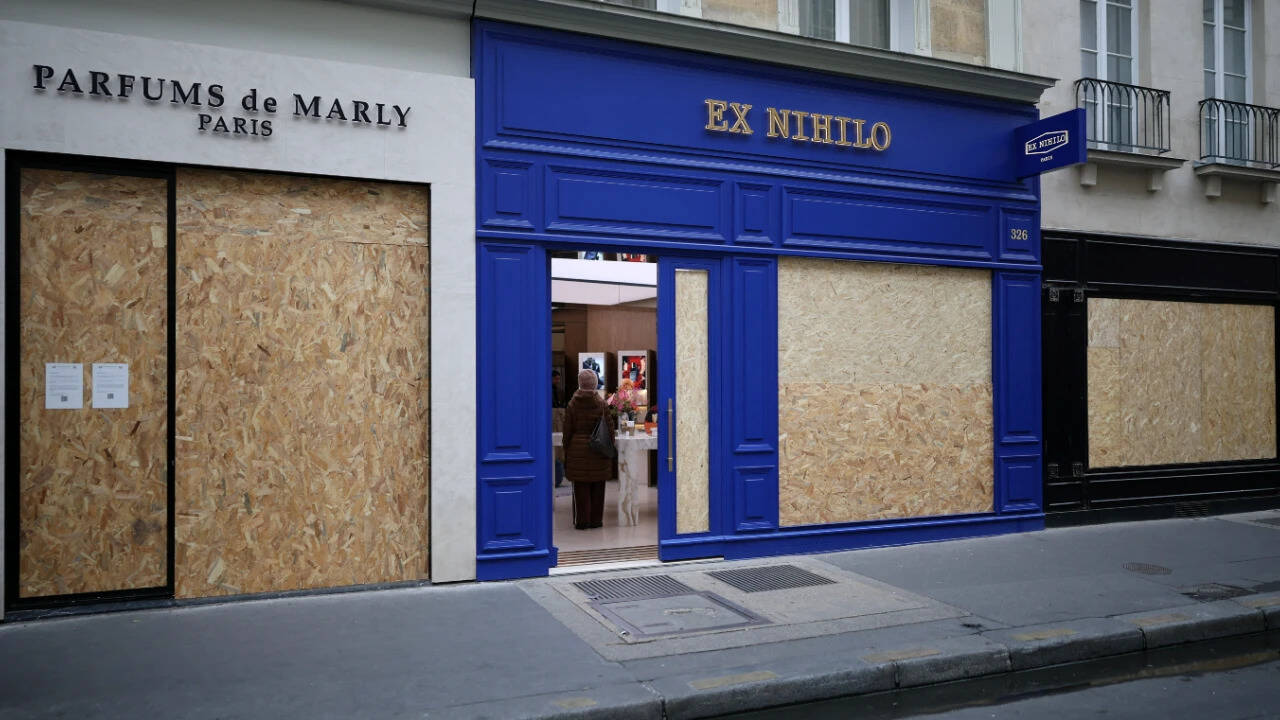
Walk down the Avenue des Champs-Élysées or cut through the Marais forty-eight hours before a major French labor strike or political demonstration, and you will hear the unmistakable sound of drills biting into pine. Paris shops increase security and board up windows not out of sudden panic, but because commercial insurance realities, strict municipal liability laws, and the evolving tactics of urban protest groups have turned pre-emptive fortification into a standard operating expense. What looks to tourists like an impending war zone is actually a cold, calculated financial routine executed by retail managers who know that a shattered storefront costs far more than plywood.
For decades, Parisian street protests followed an unwritten spatial script. Unions marched along predictable corridors—from Place de la République to Place de la Nation, or down Boulevard Saint-Germain—while storefronts along those routes simply pulled down their metal rolling shutters and waited out the afternoon. That predictability is dead. Modern demonstrations in the French capital frequently fracture into mobile, decentralized flashpoints, pulling luxury boutiques, mid-market chains, and neighborhood pharmacies into the crossfire without warning. For an alternative look, consider: this related article.
The Economics of Plywood and Shattered Glass
To understand why a flagship store spends tens of thousands of euros overnight on timber and private guards, you have to look at the balance sheet of an urban retailer. A single curved, anti-bandit glass panel on a major Parisian boulevard does not come off a shelf at a local hardware store. These custom-fabricated sheets, often treated for acoustic insulation and UV protection, carry lead times stretching into months and replacement costs that regularly climb past twenty thousand euros per pane.
When a store loses its facade, the immediate repair bill is only the opening chapter of the financial damage. Under French commercial law and municipal safety codes, an exposed retail space cannot simply remain open with a tarp taped over the frame. Until structural integrity is restored, the business faces mandatory closure, bleeding daily revenue during peak trading hours while fixed overhead costs—staff wages, commercial leases, and utilities—continue ticking. Further coverage on this trend has been provided by The Motley Fool.
Business interruption insurance rarely covers the full reality of these shutdowns. French insurers have steadily tightened policy terms following the Gilets Jaunes movement of 2018 and 2019, as well as the pension reform unrest of 2023. Deductibles for civil commotion and rioting have climbed sharply, and many policies now include strict mitigation clauses. If a retailer fails to take documented, reasonable preventative measures after a prefecture issues a security advisory, an insurer can reduce the payout or contest the claim entirely. Boarding up is no longer just physical protection; it is legal compliance for the claims adjuster.
The Hidden Supply Chain of Urban Fortification
Behind the scenes, an entire specialized industry has grown around the Paris protest calendar. Whenever the Préfecture de Police announces a high-risk demonstration route, logistics firms and commercial carpenters go on immediate standby.
Consider how a typical luxury boutique along the Rue de Rivoli prepares—not as a dramatic emergency, but as a rehearsed drill:
- Modular timber systems are pulled from suburban warehouses in the Île-de-France region, pre-cut and numbered to fit specific window dimensions so installation takes two hours instead of twelve.
- Steel reinforcement brackets remain permanently anchored into the masonry beneath decorative stone facades, allowing crews to bolt heavy marine-grade plywood directly into the structure without damaging historic stonework.
- High-value inventory is stripped from display cases and moved into subterranean concrete vaults, leaving mannequins bare behind the barricades.
- Private security contractors are booked in double shifts, stationed inside the perimeter to monitor fire alarms and prevent opportunistic break-ins once the tear gas clears.
This process is expensive. For a mid-sized retail footprint, a single weekend of boarding up, unboarding, and hiring overnight guards easily runs between five thousand and fifteen thousand euros. Multiply that across six or eight major mobilization dates in a calendar year, and security shifts from an occasional emergency cost to a permanent line item in the annual budget.
Why Traditional Shutters Are No Longer Enough
A common question from outside observers is why Parisian shops bother with wood when almost every commercial building in the city already has heavy metal rolling shutters. On paper, steel beats pine every time. On the street, the physics of crowd unrest tell a different story.
Standard rolling shutters are designed to deter a quiet burglar at three in the morning, not a sustained assault during a chaotic afternoon. Metal slats sit inside vertical guide rails mounted to the exterior wall. When struck repeatedly with heavy objects—or pried from the bottom with crowbars—those slats bend, buckle, and pop out of their tracks. Once a single section derails, the entire curtain jams, trapping the mechanism halfway and often smashing into the glass behind it.
Worse still, metal shutters are vulnerable to heat and leverage. A thick sheet of marine-grade plywood, bolted flush against the exterior masonry frame, absorbs kinetic energy differently. Wood flexes under blunt force rather than warping permanently out of a track. Because it sits flat against the building facade with no bottom lip to hook a pry bar under, it denies looters the leverage point they need to peel the barrier away. Many retailers now use a layered defense—pulling the steel shutter down first, then sealing the entire recess behind bolted timber panels.
The Shift in Street Tactics and Police Doctrine
The physical hardening of Parisian storefronts is a direct response to changes on both sides of the police line. Over the past decade, the nature of French street demonstrations has evolved from static union parades into fluid, fast-moving confrontations.
The emergence of black bloc tactics—where small, agile groups dress identically to blend into larger crowds before breaking off to target symbols of capital—changed the risk calculus for every business within a two-kilometer radius of a protest route. Banks, luxury flagship stores, real estate agencies, and multinational retail chains are primary targets. Yet independent bakeries, cafes, and corner pharmacies frequently suffer collateral damage simply because they occupy the ground floor of buildings along escape routes.
At the same time, French policing strategy has shifted toward high-mobility containment. Rather than holding rigid, immovable lines that allow crowds to pool in one square for hours, riot units frequently use dynamic maneuvers to disperse gatherings quickly. While effective at preventing prolonged occupations of major intersections, rapid dispersal pushes small groups down side streets where storefronts have not been fortified. Shopkeepers three blocks away from the official march route often discover too late that the perimeter has moved to their doorstep.
The Regulatory Squeeze on Shopkeepers
Local regulations complicate the defense even further. Paris maintains strict architectural preservation rules, particularly in historic districts and along designated heritage avenues. Storefronts cannot simply weld permanent steel bars across their windows or replace glass with solid concrete walls. Any exterior modification that alters the streetscape requires approval from municipal architects, a process that moves at a glacial pace.
Temporary boarding sits in a gray area that authorities tolerate out of necessity, provided the panels come down promptly once the prefecture lifts its security alert. Leave the plywood up too long, and a business risks municipal fines for degrading the urban environment—not to mention the silent message it sends to shoppers that the neighborhood is unsafe. Retailers are caught in an exhausting cycle of rapid assembly and immediate teardown, often paying overtime rates to contractors working at four in the morning so the street looks pristine by opening time at ten.
The Invisible Toll on Small Independents
Large luxury conglomerates and international fast-fashion chains absorb these expenses as a predictable cost of doing business in a global capital. Their balance sheets can handle a fifteen-thousand-euro weekend bill and a lost Saturday of foot traffic without threatening their survival.
Independent merchants face an entirely different math. A family-owned optician, an independent bookstore, or a neighborhood bistro operates on thin margins where Saturday sales often generate thirty to forty percent of weekly revenue. For these owners, custom-fitted timber hoarding is frequently out of reach. When unrest threatens, they face a grim choice between staying open and risking catastrophic property damage, or pulling down an aging metal grate and losing an entire weekend of income that cannot be recovered.
Many small business associations in Paris have lobbied the city and the national government for streamlined compensation funds and tax relief tied directly to protest disruptions. While emergency aid mechanisms have occasionally been activated after prolonged waves of unrest, the bureaucratic hurdles remain steep. Owners must document revenue drops against prior-year averages, prove direct geographic impact, and wait months for partial reimbursements that rarely cover the full loss of momentum.
Tourism and the Optics of the Barricade
Beyond the immediate ledger of repair bills and lost sales lies a harder metric to quantify—the psychological impact on international visitors and local shoppers. Paris relies heavily on retail tourism, particularly in the Golden Triangle, Saint-Germain-des-Prés, and the corridors around the Opéra Garnier.
When visitors step out of a metro station to find world-famous avenues encased in raw plywood and patrolled by armored vans, the visual impression is jarring. Even when demonstrations remain peaceful and confined to specific boulevards, the sight of boarded-up windows triggers immediate cancellations at nearby restaurants and hotels. Shoppers who might have spent an afternoon browsing retreat to their hotels or head to suburban shopping centers outside the city ring.
Retailers understand this optics problem acutely. That is why many high-end houses have begun painting their protective boards in neutral tones, stenciling their brand logos onto the timber, or hiring street artists to cover the barriers in murals. It is an attempt to turn an instrument of siege into something resembling a deliberate installation, softening the visual blow while keeping the oak and steel firmly bolted underneath.
What Comes Next for the Urban Storefront
Architectural firms and security engineers working in Western Europe are already designing the next generation of retail facades to eliminate the need for emergency carpentry altogether. New commercial renovations in central Paris increasingly incorporate laminated security glazing rated to withstand sustained impacts from heavy tools without breaching. These multi-layered glass and polycarbonate composites cost up to four times as much as standard commercial glass during initial construction, yet they eliminate the recurring labor costs of boarding up every time tensions flare in the capital.
Until those upgrades become universal across the city's aging building stock, the drill and the plywood sheet remain indispensable. Watching crews seal off a Parisian boutique is not a sign that the city is falling apart; it is the visible mechanics of a retail sector that has learned how to price civil unrest into its quarterly forecasts. The boards go up, the shutters drop, and by Monday morning the sawdust is swept into the gutter before the first customer turns the handle.