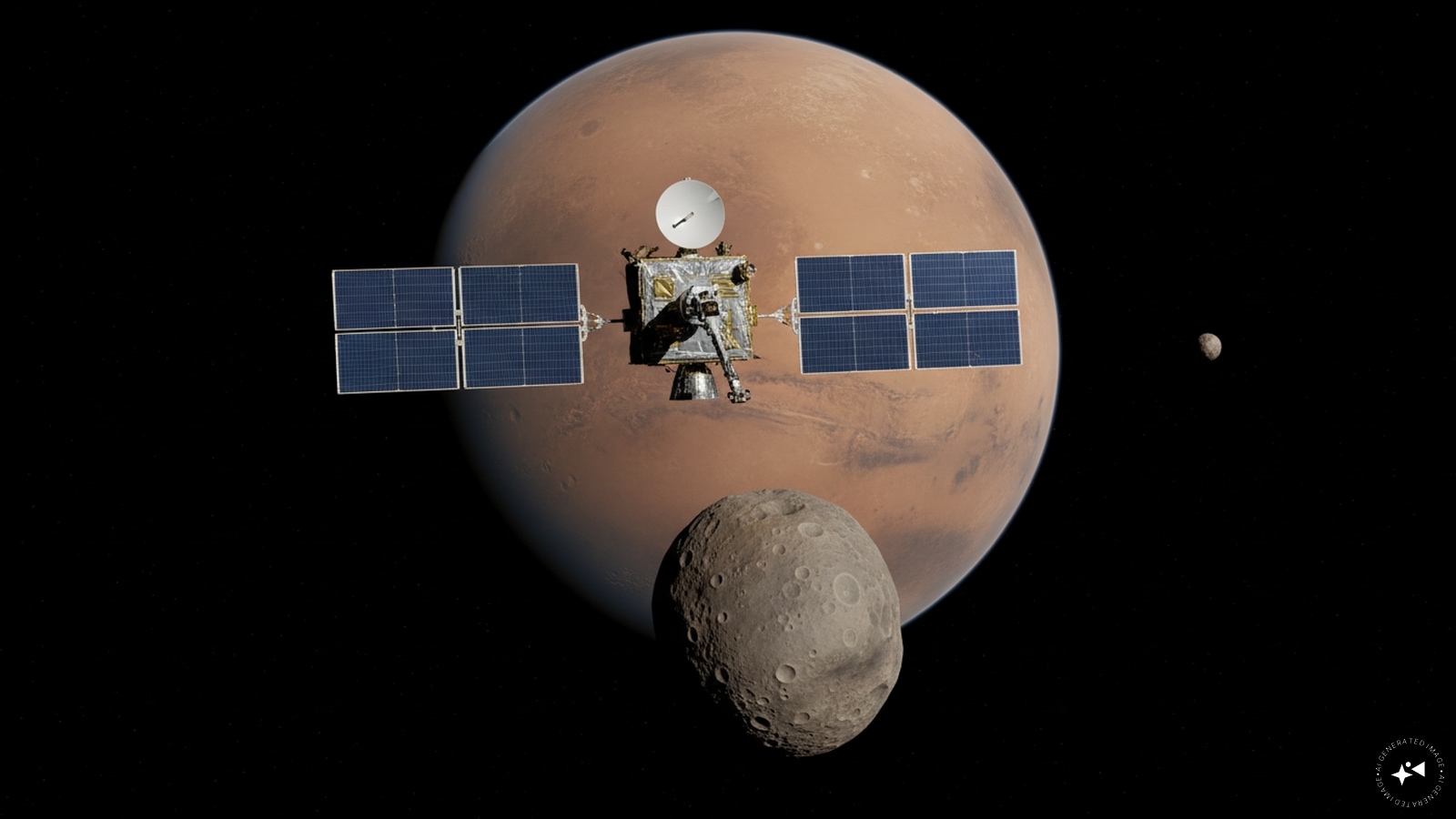
Japan is preparing to launch the Martian Moons eXploration mission, known as MMX, to return physical samples from Phobos, the larger and inner moon of Mars. If successful, it will be the first mission to bring material back from a Martian moon and the furthest sample return ever attempted.
Space agencies love a clean victory lap. Press releases paint a straightforward arc from launch pad to touchdown to laboratory analysis. Yet anyone who has spent decades watching deep-space hardware survive—or fail—far from Earth knows that Phobos sample return is less a routine milestone and more a high-stakes engineering wager. Getting a small capsule back from an airless, irregularly shaped potato of rock orbiting a distant planet requires solving problems that routinely break expensive spacecraft.
To understand why Japan and the Japan Aerospace Exploration Agency, JAXA, are taking this swing, you have to look past the novelty of a Martian moon. Phobos sits in a gravitational neighborhood that makes it a prime target for planetary science, even as its brutal environment punishes every design compromise. A single miscalculation during descent, a stubborn anchor mechanism, or an unexpectedly loose surface layer can turn a historic mission into an expensive orbital flyby.
Why Phobos Matters More Than Its Size Suggests
At roughly 22 kilometers across its longest axis, Phobos looks like a minor rock compared to Earth's moon. Size misleads. Because Phobos orbits so close to Mars—roughly 6,000 kilometers above the surface—it experiences intense tidal forces and sits inside a region where material ejected from Mars by impacts can accumulate.
Scientists have argued for decades over whether Phobos is a captured asteroid or debris left behind from a giant collision early in Martian history. A captured body offers clues about the outer solar system and the migration of planetesimals. A collision remnant offers a shortcut to sampling ancient Mars crust without enduring the entry, descent, and landing nightmare of a surface lander inside a thin carbon dioxide atmosphere.
Either origin story carries high scientific value. Dust and regolith on Phobos likely hold a mix of native moon material and Martian ejecta, giving researchers a two-for-one window into the neighborhood. That dual promise is what justifies flying millions of kilometers to a world with barely any gravity to hold onto a spacecraft.
Yet barely-there gravity cuts both ways. Low gravity reduces the propellant needed to land and take off. It also means a spacecraft cannot rely on weight and friction to stay planted when it touches down.
The Physics Trap of a Tiny Moon
Landing on a small body is nothing like landing on the Moon or Mars. On a large world, gravity pulls the spacecraft down and holds it firm while instruments work. Around Phobos, gravity is so weak that a gentle push from a thruster or an uneven contact with the surface can send a probe drifting away or tipping over.
Engineers call this dynamic instability. Touch down too hard and you bounce. Touch down too softly and you might not trigger contact sensors cleanly or get enough purchase to collect a solid sample before drifting back into space.
There is also the surface itself to contend with. Remote sensing from past orbiters has pointed to grooves, craters, and fine-grained regolith, along with questions about how cohesive or loose the top layer really is. A surface coated in deep, fine powder behaves differently from compacted gravel or exposed bedrock.
MMX approaches this problem with a deliberate mix of caution and grit. Rather than committing blindly to one spot early, the spacecraft is designed to map and characterize Phobos in detail, studying candidate sites before making the final descent. That reconnaissance phase is not filler. It is insurance against flying straight into a boulder field or a sinkhole of fine dust.
How JAXA Plans to Grab a Piece of Phobos
Bringing samples back from Mars orbit requires a sequence of tightly coupled steps, each acting as a single point of failure if something goes wrong. The architecture relies on three main elements: the main spacecraft, a small rover built with international partners, and a return module built to survive atmospheric entry back at Earth.
First comes arrival and orbital characterization. MMX has to travel from Earth to the Mars system, enter orbit, and spend time observing both Phobos and its smaller sibling, Deimos. Mapping gravitational quirks, surface features, and lighting conditions buys the mission team time to pick a landing site where the spacecraft can touch down safely and gather material reliably.
Sampling itself is a delicate dance. Touch-and-go or brief surface contact in microgravity requires precise timing and control so the spacecraft does not rebound uncontrollably or damage delicate mechanisms on uneven terrain. Once material is collected and sealed inside the return container, the mission shifts from exploration to departure.
Leaving Phobos and escaping the Mars gravitational well to head back toward Earth demands careful trajectory planning and propulsion margins. Every gram of propellant spent early is a gram not available for course corrections later. Once the return capsule reaches Earth, it has to hit a narrow atmospheric corridor without burning up or skipping off into space—a feat JAXA has previously pulled off with asteroid sample returns, though never from this far out.
The Hayabusa Shadow and Why Comparisons Only Go So Far
Whenever Japan attempts an ambitious sample return, observers immediately bring up Hayabusa and Hayabusa2. Those missions earned JAXA immense credibility by returning samples from asteroids and proving the agency could improvise through nasty technical glitches millions of kilometers from home.
Confidence is a useful asset. Overconfidence is a hazard.
An asteroid in interplanetary space is a different operating environment from a moon locked in orbit around Mars. Near Mars, the spacecraft deals with a strong planetary gravity well, eclipses that cut solar power and swing temperatures sharply, and communications delays measured in many minutes depending on orbital geometry.
Consider a hypothetical example to see how operational rhythm shifts. Imagine a ground team watching telemetry from a spacecraft hovering near Phobos when an unexpected attitude shift occurs just before a planned descent. Because radio signals take minutes to cross the distance between Mars and Earth, controllers cannot joystick the vehicle out of trouble in real time. Automation, fault-protection rules, and pre-loaded contingencies have to carry the load—and if those rules misread a sensor glitch as a safe state, a sampling attempt can be scrubbed or aborted.
Past success with asteroid sample return shows JAXA knows how to build resilient systems and tight-knit engineering teams. It does not guarantee smooth sailing in the Mars system. Each new destination introduces fresh edge cases that no test chamber on Earth can replicate in full.
International Partners and Geopolitical Realities
Deep-space exploration rarely happens in a vacuum anymore, even when one agency leads the charge. MMX includes contributions from international partners, including a small rover developed with French and German involvement designed to operate on the surface of Phobos and gather data that complements the main spacecraft's work.
Collaborative missions expand scientific reach and share engineering expertise. They also add layers of coordination across time zones, export controls, schedules, and interface standards. When a schedule slips or a subsystem faces testing delays, alignment across agencies becomes just as critical as thrust curves and thermal balance.
There is also a broader strategic lens. Space exploration has become a visible arena of national capability and long-term technical prestige. A successful Phobos sample return would cement Japan as a premier player in planetary exploration at a moment when global competition in cislunar and Martian space is intensifying.
Yet prestige does not forgive physics. Space does not care about diplomatic timelines, budget cycles, or public expectations. A valve either opens or it sticks. A thruster either fires on cue or it does not.
What Could Still Go Wrong
Even the sharpest engineering plans run into stubborn realities once hardware leaves Earth. Several vulnerabilities stand out for any Phobos sample return effort.
- Surface unpredictability: If the chosen landing site proves looser, rockier, or more irregular than orbital images suggest, contact dynamics and sample capture can become far trickier than modeled.
- Thermal and power swings: Operating around Mars means dealing with lower solar irradiance than near Earth, alongside periods in shadow where keeping propellant lines and electronics within safe temperature limits takes careful management.
- Autonomous fault handling: Long communication latencies force heavy reliance on onboard autonomy, leaving little room for human intervention during rapid maneuvers.
- Return and recovery precision: Getting samples to Mars is only half the journey; bringing a small capsule back through Earth's atmosphere and locating it cleanly requires pinpoint navigation and flawless separation.
Acknowledging these risks does not diminish the ambition of MMX. In aerospace, pretending risks are minor is how programs get blindsided. Serious engineers treat every assumption as provisional until flight data proves it out.
Why This Mission Changes the Mars Conversation
For decades, debates over Mars exploration have centered on a stark divide. On one side are rovers and landers that stay put or drive slowly across dusty plains, analyzing rocks with onboard instruments that are inevitably more limited than terrestrial laboratories. On the other side are grand, complex concepts to bring samples back from the Martian surface itself—efforts that have repeatedly run into steep cost, schedule, and architectural headwinds.
Phobos offers an intriguing middle path for understanding the Mars system. It will not answer every question about Martian geology or past habitability, because material from Mars on Phobos is mixed and altered rather than a pristine core drilled from a specific valley. Still, holding actual grains from a Martian moon in labs on Earth will let scientists apply instruments that cannot fly on a spacecraft, hunting for isotopic signatures, volatile elements, and fine mineral structures at scales impossible from orbit.
If MMX succeeds, it will prove that sample return from the Mars neighborhood is achievable with a focused, well-scoped architecture. If it runs into trouble, it will still yield valuable telemetry and lessons about operating in a harsh, low-gravity environment far from home.
Watch how MMX handles its orbital reconnaissance and surface contact sequence once it arrives at Mars, because that is where paper plans meet unyielding reality—and where space history is actually made.