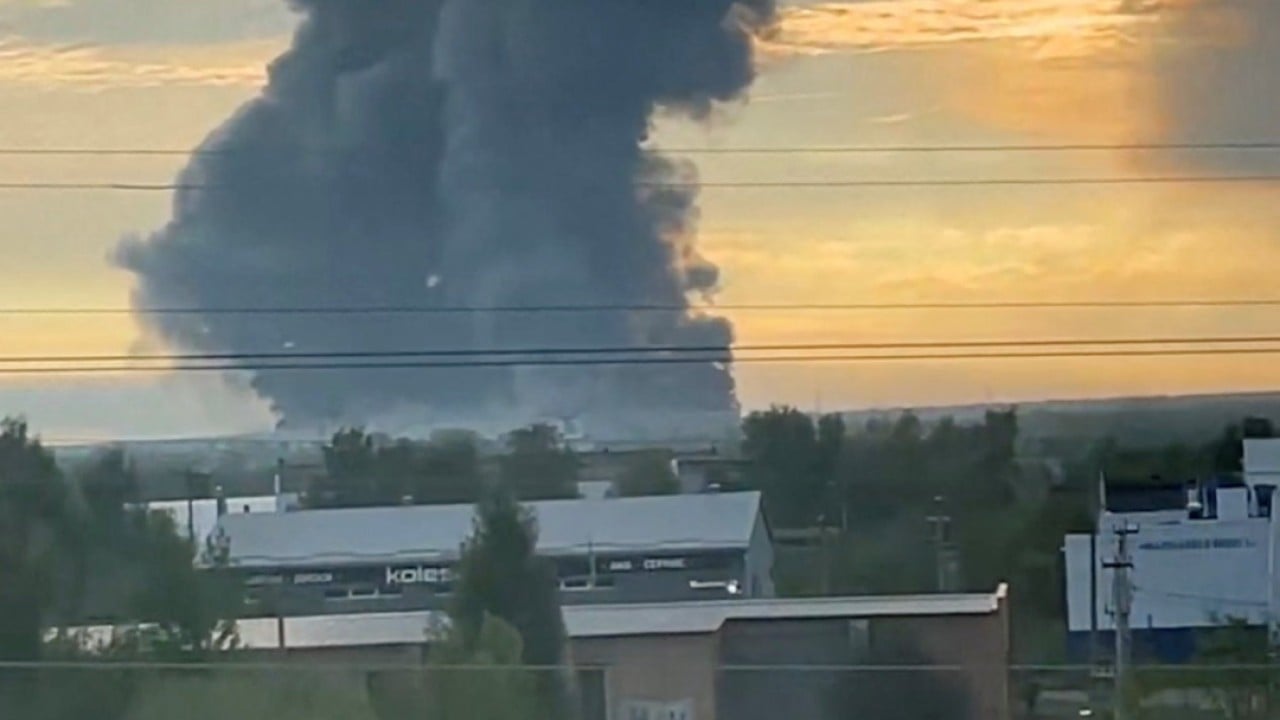
The war inside Russia no longer smells exclusively of cordite and diesel. Increasingly, it smells of scorched cardboard, melted server racks, and the distinct, acrid chemical burn of modern logistics brought to a sudden halt.
When a swarm of long-range Ukrainian drones slammed into the Samara region, the target list included more than the predictable industrial installations and oil infrastructure. For the first time, the sprawling logistics network of Ozon—Russia’s second-largest online retailer—took a direct hit. The facility in the town of Chapayevsk was forced to suspend operations amid fires and reported injuries, piercing the fragile illusion that the domestic consumer economy exists behind a glass wall, entirely separate from the grinding attrition of the front lines.
For months, strategic analysts watched as Kyiv systematically targeted facilities belonging to Wildberries, Ozon's larger domestic rival. That campaign was rarely reported as a traditional military maneuver. Instead, it was categorized as economic disruption. But the strike on Ozon marks a darker escalation. It signals that the digital arteries keeping middle-class Russian cities supplied with consumer goods, household appliances, and cheap imports are now legitimate variables in an expanding equation of total economic warfare.
The Logistics Vulnerability
Modern retail relies on extreme centralization. To achieve next-day delivery across eleven time zones, corporate giants like Ozon poured billions into hyper-efficient, mechanized fulfillment hubs. These buildings are marvels of automation, featuring endless kilometers of conveyor belts, high-density vertical storage, and computerized sorting algorithms.
They are also massive, fragile boxes vulnerable to low-cost aerial threats.
When a drone with a few kilograms of high explosive hits a traditional manufacturing plant, it damages heavy machinery designed to withstand industrial wear and tear. When that same drone penetrates a modern fulfillment center, it strikes a delicate ecosystem of automated sorting lines and combustible packaging material. A single successful hit does not just dent a steel beam; it halts a regional supply chain.
Ozon’s confirmation that work at the Chapayevsk hub was suspended exposes the vulnerability of Russia’s domestic retail backbone. Millions of consumers accustomed to frictionless digital commerce suddenly faced phantom tracking updates and canceled orders. The psychological effect of these strikes reaches far further than the physical perimeter of the burning warehouse. It forces a population that retreated into consumer comfort as a coping mechanism for the war to confront the physical reality of the conflict on their local retail apps.
The Strategy of Attrition
Kyiv’s calculus is rooted in a sober reading of the Russian state budget. Military spending consumes an unprecedented share of national resources, sustained by revenues from energy exports and taxes generated by a functioning domestic economy. By targeting refineries, ports, and now e-commerce logistics hubs, Ukraine is attempting to raise the domestic cost of the war to unsustainable levels.
For over four years of intense fighting, the Kremlin managed to insulate major urban centers from the worst of the economic disruption. Inflation rose, and Western sanctions altered the brand names on supermarket shelves, but the underlying mechanics of daily life persisted. Online retail filled the void left by departing Western multinationals, creating a semblance of normalcy.
By systematically striking the infrastructure of that normalcy, the drone campaigns shift the burden. Every ruble spent repairing a burned fulfillment center or patching a regional oil depot is a ruble diverted from the front lines. The strategy treats the corporate balance sheet of companies like Ozon as an extension of the state's logistical depth.
The Human Toll Behind the Metrics
Behind the corporate statements and stock valuations lie the realities of regional workers caught in the escalation. The overnight wave of strikes across multiple regions—from Samara to Krasnodar and Belgorod—left at least ten dead and dozens wounded, touching industrial workers, port personnel, and civilians on transit routes.
The friction between high-altitude geopolitical strategy and ground-level reality is brutal. Warehouse employees in Chapayevsk clocked into night shifts expecting standard logistical labor, only to find themselves evacuating burning bays. As air defense systems struggle to intercept dispersed, low-flying drone swarms across Russia's vast airspace—where hundreds of incoming vectors are reported in single nights—the defensive perimeter proves porous.
Retaliation follows predictable, devastating arcs. The strike on Ozon did not occur in a vacuum; it arrived hot on the heels of a catastrophic Russian missile and drone barrage that flattened a shopping center in central Ukraine, killing over a dozen civilians and wounding more than one hundred. Each cycle of violence generates its own internal momentum, closing off diplomatic off-ramps and ensuring that civilian infrastructure—whether a shopping mall in Kryvyi Rih or a distribution center in Samara—remains exposed to the expanding scope of long-range retaliation.
The fire at the Chapayevsk hub will eventually be extinguished, and the twisted steel of the conveyor systems will be cleared away. Yet the operational security of Russia’s digital retail sector is permanently altered. The era of insulated domestic commerce is over, replaced by a reality where the smartphone screen used to order household goods connects directly to the geography of the frontline.