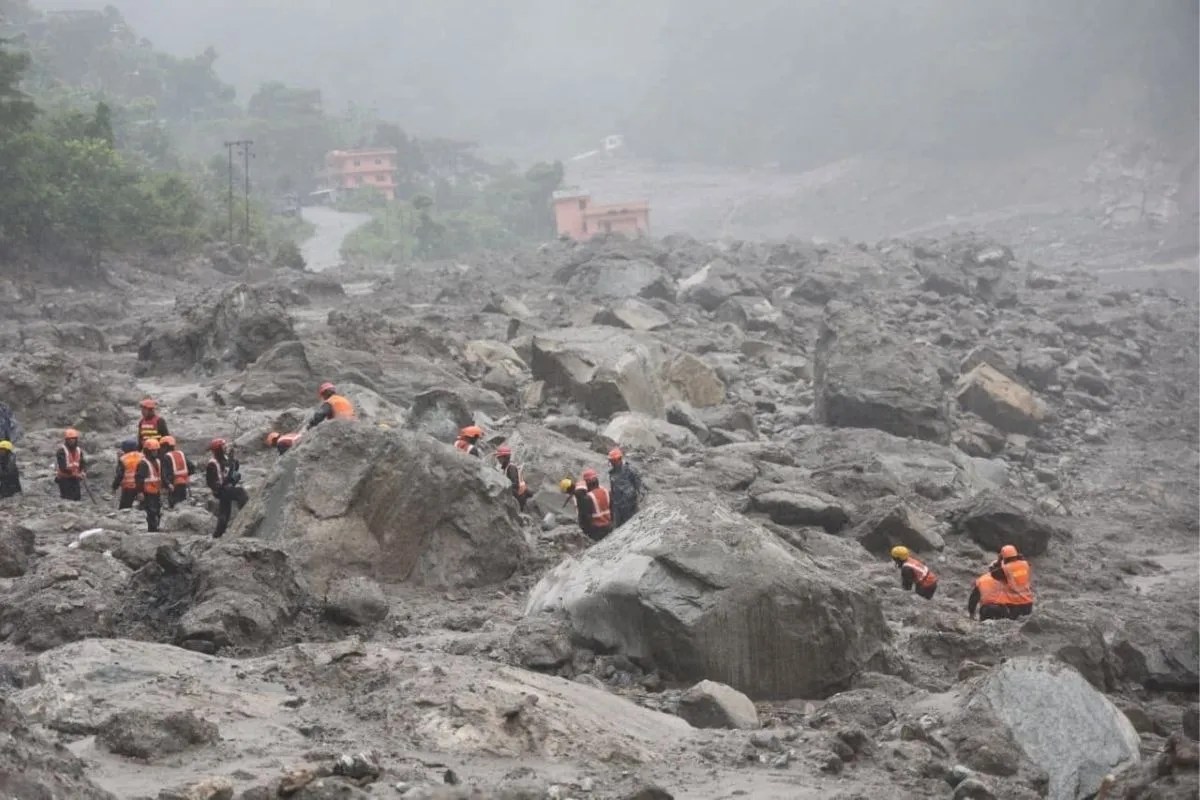
When a catastrophic wall of glacial ice, rock, and water tore down the Lhende-Bhote Koshi-Trishuli river system, it did not merely wash away roads and bridges. It converted active engineering worksites into subterranean tombs. Days after the initial flash floods hammered Nepal’s Rasuwa and Nuwakot districts, emergency crews are fighting a grueling, mechanical war against time, mud, and geological instability to reach hundreds of workers still sealed inside massive hydropower tunnels.
Official tallies place the number of missing or uncontacted individuals across multiple hydropower project sites past the five-hundred mark, with a substantial fraction believed to be trapped deep within buried adits and underground powerhouses. At sites like the Upper Trishuli-1 and Upper Trishuli-3A projects, the disaster exposed a terrifying vulnerability inherent in modern subterranean infrastructure development located within fragile Himalayan corridors. When a flash flood hits an above-ground intake or switches off the grid, underground chambers instantly transform into hazardous traps cut off by tons of dense, compacted slurry.
Military engineers and disaster response specialists face unprecedented operational hurdles. At the Upper Trishuli-3A site, where dozens of technical personnel became trapped during a scheduled overhaul of the underground powerhouse, the tunnel mouth was completely choked under more than ten feet of heavy debris. Heavy excavators and bulldozers had to be physically dismantled, airlifted in sections by military helicopters, and reassembled on-site just to begin clearing access paths.
The Subterranean Hazard Matrix
Rescuing people from a flooded or mud-choked tunnel is vastly different from standard structural collapse urban search and rescue. The physical mechanics present a distinct set of compounding dangers that push emergency responders to their absolute limits.
- Slurry Density and Suction: Unlike dry rubble, fine glacial silt mixed with water creates a heavy, viscous muck that behaves like quicksand. Once it hardens or packs tightly against tunnel walls, it exerts immense hydrostatic pressure.
- Oxygen Depletion: Underground worksites rely heavily on forced ventilation systems. The moment a flash flood trips regional power grids and inundates intake portals, internal air supplies begin to degrade rapidly.
- Secondary Collapse Risks: The seismic and hydraulic shock that sealed the portals often leaves the internal rock bolts, shotcrete linings, and crown headers structurally compromised. Heavy machinery vibrations can trigger secondary cave-ins.
- Communication Blackouts: Traditional radio frequencies do not penetrate hundreds of meters of reinforced concrete, mountain rock, and dense mud, leaving rescue teams operating blindly without knowing the exact status of trapped personnel.
Specialized international assistance has arrived to bolster local efforts, including technical teams and tunnel experts from India and China coordinating directly with the Nepali Army. These teams deployed advanced reconnaissance equipment and ground-penetrating diagnostics to map internal voids where survivors might be huddled. However, the sheer volume of displaced debris across more than a dozen separate project sites means that heavy earth-moving equipment must clear meters of packed muck foot by foot.
The Blind Spots of Himalayan Infrastructure
The disaster has also dragged a systemic industry blind spot into the harsh light of day. Independent energy monitors note that official rosters often fail to capture the true number of individuals present at active construction zones. Subcontractors frequently employ informal day laborers, local service providers, and temporary migrant workers whose names do not appear on strict corporate manifests.
This discrepancy means that even if a company accounts for its permanent engineering staff, dozens of additional workers might remain unaccounted for within the deep recesses of diversion tunnels and drainage galleries. Families outside hospital gates in Kathmandu hold up laminated photographs, shifting between despair and desperate hope as rescue updates trickle in from the valleys north of the capital.
Civil engineers point out that standard disaster mitigation frameworks for hydropower development have historically prioritized flood walls and spillway capacities designed for standard monsoon fluctuations, rather than sudden glacial lake outburst floods capable of displacing millions of cubic meters of material in minutes. As climate shifts accelerate high-altitude glacial melting across the border, the engineering assumptions of the past twenty years are proving tragically inadequate.
Right now, attention remains entirely fixed on the jagged openings carved into the hillsides of Nuwakot and Rasuwa. Rescuers continue to pump oxygen through narrow drill holes while heavy breakers shatter the hardened concrete and rock blocking the portals. Every hour that ticks away narrows the window for survival, turning a structural engineering challenge into a relentless, desperate race against the mountain itself.