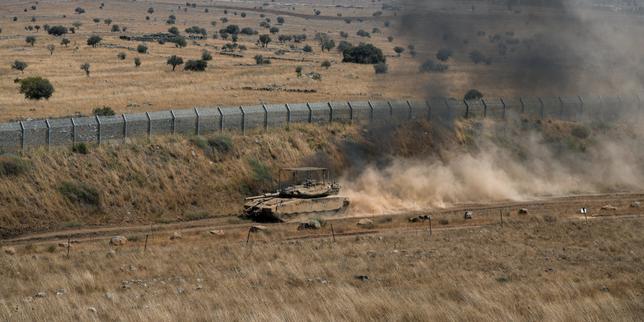
The Syrian Arab Republic officially condemned Israeli Prime Minister Benjamin Netanyahu’s unauthorized entry into southern Syrian territory, characterizing his tour of Mount Hermon as a blatant violation of national sovereignty and international law. Damascus issued sharp warnings following the visit, pointing directly to the collapse of the 1974 disengagement agreements that long governed the separation of forces. This escalation brings a fragile, heavily monitored boundary line into an entirely unchartered and dangerous phase.
Decades of regional posturing rested on a predictable architectural design. That architecture has now fractured entirely.
When regional news feeds flash standardized diplomatic protests, readers often skim past the bureaucratic phrasing. Words like "provocative" and "flagrant violation" roll off the tongue of state media outlets with automated regularity. Behind these standard-issue condemnations, however, lies a structural transformation in how military power projects across fractured state lines. Netanyahu’s appearance alongside Defense Minister Israel Katz on the heights of Mount Hermon was not merely a symbolic photo opportunity for domestic consumption. It signaled a permanent rewrite of physical control zones that international bodies spent half a century trying to freeze in amber.
The Architecture of the 1974 Disengagement
To understand why this specific ground excursion triggered such immediate alarm in Damascus, one must look backward to the aftermath of the 1973 war. The resulting United Nations Disengagement Observer Force mandate established a demilitarized buffer zone designed to keep regular armed forces at arm's length. For decades, this separation of forces held firm despite regional turbulence, civil wars, and shifting proxy alliances.
The mechanism relied on mutual deterrence and strict geographical limitations. Both capitals accepted constraints because crossing those invisible lines meant inviting immediate escalation.
Those constraints have evaporated. Over recent months, Israeli forces pushed deep beyond historical monitoring positions, taking advantage of internal Syrian weakness and the disintegration of central authority in Damascus. Netanyahu's open declaration of absolute control stretching from Mount Hermon toward the Yarmouk River represents the public codification of facts created by boots on the ground. It shifts military necessity into permanent territorial annexation logic.
Strategic Calculations Behind the Frontier Tour
Domestic political survival in Jerusalem routinely intersects with security posturing. Yet reducing thiscursion to a mere domestic distraction misses the deeper operational reality. The military establishment views the vacuum in southern Syria as an existential vulnerability. Where central governments lose the monopoly on force, external actors fill the space.
Israel’s calculation relies on forward defense doctrines. Officials argue that waiting for hostile infrastructure to consolidate near the border is no longer viable.
By planting leadership figures directly onto occupied Syrian ridges, the government sends an unambiguous message to international capitals as much as to local adversaries. The message is simple. Temporary buffer zones have transformed into permanent security perimeters. Defense Minister Katz made this explicit when he stated that forces would not vacate their newly established positions on the mountain.
The International Vacuum and Diplomatic Impotence
Damascus called on the United Nations and influential global actors to intervene and enforce compliance with historical treaties. That call will likely echo into empty chambers. Major international players are bogged down by overlapping global crises, leaving local power dynamics entirely unmediated.
When multilateral enforcement mechanisms break down, realpolitik fills the void. International law relies on consensus and the willingness of powerful states to uphold normative boundaries. When a regional power decides that security trumps sovereignty, and global monitors lack the leverage to contest that choice, treaties become historical artifacts rather than operational rules.
The response from international bodies has degraded into routine expressions of regret. Without enforcement teeth, diplomatic notes of protest function as background noise to advancing armored columns and entrenched positions.
What Comes After the Buffer Zone
The erosion of the 1974 framework leaves a vacuum where friction points multiply daily. Southern Syria is no longer a frozen zone separated by blue helmets and observation posts. It has morphed into an active frontier where friction can easily spark wider conflagrations.
As local populations absorb the reality of permanent occupation lines, resistance dynamics will inevitably adapt. Guerrilla frameworks replace conventional state threats. The irony of forward security postures is that pushing deeper into hostile territory often generates the very asymmetric threats it aims to preempt.
The ridge lines of Mount Hermon overlook a landscape that will not return to its pre-war status quo. Old lines on old maps belong to a political reality that no longer exists. Netanyahu’s boots on the ground formalized what military analysts have tracked for months. The buffer zone is dead, and the region now stands exposed to the unpredictable consequences of a border written entirely by force.


