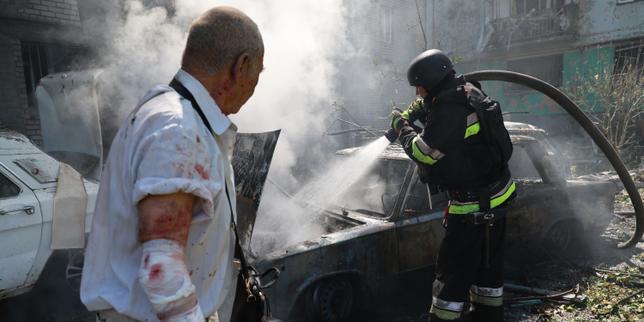
The overnight air raid sirens in Zaporizhzhia did not signal a random escalation. When Russian ballistic missiles tore through industrial zones and residential garages in the southeastern Ukrainian city, killing at least five people and injuring dozens more, it marked another calculated iteration of Moscow's evolving aerial strategy.
This was not a mistake. It was a mathematical execution of pressure.
For months, reporting on the conflict has reduced nightly bombardment to a monotonous tally of casualties and damaged infrastructure. That surface-level framing obscures the actual mechanics of the campaign. The Kremlin has systematically shifted its operational focus toward saturating urban centers with high-speed ballistic delivery systems, exploiting severe gaps in regional interception capabilities.
Understanding why cities like Zaporizhzhia bear the brunt of these nocturnal strikes requires looking past the daily casualty reports. It demands an examination of depleted interceptor stockpiles, shifting geopolitical supply chains, and the harsh realities of attritional warfare.
The Ballistic Shift and Air Defense Realities
To grasp the severity of the recent bombardment, one must analyze the weapon choice. Traditional cruise missiles and loitering munitions can often be tracked and neutralized by mobile fire groups equipped with heavy machine guns or older electronic countermeasures. Ballistic missiles operate in an entirely different operational envelope.
Traveling at hypersonic speeds during their terminal descent, these weapons leave mere seconds between radar detection and impact. Only high-tier, sophisticated anti-air platforms—such as the American-made Patriot systems—possess the trajectory calculation capabilities required to intercept them.
Yet, those specific interceptor missiles are finite. Competing global theater demands, combined with prolonged production bottlenecks, have left Ukraine's metropolitan shields dangerously thin. When Moscow unleashes a salvo against southeastern industrial hubs, they are probing for these exact coverage vacuums. Every launch forces a brutal operational calculus for local commanders: expend a scarce high-tier interceptor on a secondary industrial target, or conserve ammunition to protect critical command nodes elsewhere.
The math favors the aggressor. Production lines in partner nations struggle to outpace the sheer volume of ordinance being expended on a nightly basis.
Beyond the Frontline Narrative
Zaporizhzhia occupies a precarious geographic and psychological space in this conflict. Situated less than an hour's drive from active southern engagement zones, it functions as both a vital logistical backbone for Ukrainian forces and a densely populated civilian home.
By targeting industrial facilities, transport networks, and adjacent residential quarters simultaneously, the strategy seeks a dual-layered effect. First, it disrupts localized supply chains necessary for front-line maintenance. Second, it erodes the psychological endurance of the civilian workforce underpinning the regional economy.
Local military administration reports confirm that the recent barrage heavily impacted garage cooperatives and multi-story residential blocks adjacent to municipal infrastructure. These are civilian spaces stitched tightly into the industrial fabric of a city built for heavy manufacturing and energy production. When a ballistic missile strikes a mixed-use district, the blast radius does not distinguish between a military depot and a neighborhood block.
The human cost mounts quietly in the immediate aftermath. Rescue teams sift through concrete dust while sirens echo in the distance, knowing the trajectory could easily repeat the following night.
The External Logistics of Prolonged Attrition
The endurance of this aerial campaign relies on external supply lines that have adapted to international sanctions. Intelligence assessments from Kyiv indicate that Moscow's acquisition channels extend deep into foreign partnerships, securing fresh ballistic hardware and supplemental manpower to sustain high operational tempos.
This external pipeline changes the timeline of the conflict. Analysts who predicted a rapid exhaustion of precision-guided munitions early in the timeline miscalculated the adaptability of sanctioned defense networks. By integrating foreign-supplied tactical ballistic missiles into standard operational rosters, command centers in Russia have maintained a steady cadence of deep-strike capabilities.
Simultaneously, the theater is no longer isolated to Eastern Europe. Competing global crises draw critical air defense components toward other flashpoints, creating ripple effects that directly impact the density of protection over cities like Zaporizhzhia and Kyiv. The global architecture of missile defense is strained to its breaking point, and every regional flare-up elsewhere on the globe registers immediately in the flight paths of missiles descending over Ukrainian neighborhoods.
The smoke clears slowly over the wreckage in Zaporizhzhia. The emergency responders clear the streets, the casualty lists are updated on official channels, and the airwaves fall quiet until the next warning tone pierces the dark.