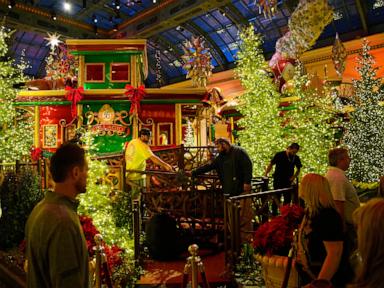
Every November, the Bellagio Conservatory and Botanical Gardens in Las Vegas transforms overnight into a winter spectacle featuring tens of thousands of live blooms, towering holiday trees, and intricate automated displays. While tourists see a seamless winter wonderland, the Bellagio holiday flower show is actually a multi-million-dollar loss leader engineered to drive foot traffic onto the casino floor, executed by a dedicated horticulture team operating under grueling overnight deadlines and strict Mojave Desert environmental constraints.
Most coverage of the annual holiday display reads like a press release. Local news outlets dutifully list the number of poinsettias, mention the height of the Christmas tree, and move on. That surface-level reporting misses the actual story. Beneath the frozen ponds and animatronic polar bears lies one of the most aggressive, high-stakes operational sprints in the hospitality industry.
The Economics of a Free Spectacle
Las Vegas does not give anything away without a mathematical expectation of return. The Bellagio Conservatory charges zero admission. It remains open twenty-four hours a day, seven days a week, drawing an estimated 15,000 to 20,000 visitors daily during peak holiday weeks.
To understand why MGM Resorts International sinks millions of dollars annually into maintaining a 14,000-square-foot indoor garden with zero direct ticket revenue, you have to look at the floor plan. You cannot reach the Conservatory without walking past the high-limit slot machines, the main casino pit, or the luxury retail promenade. The floral display is a customer acquisition funnel disguised as public art.
In casino economics, foot traffic is the primary raw material. Once a guest steps onto the property to take a photo in front of a massive floral snow globe, the property captures their dwell time. Even if only a fraction of those visitors sit down at a blackjack table, book a last-minute dinner at Prime Steakhouse, or buy a handbag at Chanel, the Conservatory pays for itself several times over.
The holiday show is the crown jewel of the five annual rotations—Lunar New Year, Spring, Summer, Harvest, and Holiday. Because Thanksgiving through New Year's Day represents a critical revenue window for the Las Vegas Strip, the budget and scale for the winter installation routinely dwarf the other four seasons.
The Six-Day Dark Period
The transition from the autumn harvest display to the winter holiday showcase is where the operational reality gets brutal. The Conservatory closes to the public for roughly six days—known internally as the "dark period"—to tear down the old exhibit and build the new one from the dirt up.
This is not a standard construction site. The Conservatory sits beneath a fifty-foot-tall glass atrium held up by a delicate copper-and-iron frame. Heavy machinery has to be brought in through specific load-bearing pathways without damaging the Italian marble floors surrounding the garden beds.
During these six days, a crew of roughly eighty to one hundred people—horticulturists, structural engineers, electricians, riggers, and theatrical set designers—work in overlapping twenty-four-hour shifts.
The process follows a rigid, unforgiving sequence:
- Deconstruction and Salvage: Every live plant from the fall display is uprooted. Salvageable perennials and shrubs are moved back to the on-site greenhouses or donated to local community organizations. Damaged blooms are hauled off to composting facilities.
- Infrastructure and Rigging: Before a single flower is planted, cranes and scissor lifts move in to anchor the heavy props. A centerpiece holiday tree—often a freshly cut Shasta fir standing over forty feet tall—must be hoisted upright, bolted to structural steel plates hidden beneath the soil line, and wired for thousands of LED lights.
- Hydration and Plumbing: Because the beds change shape every season, the irrigation grid has to be re-routed every single time. Drip lines are laid manually to ensure that thirstier plants receive adequate moisture without drowning neighboring species.
- Planting from the Inside Out: Horticulturists plant the tallest trees and shrubs first, working their way down to the ground-cover poinsettias and cyclamen. If a crew member steps in the wrong spot late in the process, they crush hours of work.
If the rigging team falls six hours behind schedule on Tuesday, the horticulture team loses six hours of planting time on Thursday. The opening date is etched in stone months in advance, tied to national press junkets and holiday travel packages. Delaying the opening is not an option.
Botany Against the Mojave Desert
Keeping tens of thousands of temperate-climate plants alive inside a bustling casino in the middle of the Mojave Desert requires constant environmental warfare. Las Vegas outside the glass dome regularly sees humidity levels drop below fifteen percent, while indoor casino air is heavily conditioned and dry.
Poinsettias, hydrangeas, and winter evergreens hate dry air. Left to standard casino climate control, the vibrant red and white bracts of the holiday poinsettias would curl, brown, and drop within forty-eight hours.
To prevent mass botanical die-off, the Conservatory operates on a completely isolated micro-climate system. Hidden vents pump humidified, temperature-controlled air directly into the plant beds, keeping the ambient moisture significantly higher inside the garden than it is ten feet away at the roulette tables.
Lighting presents another major hurdle. While the fifty-foot glass ceiling lets in abundant natural sunlight during the day, the surrounding hotel towers cast long shadows across the atrium depending on the angle of the winter sun. To compensate, theatrical lighting rigs double as grow lights, delivering specific spectrums that keep the chlorophyll active without overheating the delicate petals.
Even with these controls, plants die. Thousands of them.
The number of blooms touted in press materials—often cited around 30,000 to 50,000 plants for the holiday season—does not represent a static inventory. It represents a rolling total. Throughout the six-week run of the holiday show, the horticulture team works the graveyard shift, typically between 2:00 AM and 6:00 AM when foot traffic is at its lowest, swapping out fading plants for fresh replacements stored in Bellagio’s on-property greenhouses.
A visitor walking through on December 28 sees blooms that look just as crisp as they did on opening day in mid-November. That illusion requires replacing roughly ten to fifteen percent of the floral inventory every single week.
The Sustainability Paradox
For all its visual beauty, a rotating indoor botanical garden of this magnitude carries a massive environmental footprint. Critics of Las Vegas excess often point to the Conservatory as a prime example of resource-heavy spectacle.
Shipping tens of thousands of live plants from nurseries in California, Oregon, and Canada across the desert in climate-controlled semi-trucks burns significant fuel. Cutting down a forty-foot-tall living fir tree every year just to display it indoors for six weeks before chipping it into mulch strikes many observers as wasteful, regardless of how many tourists take selfies in front of it.
MGM Resorts and the Bellagio horticulture leadership have spent the last decade trying to soften that impact, though the inherent tension remains. The property utilizes a closed-loop water recycling system for the Conservatory's fountains and ponds, ensuring that the water flowing through the holiday displays is treated and reused rather than dumped into the municipal sewer system.
Furthermore, nearly all organic waste generated during the teardown—from dead poinsettias to the massive holiday tree itself—is processed into nutrient-rich compost used across MGM's regional landscaping properties. Bulb plants, like amaryllis and narcissus, are frequently harvested after their bloom cycle, chilled to induce dormancy, and forced to bloom again in future years.
Yet no amount of composting fully erases the carbon cost of sourcing, transporting, and climate-controlling a temporary winter forest in the middle of a desert. The Conservatory exists in a gray area where extraordinary horticultural craftsmanship meets the unapologetic resource consumption that defines the Las Vegas Strip.
The Engineering of Nostalgia
What separates the Bellagio holiday display from a standard mall Santa setup is the level of theatrical engineering embedded in the foliage. Under the direction of longtime designers like Ed Libby and the internal Bellagio horticulture team, the exhibits are built like Broadway stage sets.
Consider the weight distribution required for the props. A life-sized, floral-covered carriage or a family of towering polar bears cannot simply sit on top of wet soil. The weight would cause the structure to sink, tilt, or collapse onto the irrigation lines. Every major sculptural piece is anchored to concrete pads or steel sub-frames hidden beneath the mulch.
To achieve the signature "living sculpture" look, artisans build hollow fiberglass or welded-steel frames, wrap them in sphagnum moss, and pack soil into the cavities. Horticulturists then individually plug thousands of tiny, rooted cuttings—often sedum, preserved moss, or miniature ivy—into the frame.
Look closely at the iconic Bellagio polar bears or giant ornaments. Those textures are rarely paint or fabric. They are tens of thousands of individual dried seeds, crushed walnut shells, carnation petals, and evergreen needles glued by hand onto the fiberglass base by scenic artists working months before the installation ever reaches the casino floor.
The animatronics and water features require equal precision. Electronics and moisture are natural enemies, yet the holiday show routinely integrates moving trains, rotating carousels, and dancing water jets directly inside wet plant beds. Low-voltage wiring must be sealed in waterproof conduits, and ground-fault circuit interrupters are checked daily to ensure a leaking drip line does not short out a $50,000 custom animatronic display.
Why Competitors Rarely Replicate It
If the Bellagio Conservatory is such an effective engine for driving casino foot traffic, why hasn't every major resort on the Las Vegas Strip built one?
The answer comes down to square footage, structural load, and long-term operational discipline.
In modern casino design, every square foot of prime lobby space is fiercely contested by real estate developers. A casino executive looking at a 14,000-square-foot footprint sees space for three hundred slot machines, a high-margin celebrity chef restaurant, or a luxury watch boutique paying astronomical rent per square foot.
When Steve Wynn originally built the Bellagio in 1998, he insisted on dedicating that prime central real estate to a conservatory, modeling it after classic European glasshouses. Retrofitting an existing Strip resort to support a fifty-foot glass atrium, massive subterranean plumbing grids, and heavy-duty load-bearing floors is financially prohibitive.
More importantly, the operational overhead requires a permanent, full-time staff of specialized horticulturists, designers, and engineers. Most hotel operators prefer to outsource their holiday decor to commercial staging companies that install plastic garlands and artificial trees in late November and pack them into a warehouse in January.
The Bellagio refuses to use artificial plants in its beds. That commitment to living botany is precisely what creates the sensory impact that plastic decor cannot match. When you walk past the Conservatory doors, the smell of wet earth, pine needles, and blooming paperwhites hits you instantly, cutting through the sterile, recycled air of the casino floor.
Navigating the Crowds Without Losing Your Mind
For travelers actually planning to see the Bellagio holiday flower show, treating it like a casual afternoon stroll is a mistake. Because it is one of the few remaining free attractions on the Las Vegas Strip, the walkways surrounding the garden beds turn into gridlock between noon and 10:00 PM.
Security guards frequently have to institute one-way traffic patterns during peak weekend hours, forcing visitors into a slow-moving shuffle where stopping for more than ten seconds to frame a photo draws sharp whistles from crowd-control staff.
If you want to actually examine the botanical details and the structural craftsmanship without fighting through strollers and selfie sticks, your window is narrow. Arrive between 4:00 AM and 7:00 AM.
During those early morning hours, the daytime crowds are asleep, the nightclub patrons have finally cleared out, and the overnight horticulture crew is finishing their daily maintenance. You get unobstructed sightlines to the centerpiece tree, quiet enough to hear the indoor water features, and a front-row seat to the quiet army of gardeners keeping the illusion alive.