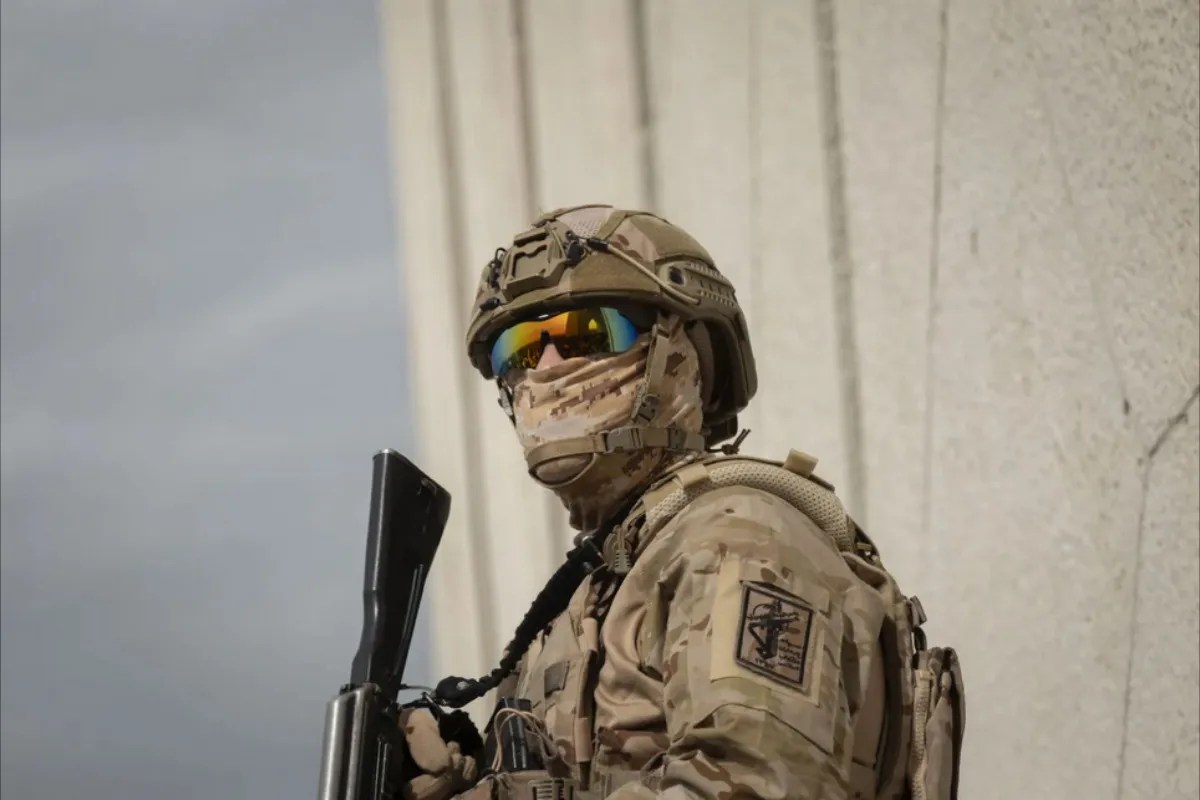
The death of two Islamic Revolutionary Guard Corps (IRGC) soldiers in Iran's southeastern borderlands follows a pattern that state media routinely minimizes. While official reports frame these persistent clashes as isolated ambushes by common criminals or foreign-backed mercenaries, the reality points to a systemic breakdown of security along the porous frontier with Pakistan and Afghanistan. The latest firefight left two guards dead and two wounded, serving as a reminder that Tehran is fighting a low-intensity war on its own soil. This conflict threatens domestic stability far more than the regime admits.
State-controlled media outlets operate on a strict script when reporting on the restive Sistan and Baluchestan province. They announce the casualties, praise the martyrs, and declare that the situation is under control. It is a calculated narrative designed to project strength. But if you talk to regional intelligence veterans or look at the hard data of border incursions over the last decade, a different picture appears. Tehran is bleeding from its periphery, and the bleeding is accelerating.
The Neglected Frontier
The rugged mountains and vast deserts of southeastern Iran are home to the Baluch minority. For decades, this region has been an afterthought for central planners in Tehran. Economic deprivation is rampant. Unemployment numbers are staggering, and basic infrastructure is practically nonexistent in many villages outside the provincial capital of Zahedan.
This neglect has created an ideal breeding ground for militancy. Groups like Jaish al-Adl, an extremist Sunni militant organization, exploit local grievances to recruit young fighters. They frame their violent campaign not just as a religious struggle, but as an insurgency against an oppressive, centralized state.
When an IRGC patrol is ambushed, the immediate response from Tehran is a kinetic military cleanup. Helicopters are deployed, artillery pieces are brought in, and villages are locked down. This heavy-handed approach yields temporary results but fails to address the root causes. It is a cycle of violence that repeats because the underlying socio-economic drivers are completely ignored by the political elite.
Black Market Economics Fueling the Fight
Militancy does not survive on ideology alone. It requires money, weapons, and logistics. In Sistan and Baluchestan, the line between insurgency and organized crime is completely blurred.
Smuggling is the primary economic engine of the border region. Fuel, drugs, and human trafficking generate millions of dollars annually. Iran’s heavily subsidized fuel is smuggled out across the border into Pakistan, where it is sold at a massive markup. Conversely, cheap opium and narcotics pour in from Afghanistan, transiting through Iranian territory on their way to lucrative markets in Europe and the Gulf states.
| Commodity | Traffic Flow Direction | Primary Economic Impact |
|---|---|---|
| Subsidized Fuel | Outbound to Pakistan | Local revenue source, drains Iranian state coffers |
| Opiates and Narcotics | Inbound from Afghanistan | Funds militant networks, fuels high local addiction rates |
| Small Arms | Inbound from regional conflict zones | Weaponizes local factions, escalates casualty rates |
Militant groups operate as protection rackets for these smuggling rings. They tax the caravans, guard the mountain passes, and use the proceeds to purchase advanced weaponry on the regional black market. The IRGC find themselves outmaneuvered by highly mobile, heavily armed networks that know the terrain intimately. Every time a border post is fortified, the smugglers and militants simply find or blast a new path through the wilderness.
The Regional Proxy Game
Tehran rarely admits that its internal security failures are homegrown. Instead, the blame is cast outward toward regional rivals and Western intelligence agencies. While it is true that foreign powers keep a close eye on Iran's internal fractures, blaming outside actors ignores local realities.
The relationship between Islamabad and Tehran is central to this issue. The border is a line drawn on a map that cuts through tribal lands. Families live on both sides, and militants routinely use the Pakistani side of the border as a safe haven. When the pressure from the Iranian military gets too high, insurgents simply slip across the frontier into Baluchistan province in Pakistan, where central government control is equally weak.
Diplomatic finger-pointing has accomplished very little. Joint border commissions are formed, memoranda of understanding are signed with great fanfare, and yet the ambushes continue. Neither country possesses the political will or the resources to permanently secure thousands of kilometers of empty, inhospitable terrain.
The Cost inside the Barracks
The human toll on the Iranian security apparatus is mounting. The soldiers dying on the border are often conscripts, young men from distant provinces serving out their mandatory military service. They are poorly trained for counter-insurgency warfare and lack the specialized equipment needed to survive a coordinated ambush.
For the IRGC leadership, these losses are a threat to institutional prestige. The Guard prides itself on being the ultimate defender of the Islamic Republic, capable of projecting power across the Middle East. Yet, it struggle to protect its own officers within its borders.
This creates internal friction. Senior commanders are forced to divert resources away from foreign operations to secure domestic sectors. The financial strain is real. With Iran's economy buckled under the weight of international sanctions and mismanagement, funding a prolonged border war is a luxury the state cannot afford.
The Failure of Current Containment Strategies
The current strategy relies almost entirely on physical barriers and surveillance. Tehran has spent millions erecting concrete walls, digging deep trenches, and setting up thermal imaging cameras along key sectors of the frontier.
These measures only shift the problem. Insurgents adapt quickly to stationary defenses. They use drones for reconnaissance, deploy sophisticated improvised explosive devices, and choose the exact time and place of their attacks to maximize casualties. Physical walls cannot fix a political problem. Until the central government views the southeastern borderlands as a region requiring development and political integration rather than just military occupation, the body bags will continue to arrive in Tehran.


