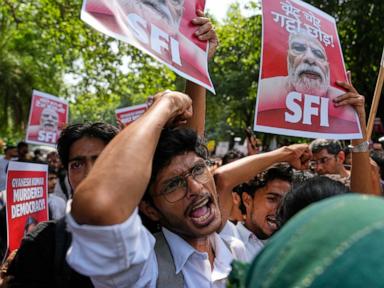
India's democratic foundations are facing an unprecedented challenge as youth-led movements and opposition coalitions lock horns with state authorities over massive voter list revisions. At the center of the storm is the Special Intensive Revision (SIR) of electoral rolls, which has resulted in more than 130 million names being struck off the voter registry. Spearheaded by groups like the Cockroach Janta Party, protesters are demanding the immediate resignation of Chief Election Commissioner Gyanesh Kumar, arguing that the sweeping purges amount to calculated political disenfranchisement.
The official justification from election authorities points to routine administrative housekeeping. Clearing out deceased voters, duplicate entries, and individuals who have relocated is standard procedure for any massive democracy. Yet, the scale and velocity of the current exercise have triggered widespread panic. In New Delhi alone, close to a third of the electorate has vanished from the active rolls. Critics and civil rights watchdogs point out that these deletions disproportionately impact vulnerable economic communities and minority populations, transforming routine verification into a systemic crisis of access.
The Anatomy of a Bureaucratic Purge
Understanding how millions of citizens lose their political voice requires looking past political rhetoric and examining bureaucratic mechanics. The revision process relies heavily on documentary proof that many ordinary citizens simply do not possess. Consider a hypothetical example of a urban
The Battle Over India Electoral Rolls and the Cockroach Protesters Breaking Electoral Stagnation
news, politics
Democracy in South Asia rarely dies in darkness. More often, it perishes under the blinding glare of television studio lights, drowned out by partisan crossfire and administrative obfuscation. When activists in New Delhi staged a stark performance-protest by dressing as cockroaches and crawling toward the Election Commission headquarters, they were not simply seeking a viral headline. They were signaling a profound structural breakdown in how India manages its electoral rolls, targeting Chief Election Commissioner Rajiv Kumar and the systematic revision processes that critics argue threaten voter disenfranchisement on an industrial scale.
The immediate trigger for the unrest centers on allegations of arbitrary voter deletions, opaque constituency restructuring, and the accelerated revision of electoral databases ahead of critical regional contests. Opposition parties and civil society groups claim that millions of eligible citizens find themselves mysteriously expunged from voter registries, disproportionately affecting working-class, migrant, and minority populations.
To understand why a protest involving insect costumes resonates so deeply, one must examine the mechanics of India's electoral machinery. The Election Commission of India exercises sweeping administrative authority. It commands constitutional independence designed to insulate it from executive pressure. Yet, in recent years, that independence has faced relentless scrutiny. The friction points are not merely political opinions; they are technical procedures. When booth-level officers conduct door-to-door verifications, errors compound rapidly. A missed visit due to urban migration, a clerical data-entry slip, or a flawed de-duplication software algorithm can strip a citizen of their constitutional franchise without a formal hearing or timely appeal.
Veteran political analysts note a dangerous shift in public trust. Electoral integrity relies entirely on the perception of absolute neutrality. When the referee is perceived as bending to administrative convenience or political expediency, the legitimacy of the entire democratic edifice fractures. The protesters adopting the moniker of cockroaches are reclaiming a dehumanizing insult hurled by bureaucrats against the marginalized—those viewed as pests cluttering administrative logs—and turning it into an emblem of systemic endurance. They are the bugs in the system that refuse to be scrubbed away.
The administrative defense from election officials usually points to statutory obligations. Regular purges of duplicate, deceased, or permanently relocated voters are necessary to maintain clean rolls. No system is infallible. Millions of records require constant updating across a nation hosting nearly a billion eligible voters. Defenders of the commission argue that malicious actors routinely weaponize administrative complaints to cast doubt on legitimate electoral outcomes.
However, the scale of complaints during recent revisions points past simple administrative error. Civil rights organizations have documented patterns where entire apartment complexes, urban slums, or specific demographic clusters vanish from digital rolls between election cycles. When notices fail to reach individuals before their names are struck off, due process is effectively short-circuited.
This brings us to the core vulnerability of modern electoral administration. As states digitize voter rolls, they introduce black-box technologies that obscure accountability. Algorithms designed to flag anomalies lack transparency. When a software script flags millions of entries for verification, the burden of proof shifts unfairly onto the citizen, who must prove their residency all over again under punitive deadlines. For daily-wage laborers, informal sector workers, and the urban poor, navigating bureaucratic tribunals means sacrificing daily bread for a chance to cast a ballot.
The Chief Election Commissioner remains the focal point of this storm. Critics argue that leadership within the commission has grown defensive rather than transparent, choosing to dismiss valid civil society audits as politically motivated sabotage rather than engaging in genuine reform. This defensiveness creates a feedback loop of suspicion. Every delayed press conference, every vague response to data discrepancy reports, and every refusal to open voter database logs to independent academic audit deepens the crisis of confidence.
Democracy requires more than the ritual of holding elections; it requires faith in the baseline equality of every vote. When citizens feel compelled to dress as insects to draw the attention of regulators, the institutional feedback loop is broken. The protest at the gates of the Election Commission was messy, theatrical, and deeply symbolic. But beneath the street theater lies a hard, unyielding question about who owns the democratic process—the bureaucrats managing the spreadsheets, or the citizens whose names give those spreadsheets meaning.
The battle over the voter lists will define the next phase of Indian political evolution. If the machinery of oversight remains opaque, the legitimacy of every future mandate will carry an asterisk. Fixing this requires an overhaul of the verification protocols, an absolute commitment to public data transparency, and an administrative culture that views public skepticism not as an attack on the state, but as a vital check on state power. Until those changes take root, the institutional friction will only intensify, echoing through the streets in ways the establishment can no longer ignore or sweep away.