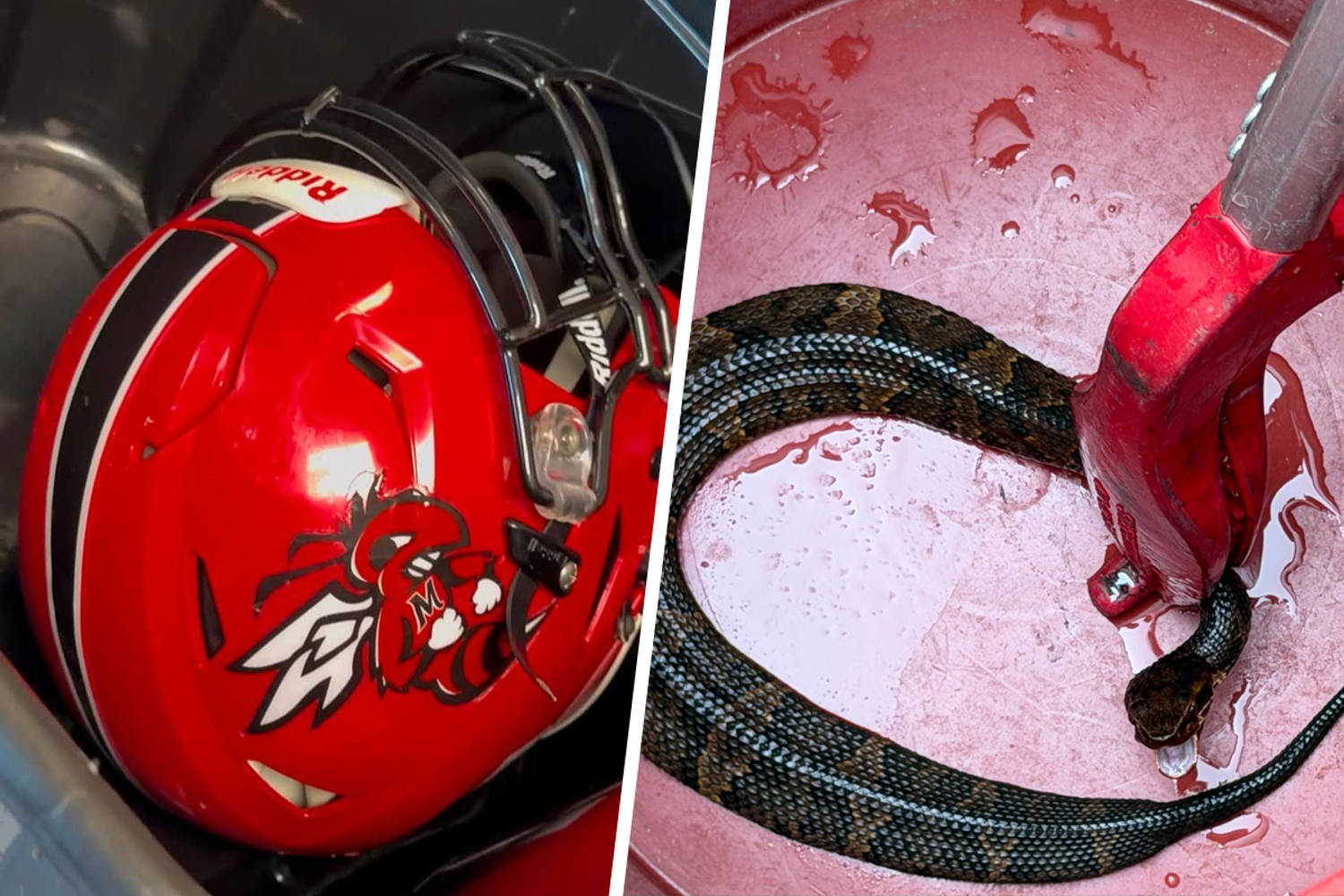
When an Arkansas high school football player practiced for an entire hour with a deadly copperhead snake coiled inside his helmet, national headlines erupted in shock. People gasped at the sheer improbability. They shared the story on social media, marveling at the stroke of fortune that kept the venomous reptile from sinking its fangs into the teenager's skull. Then, society moved on.
That collective shrug represents a profound institutional failure. Meanwhile, you can find related developments here: Why Tony Romo Leaving the Booth is the Best Thing to Happen to NFL Broadcasts.
Every single autumn, millions of adolescents across America pull on protective gear that has sat festering in damp equipment rooms, humid trailers, and concrete field houses for months. We treat athletic gear as inanimate metal and plastic. In reality, these items serve as open invitations for local fauna, fungal colonies, and bacterial hazards. The Arkansas incident was not a freak occurrence. It was an inevitable collision between nature, negligence, and systemic oversight in youth athletics.
The Infrastructure Crisis Beneath the Pads
To understand how a venomous serpent ends up nested against a student's scalp, you have to examine where that gear lives. High school athletic departments operate under perpetual financial strain. Boosters raise funds for new jerseys and scoreboard upgrades. Rarely do they finance proper climate-controlled storage facilities for shoulder pads, helmets, and cleats. To see the bigger picture, check out the detailed analysis by ESPN.
Instead, gear rots in the dark.
Storage sheds leak moisture. Lockers feature stagnant air. Equipment rooms double as dumping grounds for discarded tape, old turf mats, and organic debris. These environments mimic natural habitats. They offer warmth, darkness, and safety from predators. Small mammals, insects, and reptiles do not seek out football gear maliciously. They search for shelter.
When a player reaches blindly into a dark shelf or pulls a helmet off a top rack during two-a-days, they bypass the first line of defense: equipment auditing. Coaches rush players onto the turf to beat the heat or maximize daylight. Nobody inspects the interior padding. Nobody shakes out the chin strap. The ritual of preparation has devolved into a rushed, mechanical scramble.
Why Equipment Checks Fail
Accountability in high school sports is fragmented. Head coaches answer to athletic directors. Athletic directors answer to principals and school boards. Equipment managers, when they exist at all, are often overworked teachers pulling double duty or well-meaning parent volunteers.
Safety protocols focus almost exclusively on concussions and heat illness. These priorities are correct, born from tragic precedents and hard-earned legal settlements. Yet, environmental hazards inside the locker room remain an afterthought.
Consider the standard pre-season routine.
- Gear is unboxed in August.
- Sizes are distributed based on a quick head measurement.
- Players sweat through morning sessions.
- Gear is tossed back into wet bags or crammed into lockers overnight.
Notice what is missing from that sequence. Inspection. No protocol mandates that a piece of protective equipment be sanitized, aired out, and physically examined by an adult before a player puts it on. The burden falls entirely on the teenager. And teenagers are biologically wired to ignore minor discomforts in pursuit of playing time. If a helmet feels lumpy, a high school athlete assumes it is just a worn-out pad. They buckle it down and take the hit.
The Biological Reality of the Field House
Venomous snakes like copperheads and cottonmouths are opportunistic ambush predators. They do not hunt human heads. They hunt mice, crickets, and spiders.
School athletic facilities attract these creatures because fields are frequently bordered by woodlines, retention ponds, or overgrown acreage. Maintenance budgets for school grounds have shrunk dramatically over the past decade. Tall grass creeps closer to stadium walls. Mulch beds sit flush against storage building foundations.
When temperatures soar during late summer practice schedules, ectothermic animals seek refuge from the punishing heat. Dark, enclosed spaces like a football helmet trap cool air overnight, making them luxurious micro-climates for resting wildlife.
It is a basic ecological equation. Bring the wilderness closer to human infrastructure, ignore basic property maintenance, and you create a vector for disaster. The snake in the Arkansas helmet did not break into a secure facility. It simply walked across poorly managed school grounds and crawled into an open door.
Redefining Athletic Risk Management
If we want to prevent a recurrence of the Arkansas incident, the conversation must shift from sensationalism to structural reform. We need a fundamental overhaul of how athletic departments handle gear inventory.
First, school districts must invest in sealable, pest-proof storage systems. Wire baskets and open wooden shelving belong in the past. Equipment must be stored in heavy-duty, latching bins that prevent wildlife entry when not in use.
Second, every athletic program needs a mandatory three-point inspection protocol enforced by coaching staff prior to every single practice session.
- Visual sweep of the interior shell.
- Tactile check of padding and crown liners.
- Complete inversion and shaking of the item before placement on a player's head.
This takes less than ten seconds per player. Ten seconds stands between a routine drill and an emergency room trauma bay.
Third, groundskeeping budgets must be decoupled from general academic austerity measures. Creating a defensive perimeter around athletic facilities is not a cosmetic luxury. A thirty-foot gravel or concrete barrier between the woodline and the field house completely changes the calculus for wandering wildlife. Pests will not cross open, exposed terrain if they can avoid it.
The Cost of Complacency
It is easy to laugh off the Arkansas story as a bizarre anecdote destined for a trivia night. That attitude is precisely why systemic vulnerabilities persist.
Every time a community treats an avoidable hazard as a freak accident, they grant permission for the next failure to occur. The teenager in Arkansas survived because the snake was sluggish, cold, or simply disinclined to strike until the helmet was removed. Luck is a terrible safety strategy.
Athletic directors, school boards, and state athletic associations must wake up to the physical reality of their facilities. The danger does not only live on the gridiron via high-velocity collisions. Sometimes, the most lethal threat is the one waiting quietly in the dark, nestled against a player's skull while everyone else focuses on the playbook.