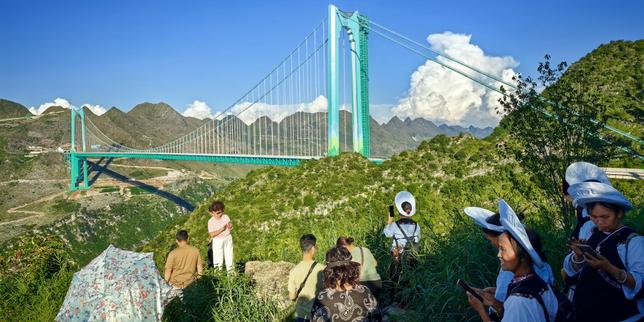
Deep in the mountainous interior of southwest China, Guizhou province achieved what once seemed like an economic miracle by building more than 20,000 bridges through sheer engineering will. Today, that miracle has curdled into a stark warning sign for the global financial system. Guizhou is suffocating under a massive debt burden, a direct consequence of an economic model that prioritizes state-led infrastructure spending over genuine fiscal returns. The province can no longer afford the interest on what it borrowed to pour all that concrete. This crisis exposes the deep structural rot within China's local government financing system, where the bill has finally come due.
For two decades, the playbook for regional growth across China was simple. Local officials borrowed money through off-balance-sheet corporate entities to fund spectacular mega-projects, driving up local gross domestic product and securing political promotions in the process. Guizhou, formerly one of the poorest and most isolated regions in the country, embraced this strategy with unmatched zeal. It built thousands of kilometers of expressways, high-speed rail links, and architectural marvels that span breathtaking gorges.
The strategy worked on paper. Guizhou consistently reported some of the highest GDP growth rates in the country throughout the 2010s. But GDP measures spending, not profitability. The actual economic utility of these projects failed to match their astronomical costs. Traffic on many of these multi-billion-dollar expressways remains sparse. Toll revenues cover only a fraction of the maintenance costs, let alone the principal on the loans used to construct them.
The financial plumbing behind this construction boom was inherently unstable from the start.
The Secret Engine of China's Debt Machine
To understand how a landlocked province accumulated an estimated hundreds of billions of dollars in liabilities, one must look at Local Government Financing Vehicles. These state-owned companies were created for a single purpose. They circumvented central government restrictions on direct municipal borrowing by taking out bank loans and issuing corporate bonds to fund public works.
The system operated on a foundational lie. Investors and state-owned banks bought these bonds, known as chengtou, assuming that local governments—and ultimately Beijing—would never allow an LGFV to default. This implicit guarantee erased any real risk assessment. Credit flowed freely to projects that had no viable path to commercial viability.
Consider a hypothetical example of a regional transport hub built in a rural county. The local LGFV borrows 5 billion yuan from a state bank to build a six-lane highway and a massive logistics park. The county has a population of fewer than 200,000 people, most of whom are subsistence farmers. The toll revenue generates barely enough to pay the electricity bill for the highway lights. When the loan matures, the LGFV does not pay it back. Instead, it issues a new bond to pay off the old bank loan.
This mechanism worked as long as two conditions were met. First, banks had to remain willing to roll over old debts. Second, local governments needed a steady stream of cash to subsidize the interest payments. For years, that cash came from selling state-owned land to private real estate developers.
That revenue engine has died. The prolonged collapse of China's property sector has wiped out the demand for land. Deprived of land sale revenues, municipalities across Guizhou found themselves unable to sustain the fiction. The province openly admitted its fiscal desperation, publicly declaring that its debt issues had reached a level where it was completely incapable of resolving them on its own. It was an unprecedented public admission of financial insolvency from a Chinese provincial authority.
The Promotion Tournament That Blinded Officials
The roots of this crisis are political, not just financial. The internal governance of the ruling party functions as a highly competitive promotion tournament. Local cadres are judged by superiors on concrete, quantifiable metrics during their short tenures in a specific locality.
Economic growth and visible modernization projects were the fastest tickets to higher office. A governor who built five record-breaking bridges and doubled regional GDP through construction spending would be promoted long before the debt matured. The long-term financial consequences became the problem of their successor.
This system created an intense institutional blindness to risk. It encouraged competitive over-building. If a neighboring province built a high-tech industrial zone, Guizhou built three, even if it lacked the engineers, the electrical grid, or the corporate tenants to occupy them.
The result is a landscape littered with white elephants. Giant stadium complexes sit empty in cities that cannot afford to maintain them. Posh tourist resorts built in remote valleys remain devoid of visitors, their concrete facades already stained by weather and neglect. The capital spent on these projects did not create sustainable economic engines. It was simply consumed.
The Limits of the Beijing Bailout
The central government now faces a dangerous dilemma. If Beijing steps in with a full, unmitigated bailout of Guizhou and other highly indebted provinces, it creates a catastrophic moral hazard. Local officials will learn that they can spend recklessly without ever facing the consequences, ensuring that the cycle repeats on an even grander scale.
Conversely, if Beijing allows these local government entities to default openly on their public bonds, the contagion could destabilize the entire domestic banking system.
Estimated LGFV Debt vs Official Provincial Debt (Illustrative Proportions)
[====================================] Total Actual Liabilities (Implicit)
[==========] Official Budgeted Debt
State banks are heavily exposed to this debt. A series of disorderly defaults would trigger a systemic credit crunch, driving up borrowing costs for healthy parts of the economy and throttling national growth.
Beijing’s current strategy is a slow, painful compromise. It is forcing state banks to extend loan maturities to 20 or 30 years, reducing interest rates, and allowing local governments to issue special bonds to swap out high-interest hidden debt for lower-interest official debt.
This is not a cure. It is a management strategy. It spreads the pain across decades, turning what could have been a sudden financial explosion into a long, agonizing drag on economic productivity. The capital that should be funding domestic consumption, technological innovation, or social safety nets is instead being diverted to service the interest on old concrete.
The Human Cost of Fiscal Exhaustion
The financial strain is filtering down to ordinary citizens. Local governments across the province have quietly begun cutting back on essential services to preserve cash for debt service.
Public transit routes have been scaled back or canceled entirely in several secondary cities. Government workers, including teachers, medical staff, and sanitation employees, report chronic delays in salary payments or outright wage cuts. Subsidies for agricultural inputs and rural healthcare have been quietly trimmed.
The economic model that was explicitly designed to lift Guizhou out of poverty has run out of momentum, leaving the local population to bear the burden of its excesses. The construction jobs that sustained rural households during the boom years are vanishing as new project approvals dry up. The province is left with magnificent, empty infrastructure that it cannot afford to maintain, alongside a population that still lacks basic economic security.
The broader lesson of the Guizhou crisis is that infrastructure-led growth has strict limits of utility. Building a highway to connect a major industrial city to a seaport provides a massive return on investment. Building a fourth highway through a mountainous region with minimal commercial traffic does not. China has passed the point of diminishing returns on physical capital expenditure, yet its institutional structures remain rigidly wired to keep pouring concrete.
The financial friction created by these bad debts cannot be wished away by administrative decrees or accounting tricks. Every yuan spent keeping a insolvent financing vehicle on life support is a yuan that cannot be spent rebalancing the economy toward consumption. The mountains of Guizhou stand as a monument to a developmental era that has reached its definitive end, leaving behind a financial reckoning that will shape the country's economic path for a generation.