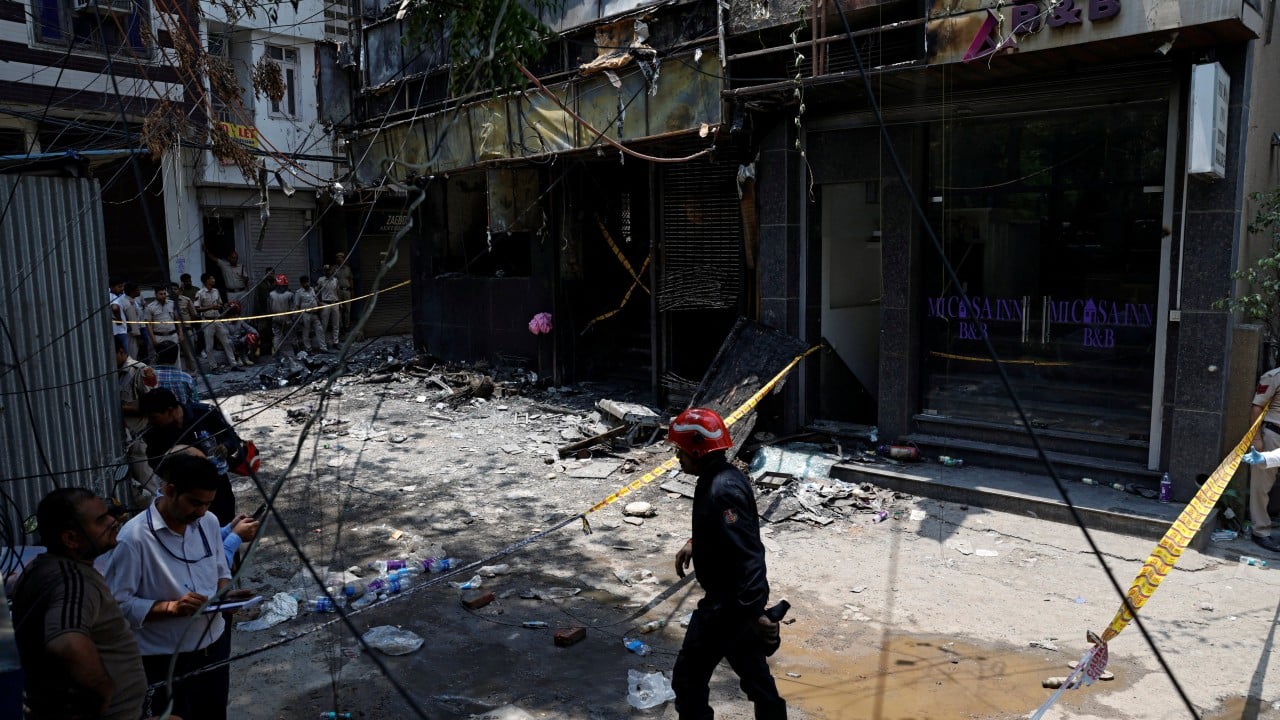
A devastating morning blaze at the Flourish Stay hotel in South Delhi’s congested Malviya Nagar neighborhood has claimed the lives of at least 21 people, exposing a grim systemic failure beneath India's multi-billion-dollar medical tourism boom. The fire broke out early Wednesday morning, trapping dozens of unsuspecting guests—primarily vulnerable foreign patients from African and Central Asian nations who had traveled to the Indian capital for life-saving medical care. While local authorities scrambled to deploy eight fire tenders to douse the inferno and managed to rescue more than 40 survivors, the disaster points directly to a lethal, recurring cycle of regulatory evasion, compromised urban planning, and administrative apathy that transforms budget guest houses into literal death traps.
Initial reports indicate that the blaze originated around 8:45 AM, likely connected to a commercial restaurant operating on the ground floor of the multi-story structure. As heavy smoke and flames quickly choked the building’s only exit routes, trapped guests were seen hanging from windows, desperately screaming for help. While the Delhi Police have swiftly registered a First Information Report (FIR) under charges of culpable homicide, assigning blame to individual operators ignores the institutional blind spots that permit these hazards to exist in the first place.
The Illusion of Safety in Medical Tourism Hubs
Every year, hundreds of thousands of international patients arrive in New Delhi, drawn by world-class hospital networks and highly competitive surgical costs. What the brochures deliberately omit is the reality of the secondary infrastructure supporting this influx. Major private hospital hubs lack the internal housing capacity for long-term outpatients and their families. This gap is filled by thousands of unauthorized, poorly converted residential buildings operating as commercial bed-and-breakfasts.
The Hauz Rani and Malviya Nagar enclaves are prime examples of this phenomenon. Dense, labyrinthine, and packed with unauthorized constructions, these neighborhoods have organically transformed into medical tourism colonies.
Foreign nationals, often recovering from major surgeries or undergoing intensive treatments, are forced into these low-cost accommodations. They have no way of knowing that the property lacks a valid Fire Safety Certificate or that the structural layout violates fundamental zoning laws. In this instance, a vulnerable demographic was sleeping in a structure built like a chimney, situated on a street too narrow for a modern fire engine to navigate effectively.
The Commercial Conversion Trap
The mechanics of this disaster are rooted in a lucrative economic loophole. In Delhi, converting a residential property into a commercial guest house or B&B requires a series of clearances that are routinely bypassed or obtained through bureaucratic manipulation.
Structural Violations as Standard Practice
- Single Points of Failure: Most converted residential plots feature a single central staircase. When a fire originates on the ground floor—particularly in a kitchen or an electrical meter board—this staircase acts as a funnel for toxic smoke, rendering the primary escape route completely unusable within minutes.
- Mixed-Use Hazards: Operating a commercial kitchen directly beneath guest rooms introduces high-pressure commercial LPG cylinders and open flames into structures never engineered to contain industrial hazards.
- Flammable Interiors: Budget accommodations rely heavily on cheap, highly combustible interior modifications like wood paneling, synthetic carpeting, and low-grade polyurethane foam insulation to maximize room counts.
When these elements combine, a simple electrical malfunction transforms into an unstoppable flashover. Fire officials have long warned that the combination of narrow alleys, dangling high-voltage wires, and illegal commercial extensions creates zones where rescue operations are fundamentally compromised before the first alarm even sounds.
Why the Regulatory Enforcement Mechanism Fails
In the wake of a mass-casualty fire, the political script is entirely predictable. High-profile political figures express condolences, financial compensation packages worth a few thousand dollars are announced for the families of the victims, and local municipal bodies issue a flurry of sealing orders against neighboring properties. Then, the public scrutiny fades, and the status quo returns.
The true failure lies in the fragmented nature of urban enforcement. Responsibility is deliberately divided among a chaotic web of agencies: the Municipal Corporation of Delhi (MCD), the Delhi Development Authority (DDA), the Delhi Fire Service (DFS), and local police divisions. This bureaucratic friction allows corrupt property owners to exploit enforcement gaps.
A property sealed by one agency frequently reopens weeks later under a slightly modified commercial name or via a temporary court stay order. The threat of criminal prosecution lacks a meaningful deterrent effect when the judicial process drags on for decades. Property owners view occasional fines and bribery as a predictable cost of doing business rather than an incentive to protect human life.
[Ground Floor: Restaurant/Kitchen] ──> Ignition Source / LPG Risk
      │
      ▼
[Central Staircase] ─────────────────> Smoke Funnel / Traps Upper Floors
      │
      ▼
[Upper Floors: 25 Guest Rooms] ──────> Highly Combustible Interior Upgrades
The High Cost of Regulatory Surrender
Tragedies like the Malviya Nagar fire are not accidental. They are the logical outcome of an administrative apparatus that consistently prioritizes real estate monetization over public safety. The immediate implementation of a centralized, transparent digital registry for all commercial accommodations is critical. This registry must link building sanctions, fire safety clearances, and commercial operating licenses into a single, public-facing portal. If a property lacks a verified, updated fire clearance, its listing on global booking platforms and medical tourism referral networks must be blocked automatically.
Furthermore, local administrative bodies must face direct legal accountability when unauthorized commercial structures operate openly under their jurisdiction. Until criminal liability is extended beyond low-level hotel managers to include the municipal inspectors who ignore flagrant violations, the narrow alleys of India's capital will remain primed for the next entirely preventable catastrophe.