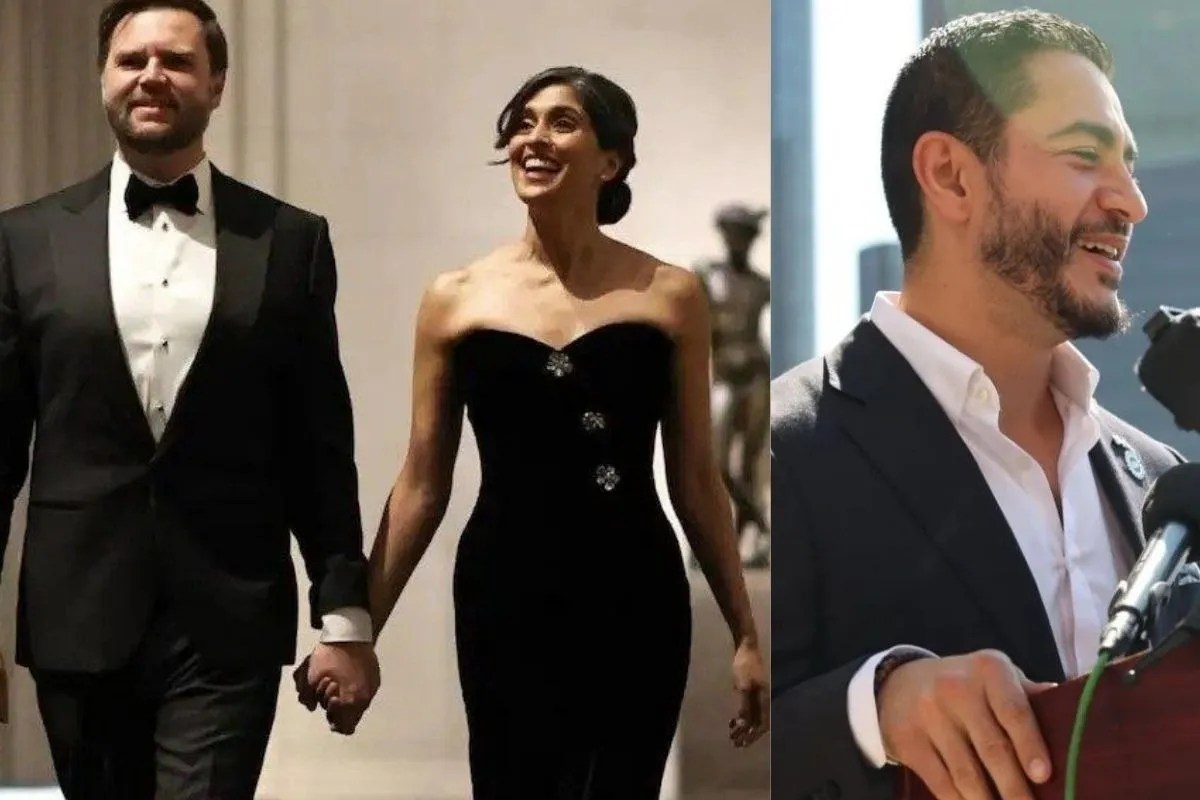
The unwritten code of American political combat used to protect immediate family members from direct crossfire. That informal boundary dissolved completely during a fiery campaign stop in Michigan, where Vice President JD Vance unloaded a blistering warning at Democratic Senate nominee Abdul El-Sayed. The flashpoint centered squarely on Usha Vance, turning a standard Midwestern legislative showdown into a deeply personal brawl over boundaries, political hypocrisy, and the weaponization of personal lives in modern elections.
Vance took the stage at a high-stakes rally and did not mince words. Responding directly to attacks leveled by El-Sayed regarding his family, Vance delivered an explicit ultimatum that quickly scorched across media networks.
"Whatever you want to talk about, Abdul, keep my wife's name the hell out of your mouth," Vance declared to an roaring auditorium, calling his opponent's political maneuvers crossing a line.
To understand why this specific clash matters beyond the usual theater of a Senate race, one must examine the intersection of identity politics and ambition in the Rust Belt. Abdul El-Sayed, a prominent progressive figure running a closely watched campaign in Michigan, had targeted the ideological contradictions he perceived within the Vance household. Critics on the left have long scrutinized how Vance’s hardline stance on cultural traditionalism and immigration coexists with his marriage to Usha Vance, a litigator of Indian descent.
For months, opposition strategists have tried to leverage these perceived friction points. They view the family dynamic not as a private sanctuary, but as a fair canvas to critique political hypocrisy. El-Sayed’s camp, aiming to mobilize progressive and minority voters in a pivotal swing state, seized on these talking points to challenge the authenticity of the conservative platform.
Vance's counter-offensive marks a notable escalation in how high-ranking officials manage personal attacks. Rather than ignoring the provocation or issuing a sterile statement through a press secretary, the Vice President chose direct, unfiltered confrontation. By labeling the opposition's tactics as out-of-bounds, he attempted to frame the attacks not as legitimate political critique, but as a breach of basic civic decorum.
This strategy carries distinct risks. Drawing heightened attention to the rhetoric only amplifies the underlying debates that campaigns typically prefer to bury. Yet, it also plays effectively to a base that hungers for aggressive defense of traditional values and familial loyalty. When political figures push back with raw, unfiltered vernacular, they signal strength to supporters who view polite political discourse as a weakness.
The Michigan Senate race was already tracking as one of the most contentious contests of the cycle. With national figures now actively dropping into local rallies to settle personal and ideological scores, the temperature of the ground campaign has reached a boiling point. The friction between Vance and El-Sayed demonstrates that personal lines in political messaging are increasingly vanishing, replaced by total-war tactics where no subject remains off-limits.
As the calendar moves closer to the general election, both sides recognize that every stray comment will be hyper-analyzed, clipped, and weaponized across digital platforms. The warning delivered in Michigan was not merely an isolated outburst. It served as a stark preview of how raw and personal the battlelines have become for the future control of Congress.
Watch JD Vance's fiery warning to Abdul El-Sayed
This video captures the exact moment Vice President JD Vance delivered his blunt warning regarding political attacks on his wife during a high-stakes campaign appearance.

