A single gunshot can change the social contract of an entire nation.
When a late-night electronic music gathering at the Schachen horse racing track in Aarau erupted into sudden violence early Sunday, the casualty count stood at one dead and five wounded. A 22-year-old woman lost her life on the concrete, while four men and another woman between the ages of 24 and 27 were rushed to regional hospitals with injuries ranging from minor to severe. Yet the true collateral damage of the Aarau Rave Vol. 7 extends far beyond the police tape cordoning off the northern Swiss canton. It struck at the core of a cultural psyche that treats public safety as an unwritten birthright.
Switzerland maintains one of the highest rates of civilian gun ownership in Europe, a byproduct of a militia military system where conscripts frequently keep their service weapons at home. For generations, politicians and citizens pointed to low rates of street-level homicide as proof that high firearm density could coexist with profound social stability. Mass shootings remain historic anomalies. When gunfire shatters a public celebration in a quiet Swiss capital, the shockwaves reverberate much further than the immediate perimeter set up by the Aargau cantonal police.
The Anatomy of a Midnight Panic
The timeline reconstructed by investigators and local eyewitnesses reveals a terrifying transition from collective joy to absolute chaos. At approximately 2:30 a.m., the underground music event was winding down. Hundreds of attendees lingered near the stages and grounds of the historic racing venue. Multiple shots rang out in rapid succession within a dense cluster of people.
Initial reactions mirrored a tragic modern psychological defense mechanism. Witnesses reported that many partygoers mistook the initial pops for celebratory fireworks, a common sensory confusion in environments accustomed to flashing lights and high-decibel sound design. Only when panic rippled through the crowd and urgent shouts pierced the air did reality take hold.
Partygoers dropped to the ground, diving beneath DJ booths and temporary structures for cover. By the time the music stopped entirely, the venue had transformed from a sanctuary of countercultural freedom into a crime scene. Emergency responders arrived to find a scene of utter disbelief. Medics attempted lifesaving interventions on the ground, but the young woman succumbed to her wounds before she could be transported.
The Manhunt and the Institutional Void
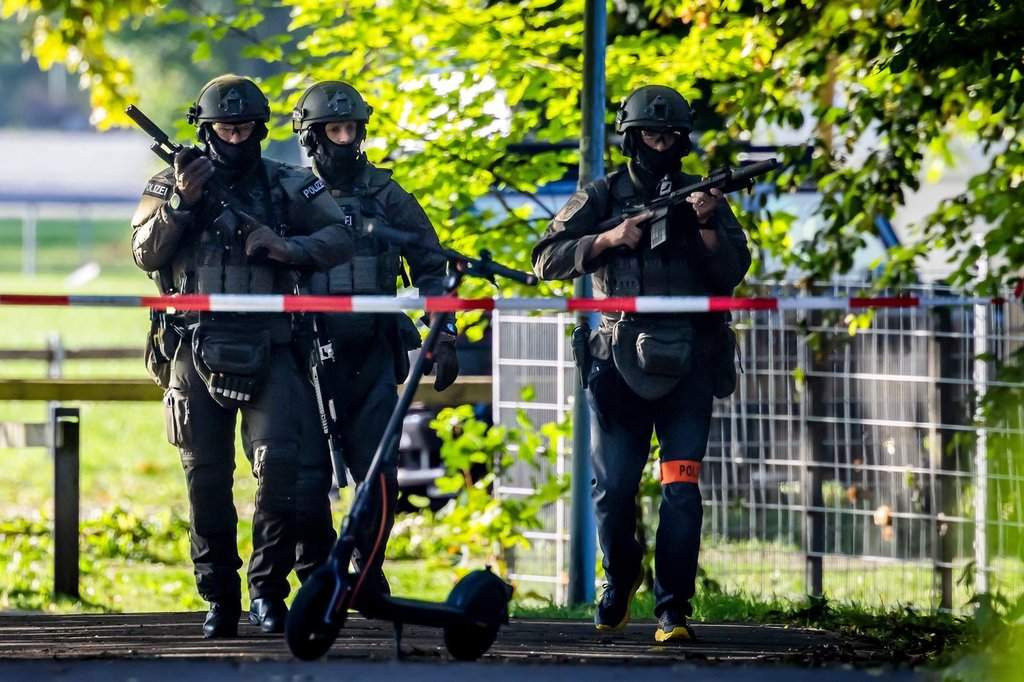
Hours after the incident, the response from local law enforcement highlighted the logistical nightmare of modern fugitive tracking in Central Europe. Bernhard Graser, spokesperson for the Aargau police, confirmed that virtually the entire regional force deployed to the streets in a high-speed manhunt. Authorities cast a wide net, coordinating even with cross-border police units in nearby Freiburg, Germany, to monitor potential escape routes.
Despite these extensive efforts, investigators faced an immediate wall of silence regarding motives. Officials quickly pushed back against speculative theories of organized terrorism, noting that the timing of the event—occurring as the crowd was dispersing—pointed away from coordinated ideological strikes. Instead, investigators turned their focus toward localized altercations, personal disputes, or sudden escalations among attendees.
This uncertainty exposes a vulnerable gap in modern event security protocols. While large-scale commercial festivals implement rigorous bag checks, metal detectors, and perimeter fortifications, underground or regional raves often rely on a communal culture of trust. Promoters bank on the ethos of electronic music subcultures, where peace and unity are preached from the decks. When an individual bypasses these informal social contracts by introducing lethal force, the lack of hardened physical security leaves crowds entirely exposed.
The Fragility of Public Sanctuaries
Electronic music events have long positioned themselves as alternative spaces, safe harbors where individuals from diverse walks of life can escape the rigid structures of daily routine. Swiss DJ Tekibo, who performed at the Aarau event, captured this sentiment in a public statement following the tragedy, noting that raves should forever remain zones of absolute safety rather than theaters for violence.
That ideal now faces a severe reckoning. The incident in Aargau follows a growing anxiety across Europe regarding safety at unmonitored or semi-private public gatherings. When public spaces become volatile, the reaction from municipal governments is predictable: heavier policing, stricter permitting processes, and the gradual erosion of the spontaneous countercultural events that define urban youth expression.
Authorities have urged citizens to supply smartphone footage, photographs, and digital evidence to help reconstruct the exact sequence of events that led an ordinary August weekend into national mourning. Yet gathering digital clues after the fact offers cold comfort to a community grappling with a shattered illusion.
The perimeter around the Schachen track remains locked down, forensic teams comb through the grass for ballistic evidence, and families across Switzerland and neighboring countries mourn the victims of a midnight catastrophe. The investigation will eventually identify a suspect, and the courts will assign accountability under Swiss penal code. Yet the deeper wound—the realization that safety can evaporate in a fraction of a second beneath the basslines of a local rave—will linger long after the police tape is finally removed.