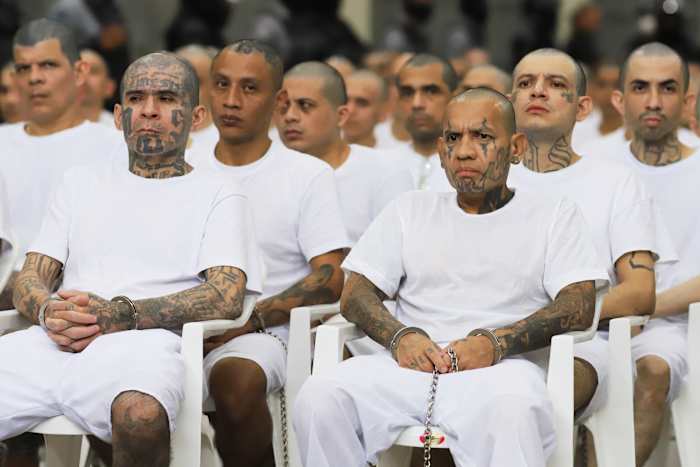
A sovereign nation attempting to litigate tens of thousands of criminal charges across hundreds of defendants simultaneously does not merely stretch the limits of judicial capacity. It fundamentally redesigns the operational architecture of state power. The conclusion of El Salvador’s mass trial of 485 alleged leaders and members of the Mara Salvatrucha (MS-13) gang represents a critical transition point in this administrative restructuring. By grouping hundreds of distinct cases into a singular judicial transaction, the Salvadoran state is attempting to solve a severe logistical bottleneck. This strategy, however, introduces unprecedented systemic risks to the rule of law and long-term fiscal stability.
To evaluate this strategy, we must analyze the operational mechanics, economic realities, and structural trade-offs of mass adjudication. For an alternative perspective, see: this related article.
The Judicial Bandwidth Problem and Collective Adjudication
The fundamental limitation of any classical legal system is judicial bandwidth. In a standard criminal justice model, the court processes cases sequentially. This is done to ensure that the unique evidentiary profile of each defendant is weighed against specific charges.
When a state arrests more than 92,480 individuals under a prolonged state of emergency, the classical sequential model collapses under the weight of its own administrative overhead. Further reporting on the subject has been published by The Guardian.
If the state were to grant each of the 92,480 detainees a modest three-day individual trial, the required judicial run-time would exceed 750 years of continuous, single-court operations.
To bypass this bottleneck, El Salvador enacted a July 2023 reform of its criminal code. This reform allows the judiciary to group defendants by gang affiliation or geographic territory rather than processing them individually.
The mass trial of 485 MS-13 members consolidated approximately 14,420 crimes—with some estimates reaching up to 47,000 total offenses across the broader leadership cohort—committed between 2012 and 2022.
We can model this shift using a throughput formula. Let $T$ represent the total time required to clear a docket, $D$ represent the number of defendants, $E_d$ represent the average volume of evidentiary units per defendant, and $c$ represent the administrative processing constant per case:
$$T_{\text{sequential}} = \sum_{i=1}^{D} (E_i \cdot c)$$
Under the collective adjudication model, the state treats the entire cohort as a single joint enterprise. This collapses the variable $D$ toward a value of 1 for trial scheduling purposes, transforming the equation:
$$T_{\text{collective}} = (E_{\text{shared}} \cdot c) + \epsilon$$
Where $E_{\text{shared}}$ represents the macro-evidence of gang structure, and $\epsilon$ represents the minimal time allocated to individual verification.
This systemic compression allows the state to process 485 defendants in a single three-month window.
The immediate trade-off is the degradation of individualized defense. In this trial, defendants appeared virtually via video link from the high-security Terrorism Confinement Center (CECOT). They were separated from the physical courtroom and stripped of standard attorney-client confidentiality.
The defense counsel's role is reduced to a nominal presence. This is because the prosecution’s evidence relies heavily on macro-level items. These include systemic wiretaps, organizational charts, and institutional financial records designed to prove membership in a criminal enterprise, rather than linking specific defendants to specific physical acts.
The Economics of Mass Incarceration
The physical manifestation of this judicial strategy is the megaprison. The Terrorism Confinement Center (CECOT) acts as the primary sink for the state's massive detention apparatus.
While the concentration of prisoners in a single highly fortified facility reduces the immediate operational costs of transport and peripheral security, it creates a rigid long-term fiscal commitment.
[Arrests: 92,480+] ---> [CECOT / Megaprison Storage] ---> [Collective Adjudication]
                                 |                                 |
                        (High Fixed Costs)              (Compressed Timeframe)
                                 |                                 |
                                 v                                 v
                     [Long-term Fiscal Burden]         [High False Positive Rate]
The economics of maintaining this system depend on three variables:
- The Cost of Incarceration Per Capita: Even if the state minimizes variable costs—such as food, medical care, and rehabilitation programs—the fixed cost of security personnel, facility maintenance, and technological surveillance for tens of thousands of inmates is a continuous drain on the national budget.
- The Loss of Productive Labor: Removing over 1.5% of the total adult population from the formal and informal economies reduces tax revenue and domestic consumption.
- The Sunk Cost of Counter-Gang Infrastructure: Facilities like CECOT have zero alternative utility. They represent massive capital investments that yield no economic return, functioning purely as cost sinks.
When the prosecution requests millions of dollars in civil damages—such as the $9 million targeted in the MS-13 trial—it is highly unlikely to recover these funds from assets held by gang members.
As a result, the state must fund the maintenance of this prison system through external borrowing, reallocation of social spending, or increased taxation. This creates a structural deficit that could threaten the country's macroeconomic stability.
The Operational Limits of the False Positive Rate
The primary vulnerability of any high-throughput security apparatus is its error rate. When arrests are made without prior judicial warrants during a state of emergency, the quality of the initial screening falls significantly.
The government has acknowledged this dynamic by releasing approximately 8,000 individuals due to a lack of evidence. This represents an initial false positive rate of roughly 8.6% of total detentions:
$$\text{False Positive Rate} = \frac{\text{Innocent Detainees Released}}{\text{Total Detained}} \approx \frac{8,000}{92,480} \approx 8.65%$$
This calculated rate is likely conservative. Human rights organizations have documented over 6,000 complaints of arbitrary detention and at least 547 custodial deaths. These figures indicate that the true error rate in the arrest-to-trial pipeline is likely higher.
In a standard judicial system, the trial serves as the final filter to catch these errors. By shifting to collective trials where hundreds of defendants are sentenced in blocks, the system removes this safeguard.
The danger is that a high false-positive rate undercuts the state’s security goals. When innocent young men from low-income neighborhoods are swept into high-security facilities alongside hard-core gang leaders, several negative outcomes occur:
- The Prison as an Integration Zone: Intersecting innocent individuals with structured gang hierarchies inside prisons increases the recruitment pool for these criminal organizations.
- Destruction of Human Capital: Long-term detention of young workers damages the informal economic networks that support El Salvador's poorest communities.
- Erosion of Institutional Trust: When a community sees that compliance with the law does not protect them from arbitrary arrest, the incentive to cooperate with state security forces drops.
The Structural Mechanics of Transnational Gang Networks
The prosecution's case against MS-13 highlights that the gang operated 32 distinct subgroups, including two that directed operations from outside El Salvador. This structure reveals a key reality: MS-13 is not a localized street gang, but a decentralized transnational network.
       [U.S. / International Nodes] (Financing & Coordination)
                     ^
                     | (Transnational Communication Loops)
                     v
       [Salvadoran Leadership Cohort] (Virtual Trial Defendants)
                     ^
                     | (Decapitated Command Chain)
                     v
       [Street-Level Cliques] (Extortion / Territory Control)
This decentralized structure explains both the short-term success of the government's strategy and its long-term vulnerabilities:
- Decapitation of the Command Chain: By detaining and prosecuting historic leaders like Dionisio Arístides Umanzor Osorio ("El Sirra de Teclas") and Borromeo Henríquez Solórzano ("Diablito de Hollywood"), the state has broken the command-and-control loops of the gang. This disruption is the main reason street-level violence and extortion have dropped so sharply across the country.
- The Resiliency of External Nodes: Because key parts of the gang operate outside El Salvador’s physical jurisdiction—primarily in the United States and neighboring Central American countries—the organization retains its brand, financial networks, and potential for violence.
- The Risk of Re-Infiltration: If El Salvador eventually eases its state of emergency, the external nodes of MS-13 could rapidly re-establish local operations. They can leverage their existing financial resources and recruit from communities hit hard by the economic costs of mass incarceration.
The Strategic Path Forward
To prevent its security gains from slipping away, the Salvadoran government must shift from emergency tactics to a sustainable, institutional model.
First, the state must replace the temporary state of emergency with a permanent, targeted investigative model. This means training specialized police units in forensic accounting and digital surveillance to target gang financial structures, rather than relying on broad neighborhood sweeps.
Second, the judiciary must set up a fast-track, individualized review system for low-risk detainees. Isolating gang leaders is necessary, but holding thousands of low-level offenders or innocent people without a clear trial timeline creates a severe fiscal and social burden.
The state should establish a transparent process to identify and release non-violent individuals, redirecting those resources to secure its highest-priority prisons.
Finally, the government must address the economic roots of gang recruitment. The security crackdown has made El Salvador’s streets safer, but it has not resolved the country's underlying economic challenges.
If the state does not pair its policing with investments in job training, education, and formal employment in historically marginalized communities, new criminal organizations will eventually step in to fill the vacuum.
For a deeper look into the legal proceedings and the scale of the accusations faced by the gang leadership in this historic trial, you can view this detailed video analysis on the historic MS-13 trial. This video covers the courtroom arguments, specific charges, and the security environment surrounding the prosecution of the 485 gang leaders.