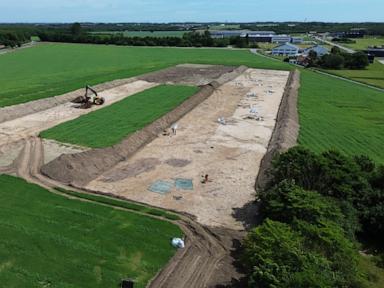
Recent archaeological excavations in Denmark have uncovered a massive textile production site, fundamentally shifting our understanding of the Norse economy. For decades, popular history focused on longships, silver hoards, and violent raids. This discovery proves that the real engine of the Viking expansion was not just steel, but wool. The sheer scale of the looms and workshops found at the site indicates an organized, mass-production assembly line that predates the recognized industrialization of Northern Europe by centuries. It forces a complete rewrite of how these seafaring societies funded and sustained their global reach.
The Raw Math of Medieval Logistics
To understand the scale of the Danish discovery, you have to look at the brutal reality of maritime logistics. A single Viking longship required a sail of roughly 100 square meters. Making that sail was not a casual weekend hobby for a farmer’s family.
It required more than two tons of raw wool. It demanded the labor of multiple skilled workers for an entire year.
When you multiply that by the fleets of hundreds of ships that struck the coasts of Britain, France, and Ireland, the math becomes staggering. The Norsemen were not just raiders who stumbled out of the fjords when they got bored. They were managing a massive, highly integrated supply chain. The newly excavated site in Denmark serves as the central factory floor for this naval empire.
The site contains dozens of sunken-floor huts, known as grubenhäuser, which were specifically designed to maintain the high humidity levels required to keep wool threads pliable during weaving. Discovering these huts clustered together in such high concentrations shatters the old academic consensus that textile work was purely a domestic, decentralized chore.
Labor Exploitation in the Loom Huts
The discovery exposes a darker truth about the structure of Norse society. This was not a community of egalitarian artisans singing songs around a hearth. The layout of the workshops suggests a rigid, highly controlled labor hierarchy.
Experts pointing to the sheer volume of loom weights and spindle whorls found at the site are looking at the footprint of forced labor. The Viking economy relied heavily on the thrall system—enslaved captives captured during foreign raids.
Women and children captured from Anglo-Saxon villages or Slavic settlements were likely crammed into these damp, dark pit houses, forced to spin and weave for hours on end under brutal conditions. The wealth of the Viking Age was spun from the sweat of an invisible, captive workforce.
The Economic Engine Behind the Shields
Historians have long argued over what triggered the sudden explosion of Viking activity in the late eighth century. Some blamed population pressure, while others pointed to political instability in Scandinavia. The scale of this textile site offers a much simpler, economic explanation.
They had the means to mass-produce the single most valuable technology of the era.
A sail was the medieval equivalent of an airplane engine. By industrializing sail production, Danish chieftains could rapidly expand their fleets, project power across the North Sea, and dominate trade routes down to Byzantium. The textiles themselves became a highly liquid currency, traded for silver, silk, and spices in markets across the known world.
The Fragility of the Wool Empire
This hyper-specialized economy carried massive risks. Relying on centralized production centers meant that a single bad winter, a livestock disease that wiped out sheep populations, or a localized conflict could instantly paralyze the naval production line.
Without a steady supply of new sails, the ships rotted in the harbors. The raiders were grounded.
The Danish site shows signs of abrupt abandonment, a stark reminder that early industrial experiments were incredibly fragile. When the political alliances between regional chieftains fractured, the supply lines collapsed, leaving the massive weaving huts to be swallowed by the earth until modern shovels brought them back to light.