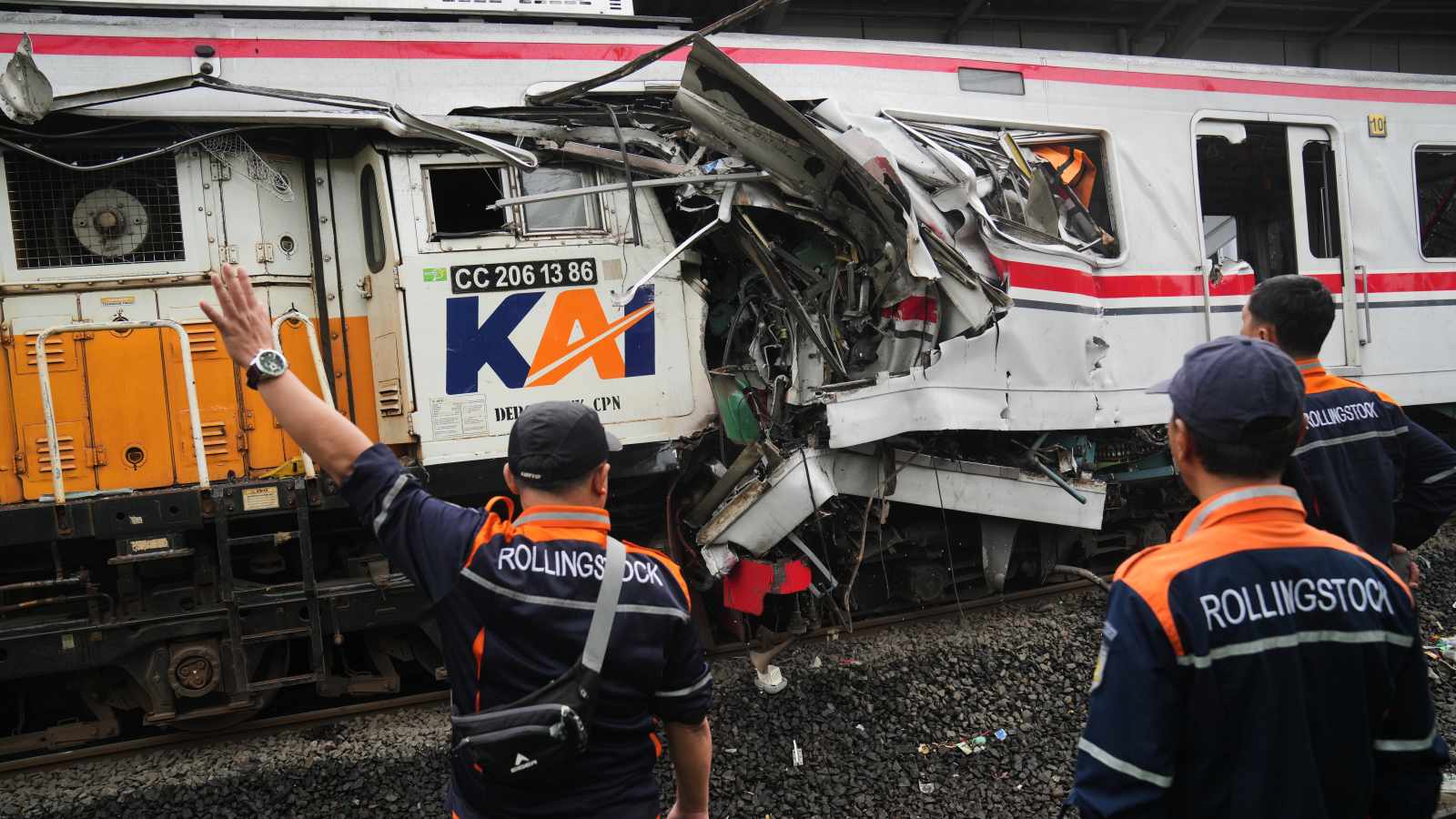
Chaos broke out on the tracks in Indonesia's West Java province when two passenger trains slammed into each other, leaving seven people dead and over 80 others fighting for their lives in nearby hospitals. It’s a nightmare scenario that rail authorities have been trying to prevent for decades. This wasn't just a minor bump or a derailment. This was a head-on impact between the Turangga express and a local commuter line near Cicalengka. The force of the crash was enough to crumple steel like it was paper.
When you look at the wreckage, it’s hard to believe anyone walked away. Rescue teams spent hours crawling through jagged metal and shattered glass to reach those trapped inside. Indonesia’s railway network, operated by PT Kereta Api Indonesia (KAI), has seen significant upgrades lately, but this disaster proves that technology alone can't fix every vulnerability.
Why Indonesia Still Struggles With Rail Safety
I've watched the Indonesian rail system evolve over the years. They’ve introduced high-speed rail and sleeker carriages, but the core infrastructure in rural areas remains a patchwork of old and new. This collision happened on a single-track section. That’s a massive red flag. When you have two trains moving in opposite directions on the same line, you're betting everything on signaling and human communication. One mistake. That's all it takes.
The Turangga train was traveling from Surabaya to Bandung—a long-haul route—while the local Bandung Raya line was heading the opposite way. They met on a stretch where there is simply no room for error. The investigation is still ongoing, but history suggests we’re looking at a breakdown in signaling or a massive dispatching blunder. Honestly, it’s frustrating. We see these "unavoidable" accidents happen, yet they almost always trace back to a system that failed to account for a single human slip-up.
The Grim Reality Of The Rescue Operation
The scene at Cicalengka was nothing short of horrific. Imagine the sound of that impact echoing through the rice fields. Local residents were the first on the scene, using whatever tools they had to pry open doors before official crews arrived with heavy machinery.
- The Casualties: The seven confirmed dead included train crew members who were in the direct line of impact.
- The Injuries: Most of the 80+ injured suffered from blunt force trauma, broken limbs, and deep lacerations from flying debris.
- The Evacuation: Hospitals in Bandung and surrounding districts were quickly overwhelmed, shifting into emergency mode to handle the influx of victims.
The National Transportation Safety Committee (KNKT) is currently digging through the "black box" data and signal logs. They need to figure out why both trains were cleared for the same section of track at the same time. If the signaling system showed a green light for both, we're looking at a catastrophic technical failure. If it was a manual override, someone has some serious answering to do.
A Pattern Of Infrastructure Problems
Indonesia’s geography makes rail maintenance a literal uphill battle. You’ve got volcanic terrain, heavy monsoon rains that cause landslides, and a population density that puts immense pressure on every mile of track. But this wasn't a landslide. This wasn't a natural disaster. This was a collision.
Public trust in KAI has taken a massive hit. Just as the country is celebrating the launch of "Whoosh," the first high-speed rail in Southeast Asia, this tragedy reminds everyone that the "ordinary" lines—the ones millions of people use every day to get to work—are often neglected. It’s a classic case of focusing on the shiny new toy while the foundation is cracked.
What Needs To Change Right Now
We can't just keep sending "thoughts and prayers" every time a train car ends up in a ditch or crumpled against another locomotive. There are specific, actionable steps that Indonesian rail authorities need to take to ensure this doesn't happen again next month.
First, the push for double-tracking must be accelerated. Single-track lines are a relic of a bygone era and have no place in a modern transport network handling this much volume. If there were two sets of tracks, these trains would have passed each other safely. It's that simple.
Second, the signaling systems need an overhaul. We need automated "Positive Train Control" (PTC) style systems that can automatically slow or stop a train if it detects another vehicle on the same block of track. Relying on a dispatcher’s voice over a radio or a manual switch is just asking for trouble in 2026.
Third, there has to be real accountability. In many of these cases, the blame gets shifted to a low-level operator while the management that ignored safety audits stays in power. That cycle has to break.
The victims aren't just statistics. They were commuters, parents, and workers. The government needs to prove that their lives are worth more than the cost of a track upgrade. If you’re traveling by rail in West Java anytime soon, keep your eyes open. Check for updates on line closures and don't be afraid to demand better standards from the carriers you pay to keep you safe. The era of "good enough" safety is over.