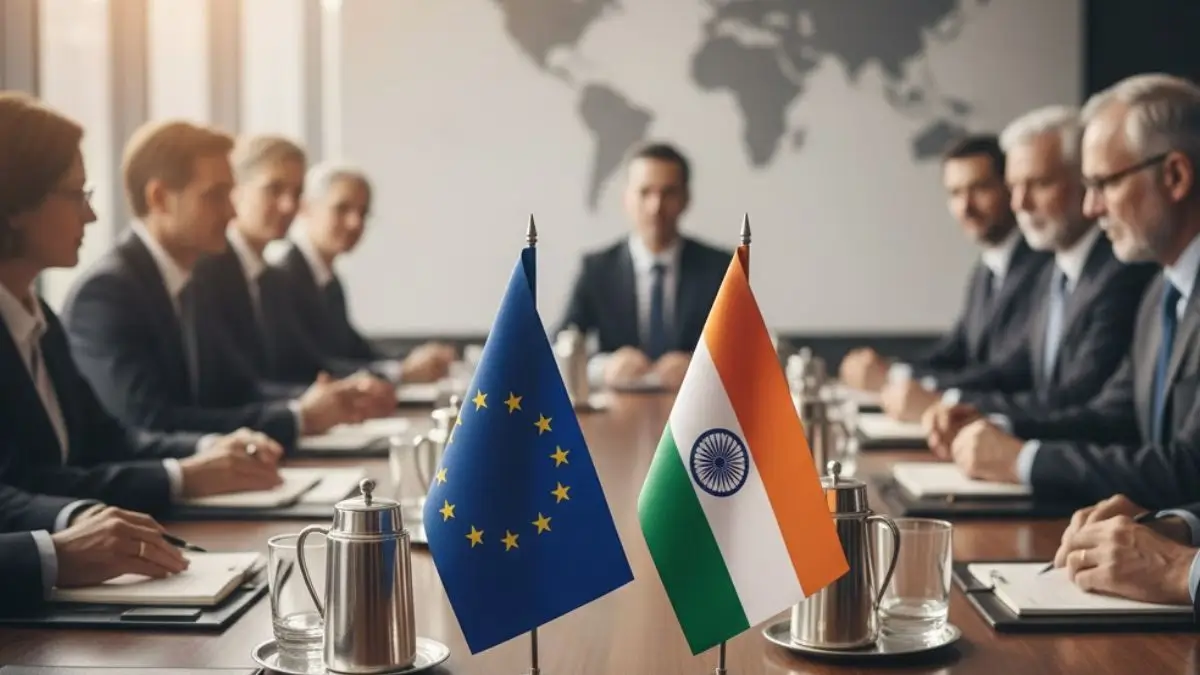
New Delhi and Brussels are finally talking like they mean it. For years, the relationship between India and the European Union felt like a slow-moving bureaucracy exercise. You had endless summits, polite handshakes, and very little concrete action. That's changing fast. The recent high-level discussions in Delhi about deepening the Strategic Partnership aren't just another photo op. They represent a massive shift in how the world’s largest democracy and the world’s largest trading bloc view each other in an increasingly messy global neighborhood.
We aren't just talking about selling more basmati rice or luxury cars anymore. This is about survival in a world where supply chains are brittle and geopolitical tensions are through the roof. If you've been following the news, you know that "de-risking" is the buzzword of the year. For the EU, that means finding a reliable partner that isn't China. For India, it means getting the tech and investment needed to fuel its massive growth.
The trade deal that everyone is waiting for
Let’s be real about the elephant in the room. The India-EU Free Trade Agreement (FTA) has been in the works for what feels like a century. They started talks in 2007, paused them in 2013, and only restarted a couple of years ago. It’s a tough nut to crack. The EU wants India to slash duties on wines, spirits, and cars. India wants better access for its professionals and a fairer shake on environmental taxes.
Specifically, India is worried about the Carbon Border Adjustment Mechanism (CBAM). This is the EU’s plan to tax carbon-intensive imports like steel and aluminum. Indian manufacturers think it’s a backdoor way to protect European industries. During these recent talks, both sides spent a lot of time trying to find a middle ground here. You can’t have a "strategic partnership" if one side feels like the other is using green rules to block their growth.
Progress is happening, though. Both sides have realized that waiting for a "perfect" deal is a losing game. They're now looking at an Investment Protection Agreement and an agreement on Geographical Indications alongside the main trade pact. It’s a smarter, more modular way to get things done.
Tech and security are the new front lines
The Trade and Technology Council (TTC) is where the real action is happening. This is only the second time the EU has set up such a body—the first was with the United States. That tells you exactly how much weight Brussels is putting on New Delhi these days.
They’re focusing on things that actually impact your daily life. Semi-conductors are a huge part of the conversation. India wants to become a global hub for chip manufacturing, and European companies have the expertise to help make that happen. Then there’s Artificial Intelligence. Both regions are trying to figure out how to regulate AI without killing innovation. By aligning their rules now, they can create a massive "democratic tech zone" that sets the standard for the rest of the world.
Clean energy isn't just a talking point
India's ambitious goal of reaching net-zero by 2070 requires trillions of dollars. Europe has the green tech and the capital. During these discussions, the push for Green Hydrogen became a central pillar. India wants to export it; Europe needs to import it to meet its climate goals. It’s a match made in heaven, but only if the infrastructure and financing follow the rhetoric.
The Global Gateway initiative is the EU's answer to China's Belt and Road. It’s starting to pour money into sustainable infrastructure projects across India. This isn't charity. It’s a strategic move to ensure that the backbone of India’s future economy is built on transparent, high-quality European standards.
Why the timing is so urgent
Look at the map. You have a war in Ukraine that has dragged on far longer than anyone expected. You have rising friction in the Indo-Pacific. Both India and the EU have realized they can't afford to be lonely players.
For a long time, Europe viewed India mainly through the lens of developmental aid. That’s over. India is now a top-five global economy. On the flip side, India used to see the EU as a collection of fragmented states. Now, it sees a unified bloc that can act as a powerful counterweight in a multipolar world.
The security cooperation is getting deeper too. We’re seeing more joint naval exercises in the Indian Ocean. There’s better intelligence sharing on counter-terrorism. These aren't just gestures. They’re a recognition that a stable Indian Ocean is vital for European trade, and a strong Europe is good for India’s regional balance.
The hurdles that still exist
It’s not all sunshine and roses. Honestly, there are still major sticking points. Data privacy is a big one. The EU has some of the strictest data protection laws in the world (GDPR). India is still refining its own data laws. If they can't agree on how data flows across borders, the digital trade part of the partnership will stall.
Then there’s the "values" debate. Occasionally, the EU brings up human rights or press freedom, which sometimes irritates New Delhi. India, meanwhile, often feels that Europe is too preachy and doesn't understand the complexities of governing 1.4 billion people. Both sides are learning to manage these disagreements without letting them derail the entire relationship. It's a sign of maturity. They're moving past the honeymoon phase and into a practical, working marriage.
What happens next for businesses and travelers
If you're a business owner or a student, these high-level talks actually matter for you. A deeper partnership means easier visas for Indian tech workers heading to Germany or France. It means fewer regulatory headaches for a French startup looking to set up shop in Bengaluru.
The focus is now shifting to "deliverables." We expect to see more announcements regarding:
- Simplified professional certification recognition.
- Joint research grants for climate-resilient agriculture.
- New shipping corridors that bypass traditional bottlenecks.
Keep an eye on the upcoming ministerial meetings. That’s where the broad "strategic" talk gets turned into actual laws and regulations. The momentum is there. The political will is stronger than I’ve seen it in a decade.
If you want to stay ahead, start looking at European markets if you’re in India, or vice-versa. The barriers are coming down. It won't happen overnight, but the trajectory is clear. The India-EU partnership is no longer a "potential" powerhouse—it's actively being built.
Don't wait for the final signatures on a 2,000-page trade document to start building your own connections. The smart money is already moving. Follow the policy shifts in the Trade and Technology Council specifically, as those will likely yield results much faster than the broader trade negotiations.