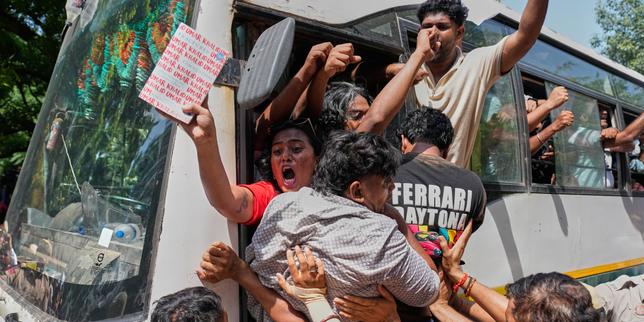
Democracy relies on a single fragile agreement. Citizens trust that the ink on their finger matches the count on the board. When that trust cracks, the streets fill up fast. That is exactly what happened across India as massive crowds demanded the immediate resignation of Chief Election Commissioner Gyanesh Kumar.
You aren't just looking at another standard political squabble. This is a full-scale institutional crisis driven by anger over massive voter roll purges. For a different view, check out: this related article.
What Sparked The Outrage
The fury didn't appear out of nowhere. It kicked off following intense investigative reporting by publications like the Indian Express, which revealed that internal disagreements had surfaced within the Election Commission of India. Specifically, two election commissioners raised serious objections regarding the rollout of the Special Intensive Revision (SIR) of electoral rolls.
Critics and opposition parties claim this massive revision process led to the unceremonious deletion of millions of voter entries. Estimates point to tens of millions of names vanishing from registers in crucial states, sparking accusations that the purge unfairly targets marginalized groups and benefits Prime Minister Narendra Modi's ruling Bharatiya Janata Party (BJP). Further insight on this trend has been provided by USA Today.
When ordinary citizens show up to vote and find their names missing after decades in the same neighborhood, panic turns into rage.
The Scale of the Backlash
Protests quickly spilled out of New Delhi and spread to major urban centers like Mumbai, Chennai, and Bengaluru. Students, civil rights activists, and major opposition figures under the INDIA bloc banner organized massive rallies, including high-profile marches at Ramlila Maidan.
Opposition leaders like Rahul Gandhi took to the stage to condemn the deletions, labeling the administrative purge an assault on democratic rights. Thousands of protesters faced police barricades, water cannons, and mass detentions as authorities tried to regain control. Youth groups and independent civic movements, including spontaneous youth coalitions, turned out in droves because many first-time voters found themselves locked out of the democratic process before they even cast a single ballot.
The Official Defense and Counter-Narrative
The government and the Election Commission of India have pushed back hard against the mounting pressure. Officials maintain that all major decisions regarding the electoral roll revision were handled properly.
The ruling BJP has dismissed the protests as a politically motivated drama engineered by a desperate opposition. Government defenders argue that cleaning up electoral rolls is a routine administrative necessity designed to eliminate duplicate entries, ghost voters, and outdated records. They insist that questioning the integrity of the polling body undermines India's constitutional framework.
Yet, the presence of internal dissent among the election commissioners makes it difficult to brush off the controversy as a pure fabrication. When top election officials openly debate the transparency of digital registration procedures, public skepticism naturally spikes.
Where Things Stand Now
With national attention riveted on the unfolding fallout, the standoff shows no signs of a quick resolution. Protesters continue to demand an independent judicial inquiry, the reversal of contested voter deletions, and the structural overhaul of how election commissioners are appointed.
If you want to track how this crisis impacts upcoming political battles, keep your eyes on the courts. The judiciary remains the primary arena where petitions challenging the legality of the Special Intensive Revision are being fought. Watch how civil society groups organize digital campaigns alongside physical rallies to pressure lawmakers. Election integrity isn't just a talking point anymore; it has become the defining political battleground for India's immediate future.