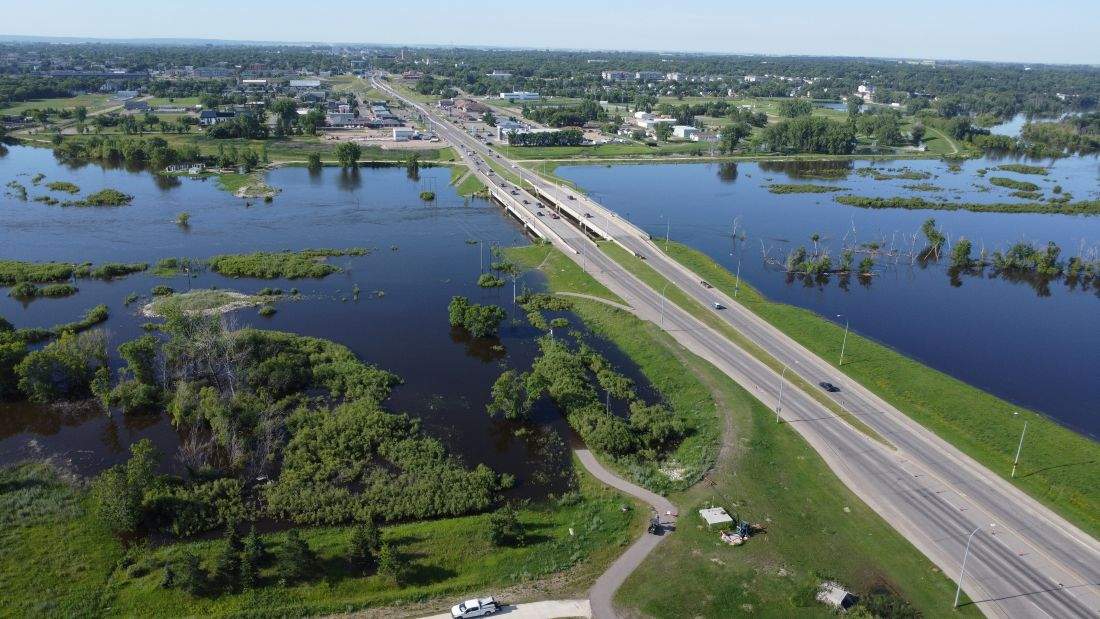
The Assiniboine River has finally peaked in Brandon, Manitoba, but the receding water levels offer little more than a temporary sigh of relief for a region battered by summer storms. On Tuesday morning, water levels at 1st Street registered at 1179.20 feet, marking a slight decline of approximately eight centimeters from the weekend's crest. While municipal leaders point to successful mitigation efforts, the reality on the ground suggests that the danger is far from over. The immediate threat of catastrophic inundation may have passed, but the long-term structural and environmental toll on western Manitoba is only beginning to surface.
A state of local emergency remains in effect. Roughly 4,000 residents living near the high-risk zones remain on standby, overnight bags packed, waiting for a final all-clear that might not come for weeks.
The False Security of the Crest
In flood management, the peak of a river is often treated as the finish line. This is a dangerous miscalculation.
When water levels begin to drop, the pressure holding saturated riverbanks in place suddenly shifts. The outward force of the river recedes faster than the water trapped inside the soil of the banks. This imbalance causes what engineers call rapid drawdown failure. The banks, heavy with trapped moisture and suddenly lacking the supporting pressure of the high river, can collapse without warning.
Mayor Jeff Fawcett acknowledged this hazard, warning that saturated ground can give way unexpectedly. Dikes and temporary sandbag barriers that held firm during the peak are now vulnerable to internal erosion as water flows back out of them. Underneath the surface, the soil is structurally compromised.
Furthermore, the Assiniboine remains incredibly high. The river swelled by roughly 2.5 meters in less than a week, fed by torrential rainfall in the Parkland region to the north. A decline of eight centimeters is a microscopic drop in a massive bucket. The high volume of fast-moving water will continue to scour the foundations of bridges, roads, and municipal dikes for days to come.
The Regional Toll of a Fractured Summer
While Brandon’s fortified defenses successfully prevented widespread municipal damage, neighboring communities have not been as fortunate. The floodwaters threatening Brandon did not appear out of thin air. They are the runoff from severe storms that devastated towns further north.
In Dauphin, the local hospital faces months of closure due to severe water damage. Swan River is still reeling from its second historic flood event in a single month. The strain on regional resources is immense.
+------------------+-----------------------------+-----------------------------+
| Location         | Primary Flood Impact        | Current Status              |
+------------------+-----------------------------+-----------------------------+
| Brandon          | 2.5-meter river rise        | Crested; slow decline       |
| Dauphin          | Severe infrastructure damage| Regional hospital closed    |
| Swan River       | Consecutive flood events    | Active recovery and cleanup |
+------------------+-----------------------------+-----------------------------+
This regional devastation highlights a growing problem in provincial water management. When upstream communities are overwhelmed, downstream cities like Brandon are forced into emergency mode, diverting massive manpower to build temporary barriers. Brandon's proactive measures succeeded this time, but relying on frantic, nighttime sandbagging operations is a fragile strategy.
The Fragility of Current Infrastructure
Municipal officials noted that current river behavior does not mirror historical flood patterns. Changes in the river channel's width and depth, driven by erosion from previous high-water years, mean that traditional formulas for predicting flood impacts are increasingly unreliable.
The province of Manitoba is facing a shifting hydrological reality. Increased frequency of extreme summer storms is replacing the traditional spring snowmelt as the primary driver of major floods. Our infrastructure was built for predictable spring swells, not sudden July torrents fueled by record-shattering heat waves.
Building higher dikes in Brandon is only a partial solution. Without comprehensive watershed management that addresses runoff from agricultural lands and upstream tributaries, the city remains at the mercy of whatever falls from the sky further north.
The water is dropping, but the ground beneath western Manitoba remains saturated and unstable. The real work begins now, as the province must assess the invisible damage left in the wake of the crest.