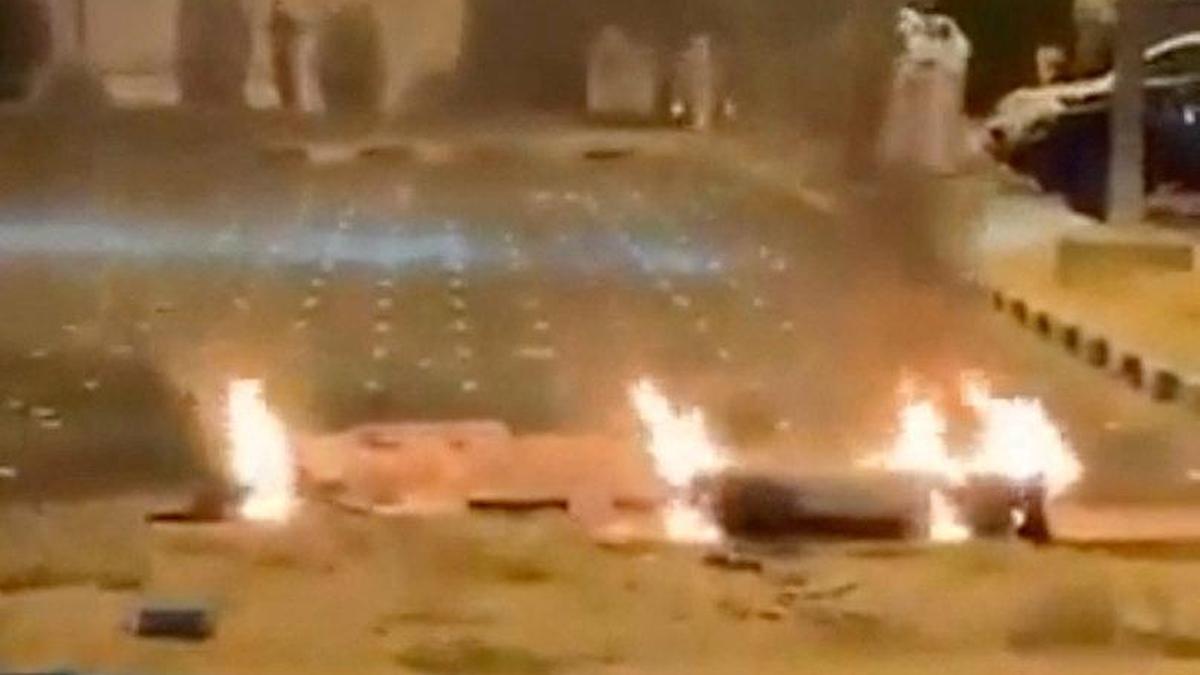
A single Indian transit worker lies dead in the wreckage of Terminal 1 at Kuwait International Airport. He was not a combatant, nor was Kuwait an active belligerent in the rapidly unraveling conflict between Washington and Tehran. Yet, the drone swarm that tore through the terminal ceiling early Wednesday morning did more than claim a life and injure 63 others; it permanently shattered the illusion that America’s Gulf allies can sit out the war next door.
While regional news outlets quickly parroted official state press releases focusing on the immediate humanitarian toll, the broader geopolitical reality is far more clinical and dangerous. This was not a random act of terror. The strike on Kuwait International Airport was a calculated execution of Iran’s "unified theater" doctrine. By directly targeting the civilian infrastructure of a non-belligerent neighbor, Tehran has sent an unmistakable signal to the oil-rich monarchies of the Gulf Cooperation Council (GCC): if American assets on your soil strike Iran, your entire economic lifeblood is fair game.
The Geography of Retaliation
To understand why a passenger terminal in Kuwait City became a war zone, one must look at the events of the preceding 24 hours. On Tuesday, US Central Command (CENTCOM) forces intercepted and disabled the M/T Lexie, a Botswana-flagged oil tanker navigating international waters toward Iran's Kharg Island, strictly enforcing the tight American maritime blockade. Hours later, US aircraft launched "self-defense" strikes against Islamic Revolutionary Guard Corps (IRGC) communication towers and ground control stations on Qeshm Island.
The US narrative was clear: a routine enforcement of sanctions followed by localized retaliation. Iran’s counter-narrative, however, is regional.
The IRGC maintains that the aircraft used in these strikes utilize the sprawling web of American airbases dotted across the western coast of the Persian Gulf. Kuwait hosts thousands of American troops at Camp Arifjan and Ali Al Salem Air Base. While the Kuwaiti government has spent decades walking a diplomatic tightrope—maintaining deep security ties with Washington while keeping channels open with Tehran—the IRGC has explicitly rejected this neutrality. Over the weekend, Iranian forces had already probed Kuwaiti airspace following a strike on an IRGC radar station. Wednesday's devastating terminal hit proves that the threshold for escalation has been crossed.
The Kinetic Failure of Integrated Air Defense
For years, Western defense contractors and Gulf defense ministries have championed the concept of a seamless, integrated regional air defense umbrella. The attack on Terminal 1 exposes the fatal flaws in this hardware-heavy strategy.
According to CENTCOM, US and regional forces successfully intercepted three ballistic missiles aimed at Bahrain and watched two others break apart over the Gulf en route to Kuwait. The military apparatus celebrated these intercepts as a technical victory.
But a partial intercept is a strategic failure when dealing with asymmetric warfare. While the heavy ballistic missiles were intercepted or failed on their own, a low-altitude, slow-flying "swarm of hostile drones" bypassed the primary radar pickets entirely. This is the terrifying math of modern regional conflict:
- Cost Asymmetry: A single Patriot Advanced Capability-3 (PAC-3) interceptor costs roughly $4 million. An Iranian-engineered Shahed-series one-way attack drone costs between $20,000 and $40,000.
- Saturation Limits: Air defense batteries possess a finite number of ready-to-fire missiles. By launching a mixed salvo of ballistic threats and low-flying loitering munitions, Iran forces defense systems to prioritize high-altitude targets, leaving civilian blind spots exposed.
- Radar Clutter: Ground-based radar optimized for tracking high-speed ballistic trajectories frequently struggles with small, composite-material drones tracking through urban coastal topography at low altitudes.
The result of this kinetic mismatch was felt on the ground in Kuwait City. Health Ministry spokesman Abdullah al-Sanad confirmed that emergency rooms were flooded with victims suffering from blast-induced trauma, cerebral hemorrhages, and severe lacerations from falling structural debris. The physical infrastructure of Terminal 1 was severely compromised, paralyzing commercial aviation across the Northern Gulf for hours.
The Diplomatic Disconnect in Washington
While the Gulf burns, the political rhetoric emanating from Washington reads as if it belongs to a different timeline. Just a day prior to the airport strike, US Secretary of State Marco Rubio assured the Senate Foreign Relations Committee that a comprehensive diplomatic breakthrough with Tehran was "within reach," claiming the Iranian regime was ready to concede on key nuclear points.
The smoking ruins of a Kuwaiti passenger terminal tell a vastly different story.
Iranian Foreign Minister Abbas Araghchi has laid out Tehran's position with brutal clarity, noting that the April 8 ceasefire cannot be compartmentalized. From the Iranian perspective, any American blockade enforcement in the Strait of Hormuz or continued Israeli operations against Hezbollah in southern Lebanon constitutes a total breach of the peace.
Washington’s belief that it can wage a localized, gray-zone economic war against Iran while keeping its regional allies insulated from the fallout is a severe miscalculation. Tehran is operating on a total-war philosophy; if their oil cannot leave the Gulf, then no one else’s logistics, commercial flights, or infrastructure will function safely either.
The Cost of the Buffer Zone
The true victims of this strategic impasse are the smaller Gulf states and the massive, vulnerable foreign workforce that keeps them running. Kuwait, Qatar, and Bahrain have spent the last thirty years transforming themselves into global logistics, financial, and transit hubs. Their financial models depend entirely on the perception of absolute safety.
By hitting a civilian airport terminal, Iran has targeted the fragile psychological foundation of the Gulf’s economic model. Airlines cannot easily absorb the insurance premiums associated with flying into active missile corridors. Foreign corporations cannot easily justify stationing personnel in capitals where a morning commute can be interrupted by an exploding loitering munition.
Kuwaiti authorities have tried to project an image of rapid recovery, announcing the gradual resumption of flight operations through alternative terminals. But the structural damage to Terminal 1 is merely a symptom. The real damage is to the regional security paradigm. The Western-backed defense umbrella can no longer guarantee the safety of the civilian spaces it was built to protect, and the cost of housing American military assets has just risen exponentially.