The air in the high country of the American West has a way of tricking you. It is crisp, thin, and so quiet that a snapping twig sounds like a pistol shot. When you stand on the edge of a golden meadow in Yellowstone, looking out at a creature that seems to have walked straight out of the Pleistocene epic, time slows down. The beast looks peaceful. It moves with a slow, rocking gait, grazing on the dry summer grass like a suburban cow.
It weighs two thousand pounds.
We live in an age of screens, where nature is curated, filtered, and safely tucked behind glass. We watch wildlife documentaries from the comfort of our couches and double-tap photos of apex predators on Instagram. This digital insulation breeds a dangerous kind of arrogance. It makes us believe that because we appreciate nature, nature somehow recognizes our good intentions.
It does not.
Consider a man standing on a dirt trail, just a few yards away from a massive bull bison. Let us call him Arthur. Arthur is not a bad person. He is a tourist, a father, someone who loves the outdoors. He wants a photograph, a tangible piece of evidence to prove he was here, standing in the presence of the untamed wild. In his mind, he is sharing a moment with the animal. He steps closer. He raises his phone. He ignores the subtle signs—the raised tail, the agitated pawing of the dirt, the sharp shake of a massive, horned head.
Then, the world explodes.
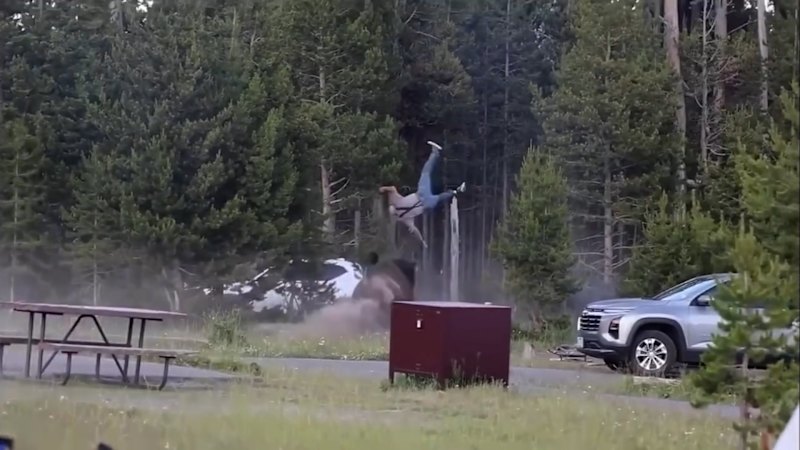
A bison can accelerate from a dead stop to thirty-five miles per hour faster than a horse. It does not charge like a bull in a movie, with a dramatic, slow-motion buildup. It strikes like a velvet-covered freight train. In a fraction of a second, the distance between Arthur and two tons of muscle evaporates. The impact is deafening. The human body is utterly defenseless against that kind of mass. With a sickening upward thrust of its neck, the bison launches the man ten feet into the air, spinning him like a ragdoll against the blue sky before he crashes back down into the dirt.
The silence returns immediately. The bison moves away, returning to its grazing as if nothing happened. For the animal, it was not a personal attack. It was simply the enforcement of a boundary. For the human, it is a life-altering moment of absolute terror.
The real problem lies in our profound misunderstanding of wild spaces. National parks are not zoos without cages. They are fully functioning, unpredictable ecosystems where the rules of civilization do not apply. Park rangers spend thousands of hours placing warning signs, distributing pamphlets, and talking to visitors, yet the human desire for proximity constantly overrides basic survival instincts.
Look at the math of a collision like this. When a two-hundred-pound human meets a two-thousand-pound animal moving at top speed, the physics are unforgiving. The kinetic energy transferred during the impact causes severe internal trauma, broken bones, and deep lacerations. It is a miracle anyone survives such an encounter. Yet, every single year, emergency medical teams have to rush into the backcountry to rescue visitors who thought they were the exception to the rule.
This is not a story about the danger of animals. It is a story about the fragility of human perception.
We have disconnected ourselves from the natural world so deeply that we no longer know how to read its language. A dog wags its tail when it is happy; a cat purrs. But a bison’s signals are different, quieter, and far more lethal if ignored. When that tail goes straight up in the air like a flag, it is not an invitation. It is a final warning. To step closer after that signal is to sign a contract with gravity and momentum.
Imagine the aftermath of that impact. The dust settling in the afternoon sun. The smell of pine needles and crushed sagebrush. The agonizing wait for a medical helicopter to appear over the mountain peaks. The realization, heavy and bitter, that a moment of thoughtlessness has rewritten the rest of your life.
The wild does not owe us safety. It does not owe us a good photo. It demands reverence, and if we refuse to offer that reverence willingly, it will extract it from us by force, leaving us broken on the forest floor while the ancient giants continue their slow, indifferent march across the plains.