The screen glows in the Seattle dark. It is 3:00 AM. In Bangalore, the morning sun is still hours away from spilling over the balcony, but the digital ledger inside Rohan's head is already calculating.
Three thousand miles away from his ancestral home, Rohan types out a message to his wife, Priya. It is not a tender good morning. It is a dispatch from an invisible logistics command center.
Did the deep cleaning service confirm for Saturday?
Check if the cook is taking leave for the festival next week.
Make sure the maid knows the white curtains need hand-washing, not machine wash.
Rohan is an NRI software architect. Priya is an architect of a different kind now. She lives in a comfortable apartment in a gated community, surrounded by marble floors and air conditioning. To the outside world, she has arrived. She has what millions dream of: domestic help on demand. A maid for the sweeping. A cook for the dal and chapatis. Periodic cleaning crews to scour the tiles until they gleam.
Zero effort, right?
Wrong.
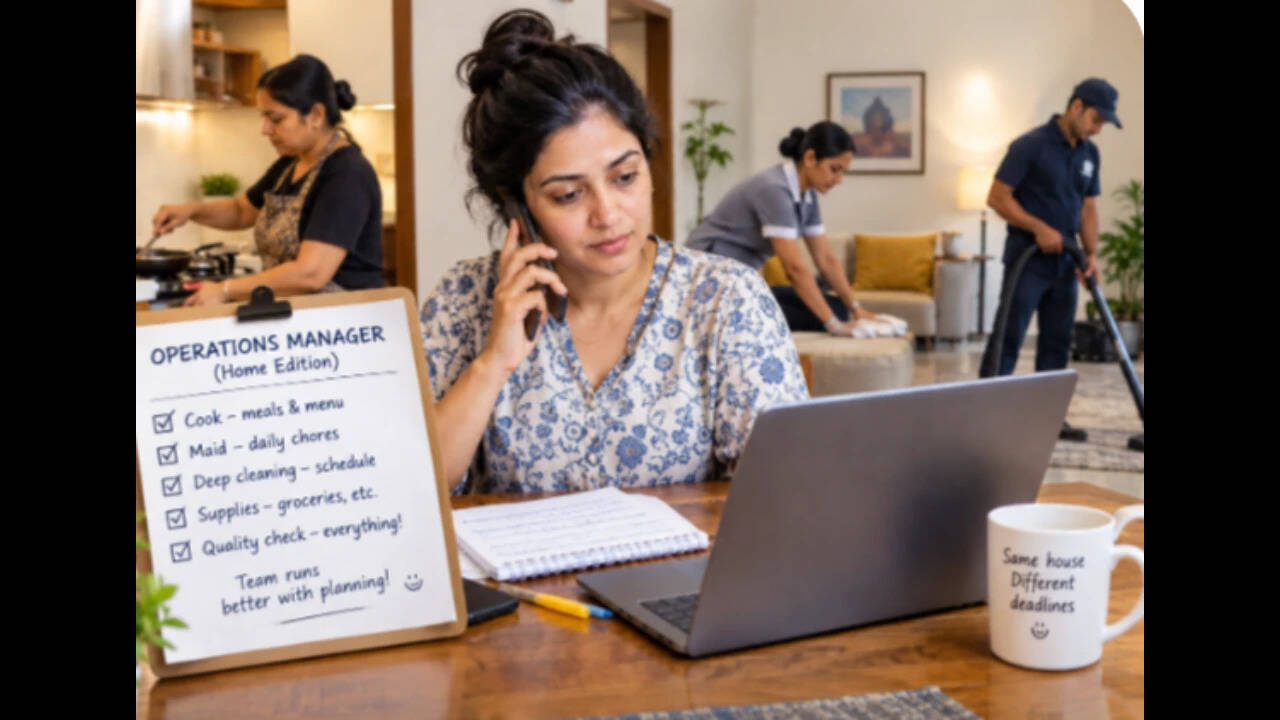
Priya did not escape the domestic treadmill. She was promoted. She is no longer the laborer. She is the operations manager. And the hours are exhausting.
Consider what happens next in thousands of households just like this one. The narrative sold to the diaspora is simple. You move abroad, earn in dollars or pounds, send money back home, and buy yourself out of drudgery. You hire hands to handle the grit so you can glide through life. But human systems do not run on autopilot. They run on friction.
Priya wakes up at 7:00 AM, not to the smell of fresh coffee, but to the hum of her phone vibrating against the nightstand. The cook’s daughter is sick. The cook will be two hours late. Priya’s day—a day carefully scheduled around client calls with Silicon Valley—fractures instantly. She must pivot. She must calculate whether to order takeout, scramble eggs herself, or renegotiate the morning timeline while her toddler pulls at her pajama hem.
This is the hidden tax of outsourcing.
We have inherited a cultural blind spot. We assume that paying someone to perform a task eliminates our relationship with that task. It does not. It merely shifts our role from execution to administration.
Think of it through an intuitive analogy. Imagine buying a franchise restaurant. You do not have to flip the burgers anymore. That sounds like freedom. But suddenly, you are managing inventory, fielding employee grievances, covering for no-shows, auditing quality control, and reconciling accounts at midnight. You traded the physical labor of flipping patties for the mental exhaustion of keeping the enterprise afloat.
Domestic help in urban households operates on the exact same logic.
When an NRI husband looks at his life in India from afar, or when an urban professional looks at their domestic staff, they often harbor a cognitive bias. They see the end state. The clean floor. The hot meal. They do not see the invisible architecture that holds it together.
Priya spends hours vetting agencies, negotiating rates, managing interpersonal dynamics between the maid and the cook, replacing broken crockery, spelling out instructions in three different languages, and absorbing the emotional weight of household staff who have their own lives, illnesses, and emergencies. She is an HR department of one. She is a supply chain manager balancing volatile variables.
And yet, society tells her she has nothing to complain about.
You have a maid.
The phrase is deployed like a magic spell to erase all stress. As if human labor functions like a kitchen appliance—plug it in, push a button, walk away.
But appliances do not text you at 8:00 PM to say they need an advance on their salary for a family wedding. Appliances do not misunderstand instructions, leaving turmeric stains on white marble. Appliances do not possess dignity, complex emotions, or the quiet agency that makes managing human relationships infinitely more delicate than managing code.
When Rohan posted his realization online—that his wife had become an operations manager—it struck a nerve because it exposed a profound cultural hypocrisy. We romanticize the ease of delegation while ignoring the cognitive load of coordination.
The internet loved the post for a day, laughed, and moved on. But Priya’s phone kept buzzing.
Let us look closely at the mechanics of this modern illusion. Why does delegation create fatigue instead of freedom? Behavioral psychologists call it the paradox of control. When you perform a task yourself, you manage your own expectations. When you delegate, you enter a permanent state of quality assurance. You must articulate standards that feel obvious to you but are entirely alien to someone else. You must monitor without micromanaging, correct without alienating, and schedule without burning out.
Priya learned this the hard way during the great deep-cleaning saga of last autumn.
The apartment needed a reset before a family gathering. She hired a specialized service. Five professionals arrived with industrial vacuum cleaners, micro-fiber cloths, and chemical sprays that smelled of artificial pine.
Did Priya sit back with a book?
She stood in her own hallway for six hours like a site supervisor. She intercepted workers who tried to use steel wool on delicate wooden finishes. She directed them away from the antique rug. She unlocked storage rooms, offered tea, verified inventory before they left, and spent the following two days dusting the fine film of chemical residue they had left behind on the bookshelves.
The service was paid for. The labor was outsourced. The mental load multiplied.
We rarely talk about the emotional labor embedded in these domestic structures. In many cultures, the relationship between a household and its domestic help is not purely transactional. It is fraught with historical hierarchies, awkward intimacies, and unspoken boundaries. How do you correct someone gently without sounding harsh? How do you set firm boundaries when personal lives inevitably bleed into professional spaces?
These are not technical questions. They are emotional ones. They drain mental bandwidth in subtle, cumulative drips.
By evening, Rohan logs off his laptop in Seattle. He calls Priya. He asks how her day went. She tells him about the cook, the cleaner, the schedule adjustments, and the mental gymnastics required to keep the household running smoothly across time zones.
Rohan pauses. For the first time, he doesn't offer a quick fix. He doesn't say, Just hire someone else. He finally sees the factory behind the showroom.
The digital age promised us liberation from chores. Instead, it automated the physical and amplified the mental. We have not eliminated domestic labor; we have simply transformed millions of homes into corporate micro-enterprises, with women like Priya serving as the unpaid, unsung CEOs.
The floor is clean. The meal is cooked.
And somewhere in the dark, the phone lights up with tomorrow’s roster.