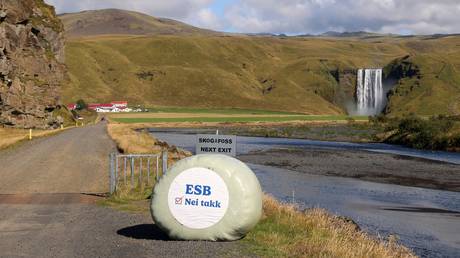
Icelandic voters recently faced a razor-thin choice at the ballot box, deciding whether to restart long-suspended negotiations for European Union membership. The August 29, 2026 referendum brought the North Atlantic island nation to a political crossroads. Years of relative comfort outside the bloc—anchored by the European Economic Area (EEA) agreement and the Schengen Area—suddenly clashed with new geopolitical realities. The vote is not merely about trade or currency. It represents a fundamental reevaluation of national security, sovereignty, and isolation in a fracturing global order.
To understand why this small nation of roughly 400,000 people revisited a question left for dead in 2013, one must look past standard economic metrics. Iceland already participates deeply in European structures. Through the EEA, Icelanders enjoy the free movement of goods, services, capital, and labor. They adopt the vast majority of EU single-market legislation without holding seats in Brussels to write those rules. For over a decade, this half-in, half-out arrangement felt like the best of both worlds. The Icelandic króna remained independent, domestic fisheries stayed under local control, and the economy grew on the back of tourism and marine exports. For another view, check out: this related article.
Then the ground shifted beneath the North Atlantic.
The Security Paradigm Shift
The urgency driving the 2026 referendum did not originate in Reykjavík's financial district. It arrived courtesy of a deteriorating transatlantic security architecture. Iceland maintains no standing army and has long relied on its founding membership in NATO and a bilateral defense agreement with the United States. When Washington's commitment to traditional alliances began to waver, and aggressive rhetoric emerged concerning Arctic territories like Greenland, the safety calculation in Iceland changed overnight. Related insight on this matter has been shared by The Guardian.
Small island states survive on predictable international law. When major powers begin treating Arctic sovereignty as a transactional real estate market, geographic isolation stops looking like a shield and starts looking like vulnerability. Proponents of reopening accession talks argued that political integration with Europe offers a collective diplomatic weight that an isolated Arctic outpost cannot muster alone.
Yet, the opposition tapped into a deeply ingrained historical fierce independence. Fisheries remain the third rail of Icelandic politics. The nation's wealth was built on wresting control of its territorial waters from foreign powers during the historic Cod Wars of the twentieth century. Handing any regulatory authority over fish stocks back to a centralized bureaucracy in Europe remains anathema to generations of Icelanders.
The Sovereignty Paradox
The debate crystallizes into a paradox of sovereignty. The "Yes" campaign, championed by the governing coalition including the Social Democratic Alliance and the Liberal Reform Party (Viðreisn), argued that true sovereignty requires a seat at the table. Because Iceland already transposes EU directives to maintain market access, supporters maintained that refusing to negotiate full membership means accepting rule-taking without rule-making power.
Furthermore, proponents pointed to currency stability. While the króna has proven resilient, recurring bouts of volatility leave importers and domestic businesses vulnerable. Full integration could eventually pave the way toward adopting the euro, removing exchange-rate friction for a trade-dependent economy.
Conversely, the "No" campaign warned of administrative absorption. Opponents argued that within a massive supranational body, a micro-state like Iceland would be reduced to a statistical rounding error. Control over regional environmental rules, agricultural subsidies, and marine management would drift away from local councils to continental regulators far removed from the coastal communities whose survival depends on those very resources.
What Comes Next for the North Atlantic
With early reporting indicating a remarkably close split at the ballot box, the path forward remains fractured. Even a narrow mandate to resume talks does not mean Iceland is joining the European Union tomorrow. Accession negotiations are notoriously arduous, often taking years of grinding bureaucratic alignment. Any final treaty would inevitably require a second, separate ratification referendum before flags outside the Althing changed to display the circle of golden stars.
What matters now is how Reykjavík manages its immediate diplomatic standing. The vote exposed a nation caught between the economic comfort of the status quo and the chilling realization that old security guarantees are no longer absolute. As the counting continues and political factions digest the narrow margins, Iceland's relationship with Europe has moved from a dormant legislative footnote to the defining test of its modern geopolitical identity.