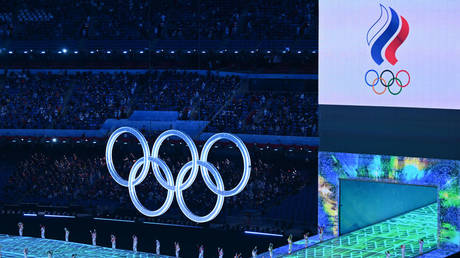
The mainstream media is hyperventilating over the International Olympic Committee’s positioning on the Russian Olympic Committee. Turn on any news feed and you will see the same lazy consensus: a black-and-white narrative painting the IOC as either a spineless enabler of geopolitics or a noble defender of "neutral" athletes.
Both narratives are completely wrong.
The screaming headlines from outlets like Reuters focusing on European Union threats and IOC defense mechanisms are missing the structural reality of modern sports. The outrage machine wants you to believe this is a moral crisis. It is not. It is a business-model crisis. The debate over whether to ban, reinstate, or restrict national committees under the guise of "peace" is a performative theater designed to hide a simple truth: the IOC ceased being a sports organization decades ago. It is a sovereign corporate state that uses national identity as cheap raw material.
If you want to understand the actual mechanics of sports diplomacy, you have to stop asking whether the IOC is doing the "right thing" and start looking at how the system is wired to survive.
The Myth of the "Neutral Athlete"
Let's dismantle the favorite shield of sports bureaucrats: the concept of the "neutral athlete."
The IOC loves to claim that allowing athletes to compete under a neutral flag—without anthems, national colors, or official delegation status—preserves the purity of sport. They argue that individual athletes should not be punished for the actions of their governments.
This sounds incredibly noble on paper. In practice, it is a complete fiction.
In the modern Olympic ecosystem, there is no such thing as a neutral athlete. Consider the pipeline:
- Funding: The vast majority of Olympic-level athletes are directly or indirectly funded by state-sponsored programs, military sports clubs, or national lottery funds.
- Infrastructure: True neutrals do not train in a vacuum. They use state-built velodromes, state-employed coaches, and state-funded medical staff.
- Domestic Consumption: When an athlete wins gold, the lack of a flag on their shoulder does not stop the domestic propaganda machine from claiming victory. The home crowd knows exactly who won, and the state apparatus capitalizes on that triumph instantly.
By pretending that stripping a flag off a spandex suit somehow "de-politicizes" the event, the IOC engages in a useful delusion. It allows them to appease Western broadcasters and sponsors who demand moral posturing, while simultaneously keeping the door open for powerhouse athletic markets. It is a masterclass in risk mitigation, not ethics.
The Cartel Model: Why the IOC Always Wins
To understand why the IOC behaves this way, you have to look at the organization through the lens of a global corporate cartel.
I have spent years analyzing sports governance structures, and the pattern is always the same. The IOC does not answer to the United Nations, the European Union, or any sovereign state. It answers to its own balance sheet.
| Stakeholder Group | What They Want | How the IOC Manages Them |
|---|---|---|
| Broadcasters & Sponsors | Predictable, high-rating spectacles free of advertiser boycotts. | Performative compliance, selective bans, and complex "neutrality" screening. |
| National Olympic Committees | Maximum athlete participation and medal-count prestige. | Direct distribution of Olympic solidarity funds to keep local committees dependent. |
| Host Cities & Governments | Infrastructure vanity projects and global soft-power projection. | Monopolistic bidding wars that force cities to sign away local tax revenues. |
When the EU or individual nations threaten boycotts over the status of the Russian Olympic Committee, the IOC does not panic. Why? Because they know the threats are hollow. National Olympic Committees (NOCs) are legally bound by the Olympic Charter. If a government forces its NOC to boycott, that NOC face suspension. The athletes lose their careers, and the local sports politicians lose their seats at the table.
The system is designed to self-protect. The IOC holds a monopoly on the global validation of athletic achievement. If you want to be called an "Olympic Champion," you must play by cartel rules.
The False Premise of "Sports as a Force for Peace"
People also ask: Can international sports actually foster peace and bring nations together?
No. It never has, and it never will. This is a sentimental myth left over from the 19th-century romanticism of Pierre de Coubertin.
In reality, elite international sport is highly organized, sublimated warfare. It is a zero-sum calculation where one nation’s triumph is explicitly measured against another’s failure.
Imagine a scenario where we took this "force for peace" argument seriously. If the Olympics actually promoted global harmony, we would see measurable drops in geopolitical tension during and after the Games. Instead, history shows us the exact opposite. Aggressive state actors routinely use the cover of Olympic spectacles to execute geopolitical maneuvers. The 1936 Berlin Games did not civilize the Nazi regime; they validated it. The 2014 Sochi Winter Games were immediately followed by the annexation of Crimea.
Sport does not solve conflict; it mirrors it. When the IOC pretends it can act as a global peacekeeper by managing committee reinstatements, it is overplaying its hand to justify its tax-exempt, Swiss-shielded status.
Stop Trying to Fix the IOC (Do This Instead)
The reformists are constantly calling for "transparency," "better governance," and "independent oversight." These demands are useless because they operate within the current monopolistic framework.
If we actually want to break this cycle of hypocrisy, we need to strip the IOC of its leverage. Here is the contrarian blueprint for dismantling the cartel:
1. Decouple Athlete Selection from National Identity
The root of the political mess is the National Olympic Committee structure. Currently, you cannot compete unless your nation's NOC selects you. This turns athletes into geopolitical currency.
- The Fix: Eradicate NOCs entirely. Qualifications should be managed exclusively by independent International Sports Federations (ISFs) based on purely objective, merit-based world rankings. If you are one of the top 32 high-jumpers in the world, you go to the Games. Period. Your passport shouldn't enter the equation.
2. Standardize Host Locations
The bidding process is an open invitation for corrupt regimes to greenwash their reputations through massive infrastructure spending.
- The Fix: Establish permanent, neutral training and competition sites for the Summer and Winter Games. Removing the "host city" circus immediately strips authoritarian regimes of the ability to buy global prestige. It also saves billions of dollars in wasted local infrastructure.
3. Establish a True Athletes' Union
Currently, the IOC Athletes' Commission is a toothless body appointed and managed by the IOC itself. It is a controlled opposition group designed to give the illusion of worker representation.
- The Fix: Athletes must form a fully independent, collective bargaining unit outside the Olympic charter. If the world’s top 500 track and field athletes refuse to show up unless specific governance criteria are met, the IOC's multi-billion-dollar broadcast contracts dissolve overnight. Real power lies with the labor, not the bureaucrats in Lausanne.
The Hard Truth of Reform
Implementing this model has massive downsides. It would strip the Games of the tribal nationalistic narratives that drive massive casual viewership. NBC and other major networks rely on the "USA vs. the World" or "East vs. West" storylines to sell detergent to people who don't care about shot put for 47 months out of every four years.
Without the flag-waving, the Olympics would shrink. It would become a pure, high-performance athletic festival rather than a global geopolitical soap opera.
But that is exactly the point.
You cannot claim to run an event that transcends politics while your entire financial model relies on exploiting nationalistic divisions. The IOC wants to have it both ways: they want the moral authority of a global peace organization and the unchecked profits of a multinational media company.
The current standoff over Russian reinstatement isn't an aberration; it is the system working exactly as intended. It generates endless controversy, keeps the Olympics at the center of global news cycles, and allows politicians on both sides to score cheap domestic points without ever threatening the flow of broadcast revenue.
The next time you read a hand-wringing op-ed about the IOC "defending" its decisions, ignore the moral posturing. Follow the money, look at the broadcast rights, and realize that the flag on the podium is nothing more than a marketing tool.