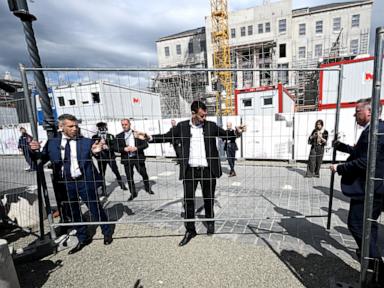
You can tell a lot about a leader by the way they handle a piece of metal. On a crisp Friday morning in Budapest, Hungary's newly minted Prime Minister Péter Magyar didn't just give a speech about transparency. He walked up to the heavy metal security fences surrounding the Karmelita, the historic former Catholic monastery on Castle Hill that served as Viktor Orbán's executive fortress, and physically helped push them open.
It wasn't a subtle stunt. It was an intentional, aggressive dismantling of a physical symbol that has defined Hungarian politics for half a decade. Also making headlines in this space: The Real Reason the Harvey Weinstein Prosecution Just Collapsed.
When Orbán cordoned off the building in 2021 under the guise of construction work, everyone in Budapest knew the real reason. It was about keeping the public, the press, and political reality out. By tearing down those barriers alongside his newly appointed transportation and investment minister, Dávid Vitézy, Magyar delivered a blunt message. The era of the fortified state is over. The doors are open.
This isn't just about optics. This is the first concrete step in a massive institutional overhaul following the April 2026 election, where Magyar's center-right Tisza party secured a stunning two-thirds majority, ending Orbán's 16-year run. If you want to understand where Hungary is heading, you have to look at the physical space these politicians occupy. More insights on this are covered by Reuters.
The Real Story Behind the Fortress on Castle Hill
To understand why removing these fences matters so much to ordinary Hungarians, you need to look at what the Karmelita building actually represented. For years, the monastery stood as the nerve center of Orbán’s self-described "illiberal democracy."
When the former administration installed the cordons in 2021, independent journalists found themselves blocked from asking questions. The perimeter became a literal wall between the ruling elite and the citizens funding them. Magyar didn't mince words standing outside the gates, noting that the historic buildings were completely funded and made beautiful by Hungarian taxpayers. There's simply no room for barricades in a country trying to move past an autocratic regime.
But Magyar is going a step further than just opening the gates. He's refusing to even work there.
Instead of moving into the opulent rooms favored by his predecessor, Magyar announced he's moving the prime minister's seat entirely out of Castle Hill. He’s taking the executive office across the Danube river to the administrative, working-class heart of the city. The move breaks the deliberate imperial illusion that the old government spent over a decade cultivating.
What happens to the multi-million dollar renovated monastery now? It’s being handed over to the public. The government has already launched a live website allowing everyday citizens to book guided tours of the building. Magyar wants people to see the luxury renovations carried out for former government officials with their tax money. Sunlight, it turns out, is the first weapon of choice for the new administration.
Dismantling the Machinery of State Capture
If you think this is just a quick PR win for a new leader, you're missing the broader economic and institutional battle happening behind the scenes. Opening the fences around the executive office is the easy part. The real work involves recovering billions in state assets and reforming a deeply entrenched political structure.
The Tisza party's 141-seat majority in the 199-seat parliament gives Magyar the constitutional power to make sweeping changes. He's already moving forward with plans to establish a National Asset Recovery and Protection Office. This new authority has one primary directive: investigate the massive corruption and wealth transfers that occurred during the final years of the previous administration. Reports are already circulating of former officials scrambling to move assets out of the country before the new investigators take their seats.
The immediate financial stakes are massive for everyday Hungarians. Because of systemic corruption and rule-of-law violations under the previous government, the European Union froze billions of euros in budget funds intended for Budapest. By demonstrating an immediate, aggressive pivot toward transparency, Magyar is unlocking that cash.
A political deal with the European Commission is expected to release up to €17 billion back to Hungary. That's roughly 8% of the country's entire GDP. It's a massive fiscal injection that Magyar desperately needs to fix crumbling public services, repair a stagnant economy, and deal with a bloated budget deficit.
A Radical Shift in European Foreign Policy
The political earthquake in Budapest doesn't just stop at the Hungarian border. For the last several years, Hungary operated as the ultimate spoiler inside the European Union and NATO. Orbán routinely used his veto power to stall critical packages, most notably a €90 billion EU loan package for Ukraine.
Magyar’s ascendancy completely flips that dynamic. Sworn into office on Europe Day, the new Prime Minister has made it explicitly clear that Hungary is reclaiming its spot in the Western democratic fold. The constant flirting with Moscow is coming to an end. The new government has committed to systematically winding down Hungary's reliance on Russian energy by 2035, while maintaining purely pragmatic diplomatic relations where absolutely necessary.
However, external observers shouldn't mistake Magyar for a standard Western progressive. He is a pragmatic, center-right lawyer who spent years inside the political system before breaking away in early 2024. He knows his electorate intimately. Many of the 3.4 million Hungarians who voted for him still hold deeply conservative views.
For instance, Magyar has openly stated that he opposes the EU’s mandatory redistribution quotas for asylum-seekers. He firmly believes in strict European border control. In a twist of political irony, the new government plans to keep the massive physical border fences constructed on Hungary's southern borders to curb illegal migration. It seems fences are acceptable to Magyar when protecting national borders, but entirely unacceptable when used to shield politicians from their own voters.
Rebuilding a Fractured Society From the Ground Up
The most challenging task facing the new administration isn't rewriting laws or negotiating with Brussels. It's fixing a deeply polarized society. The previous administration didn't just capture state institutions; it weaponized the state media into an aggressive propaganda machine designed to keep the population divided and fearful.
Magyar took the fight directly to the state broadcasters just days after his election. In his first interviews on public radio and television in over 18 months, he openly compared the current state media output to authoritarian propaganda. His solution is drastic: the government plans to completely suspend state media news services until their public service character can be legally and structurally restored under a new press law.
The upcoming months will show whether a country can truly transition away from an entrenched hybrid regime without collapsing into political chaos. The early signals show a relentless focus on transparency and institutional accountability. By inviting the public into the former halls of power and moving the executive offices closer to the people, the new administration is trying to prove that the government belongs to the citizens, not the party.
If you want to track the progress of Hungary's democratic experiment, look at the schedule for the new tours at the Karmelita. The moment those doors slam shut again will be the moment you know the new system has failed. For now, the barricades are down, the public is moving in, and a very different chapter of central European history is officially being written.