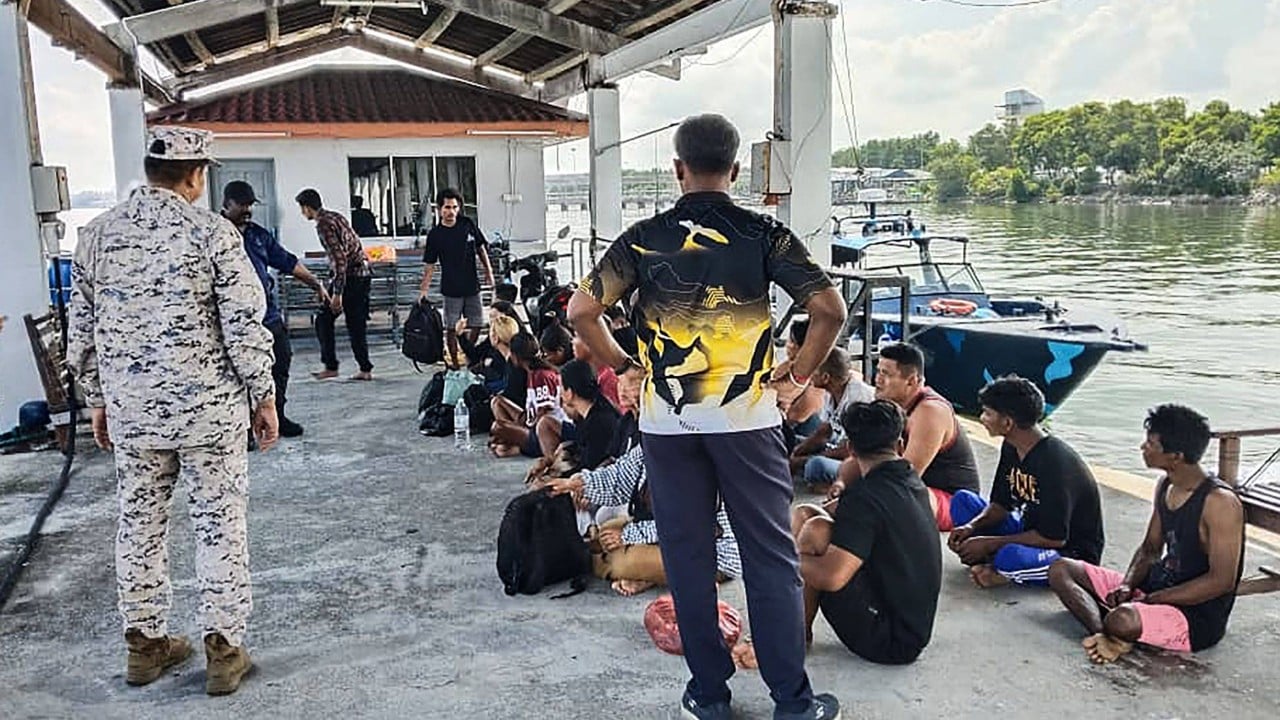
The search for 14 Indonesian nationals missing after their vessel capsized near Malaysia’s Pangkor Island has shifted from a rescue operation to a grim recovery effort. While official reports focus on the mechanics of the sinking—heavy swells and an overloaded wooden hull—the real story lies in the persistent, dangerous transit lines that bypass official immigration channels. This is not a simple maritime accident. It is a recurring symptom of a regional labor squeeze and the desperate measures taken by workers to navigate the tightening borders between Indonesia and Malaysia.
The incident occurred in the early hours of the morning, a timing favored by those attempting to evade the Malaysian Maritime Enforcement Agency (MMEA). Initial survivor accounts suggest the boat was carrying far more than its intended capacity, a common practice for unlicensed operators looking to maximize profit on a single high-risk run. When the weather turned, the vessel stood no chance.
The Geography of Risk
Pangkor Island sits along a stretch of the Malacca Strait that is notoriously difficult to patrol. Its proximity to the Indonesian coastline makes it a primary landing point for those entering Malaysia without documentation. But the geography is only half the problem. The waters here are some of the busiest in the world, filled with massive tankers and unpredictable currents. A small, wooden boat laden with people and minimal safety equipment becomes a floating coffin the moment the wind picks up.
The "why" behind these journeys is rooted in a brutal economic reality. Malaysia relies heavily on Indonesian labor for its construction and plantation sectors, yet the legal path to employment is often bogged down by predatory recruitment fees and bureaucratic delays that can take months to clear. For a worker with a family to feed, the choice between waiting six months for a legal permit or paying a week's wages for a midnight boat ride isn't much of a choice at all.
Beyond the Official Toll
Search and rescue teams have deployed multiple vessels and aircraft, but the window for finding survivors in these conditions is closing. The Malacca Strait does not give up its secrets easily. Often, the number of missing reported by authorities is an undercount. These boats do not carry passenger manifests. Families in rural Indonesia may not even know their loved ones were on this specific vessel until they fail to call home at the end of the week.
We are seeing a shift in how these operations are run. Ten years ago, these were often small-scale family affairs. Today, they are increasingly handled by organized syndicates that treat human cargo with less care than a shipment of palm oil. The boats are often in a state of advanced decay, purchased cheaply and intended for only one or two trips before being abandoned or scuttled.
The Breakdown of Border Security
The Malaysian government has poured millions into maritime surveillance, yet the sinkings continue. This suggests that the "iron fist" approach to border security is hitting a wall. You can have the best radar in the world, but you cannot stop a man who believes his only path to survival is on the other side of that water.
Corruption also plays a silent role. It is an open secret in the port towns of Sumatra and the fishing villages of Perak that some eyes are occasionally averted for the right price. Until the incentive structures for local officials and the labor laws for migrant workers are overhauled, the Pangkor Island incident will simply be another entry in a long, tragic ledger.
The Myth of the Better Life
Those who survive the crossing often find that the hardship has only just begun. The "better life" promised by recruiters frequently turns into a cycle of debt bondage. Without legal status, workers have no recourse when employers withhold pay or provide substandard housing. They live in the shadows, avoiding hospitals and police, always one tip-off away from a detention center and eventual deportation.
The risks are high, but the rewards are seen as worth the gamble. A month of manual labor in Malaysia can earn a worker three times what they would make in their home province. This wage gap is the engine that drives the boats. It is an engine that does not care about wave heights or life jacket counts.
A Failure of Diplomacy
Indonesia and Malaysia have signed numerous memorandums of understanding (MoUs) regarding the recruitment and protection of domestic and plantation workers. On paper, these documents provide a framework for safe, legal migration. In practice, they are often ignored or bypassed by the very agencies meant to enforce them.
The red tape involved in legal migration is so thick that it creates a vacuum. Criminal elements are more than happy to fill that vacuum with fast, dangerous alternatives. This latest tragedy near Pangkor Island is a direct result of a system that makes it easier to risk death at sea than to fill out a stack of forms and pay a legitimate agent.
The Mechanics of the Sinking
When a boat capsizes in the Malacca Strait, death usually comes from one of two things: impact or exhaustion. Most of these vessels lack even basic flotation devices. In the panic of a midnight capsizing, passengers are often trapped beneath the hull or swept away by currents before they can even orient themselves.
Standard maritime safety protocols require a specific ratio of life jackets to passengers. On these clandestine runs, life jackets are viewed as a liability. They take up space that could be used for another paying passenger, and they make the boat more visible to patrols. The operators prioritize stealth over survival every single time.
The Search Effort Realities
The MMEA and the Malaysian Royal Navy are currently scouring a search grid that expands with every passing hour. The difficulty lies in the debris. In a busy shipping lane, distinguishing between wreckage from a small boat and general maritime trash is an exhausting, often fruit-and-less task.
Divers are limited by the visibility in these silt-heavy waters. If the boat sank in one of the deeper channels, it may never be recovered. This leaves families in a state of perpetual limbo—unable to mourn, unable to move on, and often unable to claim whatever meager life insurance or government support might have been available if the death were officially confirmed.
Analyzing the Labor Pipeline
The demand for cheap labor is not going away. As Malaysia’s economy continues to grow, its appetite for workers from neighboring countries will only increase. This creates a permanent market for the "midnight express" boats.
The solution isn't just more patrol boats. It is a fundamental redesign of how labor moves across the ASEAN region. If the legal path is made cheaper and faster than the illegal one, the syndicates lose their customers. Until then, the profit margins for human smuggling remain high enough to outweigh the risk of losing a boat and a dozen lives.
The Role of the Syndicates
These organizations are nimble. When one route is shut down, they move to another. When Pangkor Island becomes too hot with police activity, they shift their landing points further north toward Langkawi or south toward Port Dickson. They use encrypted apps to coordinate departures and have scouts on the ground to monitor patrol movements.
They are, in many ways, more efficient than the governments trying to stop them. They understand the market, they understand the desperation, and they have no moral qualms about the outcome. To them, the 14 missing people are not a tragedy; they are a lost investment.
The Impact on Local Communities
Fishing communities on both sides of the strait are often caught in the middle. They are the ones who find the bodies in their nets or the survivors washed up on their shores. There is a quiet empathy among these coastal people, many of whom have relatives who have made similar journeys.
However, there is also a growing sense of frustration. The frequent accidents bring unwanted heat from the authorities, disrupting local fishing and trade. The presence of large-scale search and rescue operations can shut down fishing grounds for days, hitting the pockets of people who are already living on the edge.
The False Hope of Technology
There is a tendency to look toward technology for a fix. Thermal imaging, drones, and satellite tracking are all being deployed with increasing frequency. While these tools are effective at spotting larger vessels, they often struggle with the small, low-profile wooden boats used in these crossings.
Furthermore, technology cannot solve a problem that is essentially human. A drone can see a boat, but it cannot see the debt, the lack of opportunity, and the hope that pushed those people onto that boat in the first place.
The Accountability Gap
Who is held responsible when these boats go down? Usually, it is the "tekong" or the boat captain, if they happen to survive. These individuals are often just low-level employees of larger syndicates. The real kingpins—the ones who own the boats and collect the bulk of the money—are rarely, if ever, brought to justice.
They operate from the safety of air-conditioned offices in Medan or Kuala Lumpur, far removed from the spray and the screams of a sinking boat. Without a concerted effort to target the financial structures of these smuggling rings, the arrests of a few captains will do nothing to stem the tide.
Regional Cooperation or Conflict?
The relationship between Malaysia and Indonesia is often strained by these incidents. There is a cycle of blame: Malaysia accuses Indonesia of not doing enough to guard its exits, while Indonesia accuses Malaysia of not doing enough to protect workers once they arrive.
This finger-pointing serves no one. It only creates a diplomatic fog that the smuggling syndicates use as cover. A true regional solution would involve integrated border management and a shared database of labor recruiters to ensure that workers aren't being exploited before they even step foot on a boat.
The Reality of the Malacca Strait
The 14 missing Indonesians are the latest victims of a system that prizes cheap labor over human life. The Malacca Strait is a graveyard for thousands who thought they could outrun poverty. It is a stretch of water where the dreams of a better life are frequently swallowed by the reality of a poorly maintained engine and a sudden storm.
The search continues, but history suggests that the outcome will be familiar. A few bodies will be recovered, a few headlines will be written, and then the world will move on until the next boat sinks. The demand for workers remains. The wage gap remains. The boats will keep leaving the Sumatran coast under the cover of darkness, and the strait will keep taking its toll.
Stop looking for a single villain in this story. The villain is a regional economic structure that makes a deadly boat ride the most logical choice for a man trying to provide for his children. Until the legal pathways for migration are as accessible as the illegal ones, the waters around Pangkor Island will remain a site of preventable tragedy.
Check the tide charts. Watch the horizon. The next boat is already being loaded.