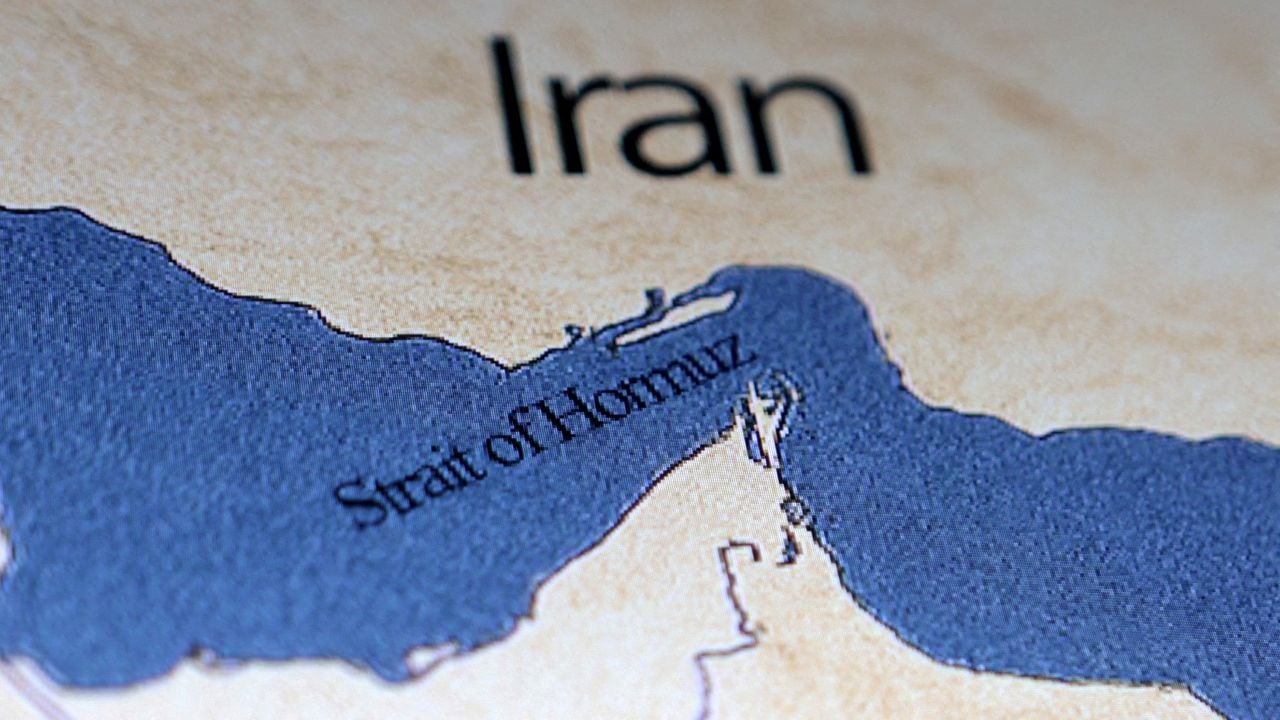
The Strait of Hormuz functions less as a geographical bottleneck and more as a binary switch for global energy stability. Any negotiation between Washington and Tehran that ignores the physical and economic architecture of this waterway is fundamentally flawed. While political analysts focus on the rhetoric of "deals" or "breakthroughs," a rigorous assessment reveals that the Strait is Iran’s primary instrument of asymmetric leverage—a tool designed to equalize a massive disparity in conventional military and economic power.
The Structural Anatomy of the Chokepoint
The Strait of Hormuz is approximately 21 miles wide at its narrowest point, but the shipping lanes—the actual functional corridors for Very Large Crude Carriers (VLCCs)—are only two miles wide in each direction, separated by a two-mile buffer zone. This geographic compression creates a high-density environment where the cost of disruption is exceptionally low compared to the cost of defense.
Iran’s strategic posture relies on three specific physical advantages:
- Territorial Proximity: The northern shores of the Strait are controlled by Iran, allowing for the deployment of land-based anti-ship cruise missiles (ASCMs) and long-range artillery that can reach any point in the navigable channel.
- Bathymetric Asymmetry: The shallow, rugged waters of the Persian Gulf favor small, fast-attack craft and midget submarines over deep-draft carrier strike groups. This environment nullifies much of the US Navy’s high-seas advantage.
- The Qeshm-Hormuz Axis: Islands like Qeshm, Larak, and Abu Musa act as "unsinkable aircraft carriers," providing forward-deployed bases for rapid-response maritime units.
The Cost Function of Maritime Disruption
To understand why the Strait remains a "deal-breaker," one must quantify the impact of even a partial closure. The global economy does not react to the actual physical stoppage of oil; it reacts to the Risk Premium of Transit.
The mechanics of this premium are driven by the London insurance market. If the Strait is declared a war zone or if the threat level reaches a specific threshold, Protection and Indemnity (P&I) clubs and hull underwriters spike premiums. In a worst-case scenario, they may withdraw coverage entirely. Since no commercial tanker will sail without insurance, a "soft closure" occurs without Iran firing a single shot. This is the primary lever Tehran pulls during high-stakes diplomatic cycles.
The Energy Dependency Matrix
Approximately 20% of the world’s total petroleum liquids consumption passes through the Strait daily. The dependency is not uniform across the globe:
- East Asian Vulnerability: China, India, Japan, and South Korea are the primary destinations for Hormuz-bound crude. A disruption here creates a demand shock in the East that ripples back to Western markets via price arbitrage.
- The LNG Bottleneck: Qatar, the world’s largest liquefied natural gas (LNG) exporter, is entirely dependent on the Strait. Unlike oil, which can be drawn from Strategic Petroleum Reserves (SPR) or redirected via pipelines (though with significant capacity constraints), LNG has no immediate substitute for large-scale power generation in Europe and Asia.
Iranian Kinetic Capabilities and Tactical Logic
Tehran’s maritime strategy is built on Distributed Lethality. Instead of engaging in a traditional naval battle, the Islamic Revolutionary Guard Corps Navy (IRGCN) utilizes a swarm logic designed to overwhelm the Aegis Combat Systems of US destroyers.
The Swarm Variable
A swarm attack utilizes dozens of high-speed boats armed with 107mm rockets, torpedoes, or C-704 anti-ship missiles. The goal is saturation. If a defense system has a 95% interception rate, launching 100 simultaneous targets ensures five hits. In the narrow confines of the Strait, the reaction time for a 9,000-ton destroyer is measured in seconds, not minutes.
The Mining Threat
Modern naval mines are no longer simple contact spheres. Influence mines—which trigger based on acoustic, magnetic, or pressure signatures—can be laid by civilian dhows or small submarines. The mere suspicion of mines requires a slow, methodical MCM (Mine Countermeasures) operation. The US Navy’s MCM assets are limited in number and move at speeds of less than 10 knots, effectively freezing commercial traffic for weeks during a clearing operation.
Pipelines as a Strategic Mitigant
Both Saudi Arabia and the United Arab Emirates have invested in "Hormuz bypass" infrastructure, yet these projects remain insufficient to offset a full closure.
- The East-West Pipeline (Petroline): Running across Saudi Arabia to the Red Sea, this line has a nameplate capacity of roughly 5 million barrels per day (mb/d). However, actual operational surge capacity is often lower due to maintenance and domestic requirements.
- The Abu Dhabi Crude Oil Pipeline (ADCOP): This connects the Habshan fields to Fujairah on the Gulf of Oman, bypassing the Strait with a capacity of 1.5 mb/d.
Even if these pipelines operate at 100% efficiency, they can only handle approximately 6.5 mb/d of the 20+ mb/d that typically flows through the Strait. This 13.5 mb/d deficit is the "Irreducible Risk" that gives Iran its seat at the negotiating table.
The Sanctions-Security Feedback Loop
The relationship between US-led sanctions and Hormuz stability is a feedback loop. When the US applies "Maximum Pressure" to Iranian oil exports, Tehran’s incentive to maintain a stable Strait evaporates. If Iran cannot export its oil, its strategic logic dictates that no one else should export theirs with ease.
This creates a Stalemate of Escalation:
- Washington imposes sanctions to force a nuclear or regional policy shift.
- Tehran increases maritime friction (tanker seizures, drone strikes) to signal the cost of those sanctions.
- Global oil prices rise, putting political pressure on Western leaders.
- Negotiations resume, but the underlying threat remains as Iran’s primary "insurance policy" against future reneging.
The Intelligence Gap in Maritime Security
A critical failure in standard analysis is the assumption that the US and its allies have total "Domain Awareness." In reality, the Persian Gulf is one of the most cluttered electromagnetic environments on earth. Thousands of small vessels, many without AIS (Automatic Identification System) transponders, create a "noise" floor that makes it easy to hide specialized military assets.
The use of Unmanned Surface Vessels (USVs) by both sides has further complicated the calculus. These "suicide drones" of the sea are low-cost, high-impact, and provide the attacker with plausible deniability—a key requirement in the "Grey Zone" conflict that precedes formal warfare.
Escalation Dominance and the "Hormuz Dilemma"
For the United States, achieving "Escalation Dominance" in the Strait is nearly impossible. Every military response to Iranian provocation risks a price spike that harms the US domestic economy. Conversely, non-response erodes the "Freedom of Navigation" principle that underpins global trade.
Iran understands this dilemma perfectly. Their strategy is not to win a war, but to make the cost of a "no-deal" scenario higher than the cost of concessions. This is why Ajay Bisaria and other seasoned diplomats view the Strait as a deal-breaker; it is the only theater where Iran holds the tactical initiative despite an overall deficit in national power.
The Role of External Power Brokers
The Strait is no longer just a US-Iran friction point. China’s "Belt and Road" interests and its reliance on Iranian and Saudi oil have made Beijing a quiet but firm stakeholder in Hormuz stability.
- The Chinese Buffer: China’s purchasing of "shadow market" Iranian oil provides Tehran with a revenue lifeline, reducing the desperation that might lead to a full closure of the Strait.
- The Russian Factor: Increased military cooperation between Moscow and Tehran suggests that any conflict in the Strait could see the introduction of more advanced Russian electronic warfare (EW) suites, further eroding the technological edge of Western naval forces.
Operational Constraints and the Logistics of Siege
A full blockade of the Strait by Iran is unlikely because it would be a "suicide move" economically. However, a "controlled instability" model is highly effective. By selectively harassing vessels from specific nations or those associated with certain shipping companies, Iran can exert surgical pressure.
The logistics of maintaining a permanent US carrier presence in the region is also a limiting factor. The "pivot to Asia" requires these assets in the South China Sea. Every time a carrier is pulled into the North Arabian Sea to deter Iran, it creates a strategic vacuum in the Indo-Pacific. This "Global Force Management" tension is a secondary victory for Iranian strategy.
Strategic Forecast: The Shift to Asymmetric Permanence
The Strait of Hormuz will remain the ultimate deal-breaker because there is no technological or geographical solution to the vulnerability it represents. Even if the Iranian nuclear issue is resolved, the conventional threat to the Strait will persist as long as the regional power balance remains contested.
The final strategic play for Western planners and energy markets is not to seek a way to "solve" the Hormuz problem, but to build enough redundancy—through massive increases in global SPR, accelerated pipeline projects in the Levant, and diversified energy sources—to reduce the "Risk Premium" to a manageable level. Until that redundancy exists, the global economy remains a hostage to the geography of the Persian Gulf and the tactical whims of the IRGCN. The only viable path forward is a security framework that treats Hormuz not as a military theater, but as a shared global utility, moving the conversation from "control" to "guaranteed access" backed by a multi-polar maritime task force that includes regional stakeholders. Without this shift, the Strait will continue to trigger a global economic heart attack whenever diplomatic temperatures rise.