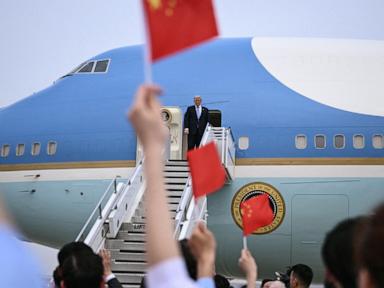
The second day of high-stakes negotiations between Donald Trump and Xi Jinping didn’t produce the breakthrough the markets were hoping for. Instead, it exposed a fundamental shift in how the world’s two largest economies view the concept of a deal. While the cameras captured the optics of a cordial lunch and measured joint statements, the underlying reality is a hardening of positions that suggests we are moving away from a trade war and toward a permanent economic divorce.
The primary takeaway is that China is no longer willing to make the sweeping structural changes to its state-led economic model that the U.S. demands. In exchange, the Trump administration is doubling down on a policy of containment disguised as commerce. This isn't just about soybeans or semiconductors anymore. It is about which nation will dictate the technical standards and financial architecture of the next fifty years.
The Illusion of the Purchase Agreement
Much of the day’s discussion centered on massive purchase agreements. On paper, these look impressive. China agrees to buy billions of dollars in American energy and agriculture products. The U.S. gets a temporary reduction in the trade deficit. It feels like a win.
However, veteran analysts know these "shopping list" deals are a distraction. They are easy to sign and even easier to ignore once the political pressure fades. They do nothing to address the core grievances of the American manufacturing sector: intellectual property theft, forced technology transfers, and the massive subsidies Beijing pumps into its "national champions." By focusing on the deficit—a metric many economists consider a secondary concern—the U.S. is trading long-term strategic advantage for short-term political optics.
China views these purchases as a "peace tax." They pay it to keep the tariffs from escalating further while they continue to build an internal ecosystem that is entirely independent of Western technology.
Silicon Sovereignty and the New Iron Curtain
The tension in the room turned sharp when the conversation shifted to telecommunications and artificial intelligence. This is the real battlefield. For the U.S., allowing Chinese firms like Huawei or ZTE into critical infrastructure is a non-starter for national security reasons. For Xi, these companies represent the crown jewels of China’s modernization.
We are witnessing the birth of "Silicon Sovereignty." This is a world where the internet splits in two. One half runs on American chips and software; the other runs on Chinese hardware and a closed-loop digital environment.
The Cost of Redundancy
This split isn't free. Global supply chains have spent thirty years optimizing for efficiency. Now, they are being forced to optimize for resilience and political alignment.
- Manufacturing shifts: Companies are moving assembly lines from Shenzhen to Vietnam or Mexico, not because it’s cheaper, but because it’s safer.
- R&D duplication: Tech giants are now being forced to develop two versions of their products—one that complies with U.S. standards and one that satisfies Beijing’s "Great Firewall."
- Resource hoarding: China’s dominance in rare earth minerals remains a silent hammer. If the U.S. pushes too hard on chip exports, Beijing has the power to choke off the raw materials needed to build those chips in the first place.
The Currency Battlefield
Beyond the trade of physical goods, a quieter war is being fought over the dominance of the dollar. During Day 2, Chinese officials hinted at the continued internationalization of the yuan. This isn't just a matter of pride.
If China can convince its trading partners—particularly those in the Belt and Road Initiative—to settle transactions in yuan, it effectively creates a financial system that is immune to U.S. sanctions. The U.S. weaponized the dollar to cut off North Korea and Iran. Beijing has watched this closely. Their goal is to ensure that the U.S. can never do the same to them.
The "Debt Trap" narrative also loomed over the summit. Washington accuses Beijing of lending billions to developing nations for infrastructure projects they can't afford, only to seize the assets when they default. Beijing counters that the U.S. uses the IMF and World Bank to impose "neoliberal" conditions on those same nations. Both sides are right, and both sides are using finance as a weapon of statecraft.
The Myth of the Level Playing Field
The phrase "level playing field" was thrown around frequently by the American delegation. It’s a nice sentiment, but it’s a fantasy. China’s economic system is built on the premise that the state and industry are one. There is no version of a trade deal where the Chinese Communist Party voluntarily gives up control over its banking system or its state-owned enterprises. To do so would be to invite the kind of political instability the party fears most.
The U.S. is beginning to realize this. Instead of trying to change China, the strategy is shifting toward building a "fortress America." This involves the CHIPS Act, domestic subsidies, and a renewed focus on industrial policy—the very things the U.S. used to criticize China for doing. We aren't convincing China to be more like us; we are becoming more like them to compete.
The Agriculture Factor
Farmers in the American Midwest remain the most vulnerable pawns in this game. They rely on the Chinese market for survival, yet they are the first to feel the sting of retaliatory tariffs. The Day 2 discussions offered them some hope through promised purchases of corn and pork, but the underlying volatility remains.
China has spent the last five years diversifying its food supply. They have invested heavily in Brazilian soy and Russian wheat. They no longer need the American farmer as much as the American farmer needs them. This creates a massive leverage point for Xi. He can turn the tap of American agricultural exports on or off to influence U.S. domestic politics, specifically in swing states.
The Security Paradox
Perhaps the most significant development was what wasn't said. There was no mention of a rollback of the most restrictive export controls. The "Entity List"—the blacklist of Chinese companies restricted from buying American tech—continues to grow.
This creates a security paradox. By cutting off China’s access to high-end chips, the U.S. is intended to slow their military modernization. However, this same move has forced China to dump billions into its own domestic chip industry. In the short term, they are struggling. In the long term, the U.S. may be inadvertently creating its most formidable competitor by removing the option of dependency.
The Real Winner of the Summit
If success is measured by clarity, then the summit was a success. If it is measured by a return to the "Goldilocks" era of globalization, it was a failure.
The real winner isn't Trump or Xi. It is the concept of regionalism. We are seeing the end of a single, globalized market. In its place, we are getting a fragmented world of competing blocs. The winners in this new era will be the "middle powers"—nations like India, Indonesia, and Brazil—who can play both sides against each other to extract the best possible terms.
The U.S. and China are now locked in a "managed competition." They are too integrated to completely decouple without destroying the global economy, but they are too distrustful to ever truly cooperate.
The Logistics of Alienation
Shipping and logistics firms are already pricing in this permanent state of friction. "Near-shoring" and "friend-shoring" are no longer buzzwords; they are line items in corporate budgets. The cost of shipping a container from Shanghai to Los Angeles is no longer just about fuel and labor; it now includes a "geopolitical risk premium."
This is the hidden tax on every consumer. Whether it’s a smartphone or a pair of sneakers, the price reflects the cost of an increasingly fractured world. The summit confirmed that neither leader is willing to blink to lower that tax.
The Industrial Intelligence Gap
One overlooked factor in these talks is the sheer speed of Chinese industrial adoption of AI and automation. While the U.S. excels at the software side of the equation, China is leading in the physical application of these technologies on the factory floor.
The "takeaways" from Day 2 suggest that China is doubling down on its "Made in China 2025" goals, even if they’ve changed the name of the program to avoid U.S. ire. They are automating at a rate that makes American manufacturing look sluggish. If the U.S. wins the trade war but loses the productivity war, the tariffs will have been for nothing.
The Private Equity Shadow
Behind the government delegations sit the private equity and venture capital firms. They are the ones who actually move the money. Despite the tough talk from the White House, American capital continues to flow into Chinese tech firms through complex offshore structures.
The summit didn't address the "de-risking" of capital. As long as American pension funds and university endowments are betting on Chinese growth, the talk of a total split is hollow. The politicians are fighting one war, while the financiers are playing a completely different game.
Structural Stalemate
We are left with a structural stalemate. Trump wants a return to 1950s-style American industrial dominance. Xi wants a 21st-century Chinese hegemony. These two visions are fundamentally incompatible.
The summit ended not with a grand bargain, but with a series of small, tactical concessions designed to prevent an immediate collapse of the global market. It was a holding action.
The most important takeaway for any business leader or investor is this: do not wait for a "normalization" of relations. This is the new normal. The friction is the point. The uncertainty is the strategy.
Prepare for a world where every transaction is a political act and every supply chain is a potential hostage. The era of the "global citizen" is over. We are back to the era of the state, and the state has a very long memory.
Check your exposure to the South China Sea. Audit your Tier 2 and Tier 3 suppliers for Chinese state-owned components. Diversify your currency holdings. The handshake in front of the flags was for the cameras; the real work of dismantling the old world order continues in the dark.


