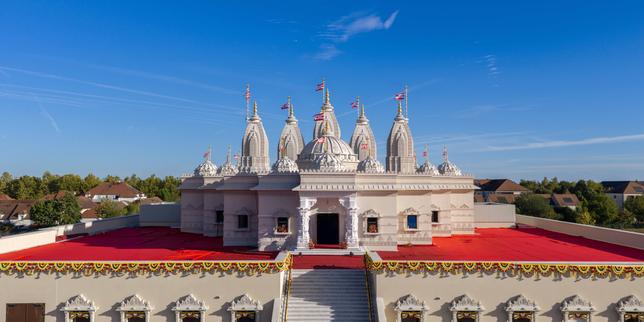
Urban planning rarely sparks fierce emotional debates, but when religious architecture and municipal identity collide on the outskirts of Paris, things get loud quickly. You don't usually expect a roundabout or a house of worship to capture national attention, yet the friction around the Hindu temple project and the Namaste roundabout in Bussy Saint Georges did just that. It's a story about local politics, cultural integration, and how suburban towns negotiate their changing identities.
If you look at France's architectural landscape, iconic symbols usually point back to Paris. Think of the Eiffel Tower dominating the skyline, representing a secular republic with a centralized identity. Move outward to the commuter towns in Seine-et-Marne, however, and you find a very different reality. Bussy Saint Georges became a fascinating case study in suburban multiculturalism, where planning committees and diaspora communities routinely clash over what public space should look like and who gets to define it.
The Roots of the Conflict in Seine-et-Marne
Bussy Saint Georges didn't become a cultural battleground overnight. Over the past few decades, the town transformed into a diverse hub, welcoming significant waves of residents from various international backgrounds, including a thriving Tamil community originating largely from Sri Lanka and India.
When a community grows, its cultural and religious needs grow with it. For years, local Hindu associations pushed for a proper place of worship. Setting up a temple isn't just about finding a piece of land; it involves navigating strict French zoning laws, securing funding, and winning over municipal councils that are often hyper-sensitive to any project perceived as altering the traditional layout of a French commune.
The proposal for the Hindu temple faced bureaucratic hurdles and local skepticism from the start. Critics worried about parking, traffic congestion, and the visual impact of traditional Dravidian architecture in a town dominated by standard contemporary suburban housing. Proponents argued that denying or stalling the project amounted to a failure to accommodate tax-paying citizens who deserved the same architectural recognition as other faith groups.
When Roundabouts Become Political Statements
Architecture communicates values. In France, the humble roundabout is surprisingly political. Local municipalities use them for public art, civic branding, or historical nods. When the Namaste roundabout entered the local conversation, it wasn't just about traffic flow. It became a visible flashpoint.
Naming a public thoroughfare or designing a roundabout with explicit South Asian motifs forces a community to look in the mirror. For some residents, it symbolised openness, diversity, and a modern nod to the town's demographic makeup. For others, particularly those attached to a strict interpretation of French secularism, known as laïcité, it felt like an erosion of traditional French public spaces in favour of communitarianism.
You can trace similar debates across Europe whenever diaspora communities try to leave a permanent physical mark on the landscape. The tension boils down to a fundamental disagreement: Does public space belong equally to all cultural expressions that make up a modern town, or should it remain neutral ground free from specific religious or ethnic nods?
Navigating Laïcité and Suburban Identity
France's model of integration relies heavily on laïcité. The concept ensures the state remains neutral regarding religion, keeping faith out of public administration and public spaces. But applying this principle to municipal architecture and community requests creates grey areas.
A temple is private property for worship, yet its exterior style and geographic placement interact directly with the public sphere. When local councils debate building permits for places of worship outside the Catholic tradition, the discussion inevitably draws scrutiny. Opponents raise concerns about foreign influence or the visibility of religious symbols. Supporters point out that Catholic churches dot every French village square, funded historically by public resources or protected as heritage sites, creating an uneven baseline for newer religions establishing roots in the country.
This double standard sits at the heart of the Bussy Saint Georges dispute. You can't talk about these local discordances without addressing the underlying anxiety around cultural change. Suburban towns near Paris absorb the pressures of globalisation faster than rural villages, making them testing grounds for how France handles pluralism.
What Most People Miss About These Local Battles
Outsiders often view these conflicts through a purely ideological lens, assuming it is an all-out culture war. On the ground, the reality is much more mundane and administrative. It is about noise ordinances, parking spaces, architectural heights, and municipal budgets.
Local politicians walk a tightrope. They have to manage neighbourhood associations complaining about disrupted traffic alongside diaspora groups demanding dignity and recognition. When negotiations break down, the disputes spill into the press, polarising opinions far beyond the borders of Seine-et-Georges.
Yet, compromise usually wins out over time. Projects get modified, designs are adjusted to blend better with local zoning codes, and roundabouts get built with broad community input. The friction forces a dialogue that, while uncomfortable, helps shape a more inclusive suburban reality.
If you want to understand where modern France is heading, stop looking exclusively at Paris landmarks. Pay attention to the suburban roundabouts and community halls where everyday citizens negotiate what living together actually means. The discord around Bussy Saint Georges wasn't an anomaly. It was a preview of how towns across Europe will continue redesigning their spaces to reflect the people who actually live in them.