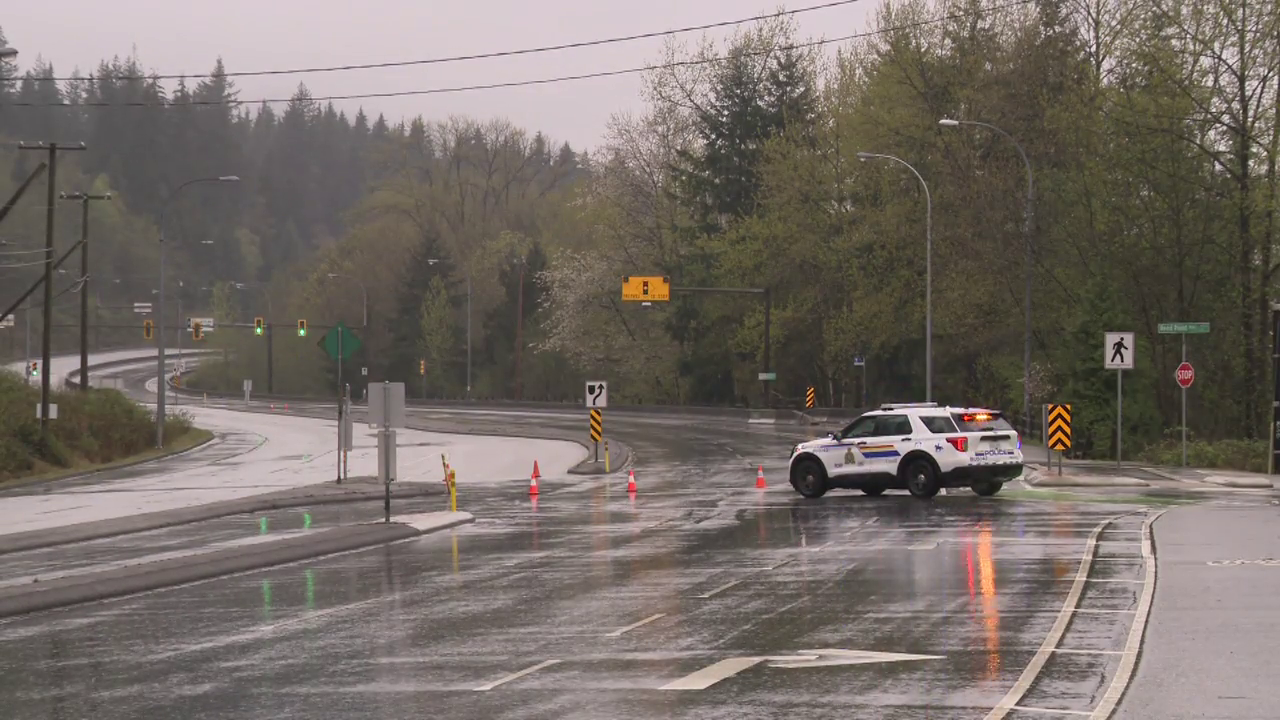
The smoke hasn’t even cleared from the Barnet Highway before the usual chorus of "slow down" and "stay alert" begins its predictable, useless hum. Another fiery wreck between Port Moody and Burnaby. Another stretch of asphalt turned into a blackened graveyard. The media treats these events like acts of God or simple lapses in individual judgment. They are wrong.
We are obsessed with blaming the driver because it’s the easiest way to avoid looking at the structural rot of our transit philosophy. We treat every crash as an isolated tragedy of human error. In reality, these "accidents" are the inevitable output of a system designed for a world that no longer exists. If you think more police presence or a lower speed limit on the Barnet is the answer, you aren’t paying attention to the physics of modern congestion.
The Myth of the "Safe" Speed Limit
Every time a car flips or bursts into flames, the immediate reflex is to demand lower speed limits. This is a cognitive trap. Speed doesn't kill; speed differential kills.
When you arbitrarily lower the limit on a major arterial like the Barnet Highway, you don't make everyone go slower. You create a volatile mix of "rule-followers" hovering at 60 km/h and "realists" trying to maintain the natural flow of 80 km/h. This friction creates a constant state of lane-shifting, hard braking, and tailgating.
Traffic engineers know this as the 85th Percentile Rule. It suggests that the safest speed is the one that 85% of drivers naturally travel at. When civil authorities ignore this and set limits based on political optics rather than kinetic reality, they turn highways into pressure cookers. You aren't "saving lives" by dropping the limit; you are manufacturing road rage and high-speed maneuvers that lead to the exact fiery wrecks we saw this week.
Our Infrastructure is Gaslighting You
Look at the Barnet Highway. It is a winding, scenic, multi-lane stretch that feels like a rural escape but functions as a critical commuter artery. It is designed to look like you can drive fast, yet it is regulated as if you are passing a playground.
This is "passive design" failure. When the environment tells the driver's brain "this is a wide-open, high-capacity road," but the signs say "crawl," the brain undergoes a fatigue known as cognitive dissonance. Boredom is a bigger killer than speed. A bored driver is a driver who checks their phone. A bored driver is a driver who doesn't notice the car in front of them has slowed down for a left-hand turn until it’s too late to avoid a rear-end collision.
I have spent years analyzing urban transit flows, and the data is clear: we build roads that encourage speed and then punish people for using them as designed. If we wanted the Barnet to be truly safe, we wouldn’t use more radar guns. We would use road diet tactics—narrowing lanes, adding physical barriers, and changing the visual texture of the asphalt to force natural alertness. But we won't do that because it’s expensive and politically unpopular to tell commuters their "highway" is actually a local road.
The Fire Problem: Why Modern Cars Are Torches
The "fiery" nature of recent crashes isn't just bad luck. It is a byproduct of modern automotive engineering that we refuse to discuss.
We have traded durability for efficiency. To meet stringent fuel economy standards, manufacturers have moved toward lighter materials and complex high-pressure fuel systems. While modern cars are "safer" in terms of crumple zones and airbags, the sheer volume of plastic, synthetic foams, and lithium-ion components means that when a crash does occur, the thermal runaway is catastrophic.
If you are driving a 2024 model, you are essentially sitting inside a highly compressed energy bomb. The competitor article talks about the "fire" as a dramatic detail. I’m telling you the fire is a systemic feature of modern manufacturing. We have prioritized "surviving the impact" over "preventing the inferno." In a high-speed collision on a highway with no median separation, the physics of energy transfer make fire an almost mathematical certainty.
Stop Asking "Who" and Start Asking "Where"
People always ask: "Was the driver drunk? Was he texting?"
These are the wrong questions. The right question is: "Why does this specific kilometer of the Barnet Highway see a 400% higher incident rate than the kilometer preceding it?"
When we focus on the "who," we let the Ministry of Transportation off the hook. We ignore the poor banking of the curves, the lack of adequate lighting, and the failure of drainage systems that lead to hydroplaning. The "lazy consensus" is that drivers are idiots. My contrarian take? Drivers are mostly predictable animals following the path of least resistance provided by the environment. If the environment is flawed, the animal will fail.
The Futility of "Awareness" Campaigns
"Drive BC" and other agencies love their digital signs telling you to "Think of Your Loved Ones." These are worse than useless—they are distractions.
True safety comes from automation and physical separation. If we were serious about stopping fiery crashes on the Barnet, we would be talking about mandatory lane-keep assist technology or, more realistically, a physical concrete median the entire length of the highway. But medians cost millions, and digital signs cost pennies.
We are being sold "awareness" as a substitute for "engineering." It is a cheap way to shift the liability onto the citizen. I have seen municipal budgets where millions are allocated for "marketing" road safety while actual hazardous intersections remain unlit for decades. It is a shell game.
The Actionable Truth
If you want to survive your commute between Port Moody and Burnaby, stop trusting the signs and start trusting physics.
- Ignore the Pack: The safest place to be is in the largest gap of traffic you can find. If you are surrounded by other cars, you are part of a potential chain reaction.
- Assume Design Flaws: Every curve on the Barnet was designed by a committee trying to save money. Approach every bend as if the drainage is clogged and the banking is off—because it likely is.
- The 3-Second Lie: On high-speed arterials, three seconds isn't enough. Modern braking distances are great, but human reaction time hasn't improved in 10,000 years. Give yourself five.
The fiery wreck yesterday wasn't a fluke. It was a symptom. Until we stop treating the Barnet Highway like a scenic path and start treating it like the high-risk industrial corridor it is, the smoke will keep rising.
Stop blaming the driver. Start blaming the blueprint.