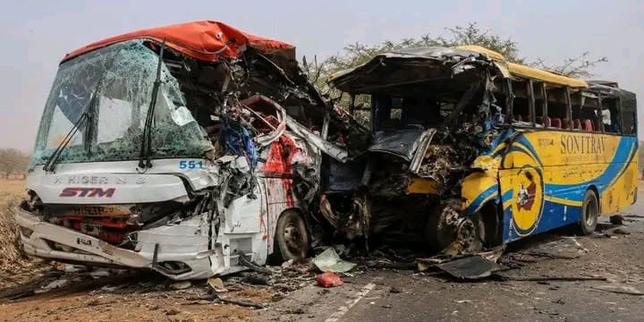
The headlights cut through the Sahel darkness like surgical steel.
Ahead lies the tarmac ribbon connecting the capital of Niger to the country's southern arteries, a long and lonely stretch where the horizon dissolves into an ocean of dry scrub and acacia trees. Drivers know this road well. They respect its monotony. They dread its sudden, violent interruptions.
Silence. Then, metal screaming against metal.
On a quiet stretch of highway, two heavy transport buses collided with a devastating, kinetic finality. There was no time to brake. No time to swerve. Just the deafening roar of impact, the shattering of safety glass, and the instant collapse of steel frames that were built to carry human lives across vast distances.
When the dust settled and the acrid smell of burnt rubber and radiator fluid filled the night air, the scale of the tragedy became glaringly apparent. At least twenty-two lives were extinguished in an instant. Seventeen of them belonged to soldiers—men who had traded the frontlines of national defense for a transit journey, only to meet their end far from any battlefield, under the indifferent desert stars.
We talk about statistics in numbers. Twenty-two. Seventeen.
Numbers are comfortable. Numbers let us categorize loss, file it away in a bureaucratic drawer, and move on to the next morning brief. But numbers do not bleed. Numbers do not leave behind empty chairs at dinner tables, unwashed boots by the door, or families waking up to a world that shifted its axis while they slept.
Consider what happens next in a community touched by such a loss.
The phones ring. The local barracks receive the call that every commander dreads. A wave of heavy, suffocating grief ripples outward from the crash site, touching villages, military outposts, and quiet neighborhoods where ordinary citizens share the collective shock. These seventeen soldiers were sons, brothers, fathers, and protectors. They were moving through the country they swore to secure, trusting the infrastructure beneath their wheels to carry them safely to their next destination.
Road accidents on major African transport corridors are rarely just accidents. They are symptoms of a systemic vulnerability.
We must look closer at the mechanics of these disasters. Long-distance buses in the region often bear the heavy burden of nation-wide mobility, navigating poorly lit roads, navigating fatigue, and enduring the immense strain of high-speed transit over aging infrastructure. When a vehicle carrying dozens of passengers collides head-on with another behemoth of the road, the physics are unforgiving. Kinetic energy converts into sheer destruction in milliseconds.
Driver fatigue hangs over these highways like a phantom passenger. Mechanics fail. Potholes swallow tires. Schedules demand speed where caution is the only rational choice.
Yet, beneath the structural failures and the tragic logistics lies the raw, beating heart of human vulnerability.
I remember standing near a transit hub years ago, watching passengers load their meager belongings into the belly of a long-distance coach. There was an atmosphere of quiet hope. People were traveling for work, for family reunions, for survival in a changing economy. They trusted the driver. They trusted the road. That fundamental human trust—the quiet assumption that when you step onto a vehicle, you will step off it at your destination—is what makes tragedies like the one in Niger so profoundly unsettling.
It shatters the illusion of safety in daily transit.
The authorities arrived at the scene long after the wreckage had locked together. Emergency responders pulled survivors from the twisted aluminum. Wounded passengers were rushed to regional medical centers, where doctors and nurses worked through the agonizing hours of the night to stem the bleeding, mend fractured bones, and offer comfort to those who had lost companions in the seat beside them.
Every injured survivor carries an invisible passenger now: the memory of the screech, the impact, and the sudden darkness.
Governments will issue statements. Investigations will be launched into the exact trajectory of the vehicles, the speed gauges, the brake integrity, and the compliance with highway regulations. Reports will be written, filed, and archived.
None of that brings back the seventeen soldiers. None of that restores the civilian lives lost in the violent collision.
The dust has long since settled on the tarmac in Niger. The wreckage has been cleared away to the margins of the road. But the stretch of highway remains, waiting for the next set of headlights to pierce the darkness, a quiet reminder of how fragile our journeys truly are when we move across the earth.