Two hundred miles an hour smells like burnt rubber, hot transmission fluid, and copper.
If you have never sat inside a stock car barreling into the high banks of Daytona International Speedway, it is almost impossible to explain the violence of the sensation. Your spine compresses into the carbon-fiber seat. The steering wheel vibrates with a frequency that blurs your peripheral vision, turning the white concrete retaining wall into a continuous, howling smear. Every instinct in the human brain—millions of years of evolutionary programming designed to keep soft tissue away from hard objects—screams at you to lift your right foot. For a deeper dive into this area, we recommend: this related article.
You don't. You keep it pinned to the floor.
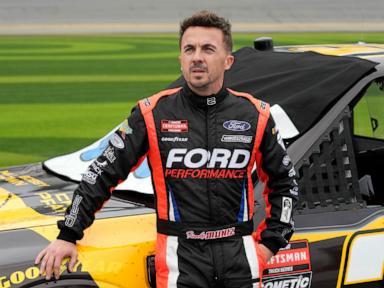
For Frankie Muniz, keeping his foot pinned to the floor was never supposed to be the script. In the collective memory of millions, he is still fourteen years old, staring directly into a camera lens with wide, exasperated eyes, trapped in the chaotic suburban purgatory of Malcolm in the Middle. He was supposed to be a Hollywood trivia answer, a child star who cashed his syndication checks, bought a quiet estate in Scottsdale, and spent his thirties playing golf or judging reality television. To get more information on this development, comprehensive reporting is available at BBC.
Instead, he chose Daytona. And at Daytona, physics does not care how famous you were in 2003.
When news broke that Muniz had been transported to a local hospital following a multi-car wreck during racing action at the World Center of Racing, the internet reacted with predictable, morbid curiosity. Headlines reduced a complex human reckoning into a punchy, clickable curiosity. Former sitcom star crashes race car. Hospitalized for evaluation. People scrolled past, paused for three seconds to wonder if he was okay, and moved on to the next tragedy or triumph in their feed.
They missed the real story entirely.
To understand what happened when sheet metal met the SAFER barrier at Daytona, you have to look past the ambulance lights and examine the quiet, terrifying bargain every second-act athlete makes when they trade safety for meaning.
The Illusion of the Soft Landing
We love a reinvention story until the bill comes due.
In 2023, when Muniz announced he would compete full-time in the ARCA Menards Series—the proving ground directly beneath NASCAR's national touring divisions—the motorsport world met him with a mixture of polite skepticism and cynical amusement. Racing has a long, uneasy history with celebrity tourists. Usually, an actor shows up for a celebrity pro-am, spins out in Turn 2, laughs it off for the cameras, and goes back to a climate-controlled trailer.
Muniz didn't do that. He showed up to every track, week after week, climbing into heavy, unforgiving machines that required immense upper-body strength and split-second spatial calculation. He finished fourth in the overall ARCA standings that season, earning the respect of hard-nosed mechanics who grew up turning wrenches in dirt-floor garages and had zero patience for Hollywood vanity projects.
By the time he stepped up to the NASCAR Xfinity Series and Craftsman Truck Series level at Daytona, he wasn't a novelty act anymore. He was a driver.
And that is precisely when the danger becomes real.
In racing, the most perilous phase of a driver's career isn't the first day they sit in a cockpit. On day one, fear keeps you slow. Fear makes you brake fifty feet too early and leave three car-lengths of cushion between your fender and the guy next to you. The real danger arrives when competence catches up to ambition—when you finally trust the aerodynamics enough to tuck your bumper two inches behind another car in a thirty-car draft at 190 miles per hour.
Imagine running at a full sprint down a crowded, pitch-black hallway while wearing blinders, trusting that the twenty people running directly in front of you won't trip. That is restrictor-plate racing at Daytona. Because the engines are choked down to keep speeds under control, nobody can simply pull out and pass on raw horsepower. The cars bunch together in tight, claustrophobic packs. Air becomes a physical thing, pushing and pulling the sheet metal like invisible hands. One tiny miscalculation—a twitch of a wrist three rows ahead, a tire losing grip by a fraction of an inch—triggers a chain reaction that no human reflex can outrun.
Inside the Tin Can
I have watched enough pack wrecks from pit road to know the exact sound they make. It isn't one loud bang. It is a sickening, drawn-out symphony of tearing aluminum, shattering fiberglass, and screaming tires that lasts four or five eternal seconds.
When you are inside the car during the "Big One," time loses its normal architecture.
First comes the sudden, unnatural silence as the tires break traction and the car goes sideways. Your hands instinctively saw at the wheel, trying to catch a slide that cannot be caught. Then comes the impact. Even with modern safety breakthroughs—the HANS device tethering your helmet to your shoulders, the energy-absorbing foam walls, the containment seats cradling your ribs—the deceleration forces are brutal. A sudden stop from 180 miles per hour subjects the human body to dozens of G-forces in a fraction of a second. Your internal organs slam against your ribcage. Your brain sloshes inside your skull.
Then, worst of all, comes the waiting.
Sitting strapped into a wrecked race car while smoke fills the cockpit and traffic is still sliding past your doors is a uniquely lonely kind of terror. You run a frantic mental checklist. Can I wiggle my toes? Can I breathe? Where is the fire? You reach down to unlatch the five-point harness, your fingers trembling slightly from the massive dump of adrenaline flooding your bloodstream, waiting for the safety crew to reach your window net.
For Muniz, that walk to the infield care center—and the subsequent ambulance ride to the hospital—carried an extra layer of invisible weight.
The Ghost in the Medical Chart
Most drivers walk into an emergency room after a crash carrying only the bruises of that afternoon. Muniz walks in carrying a complicated, heavily scrutinized neurological history.
Years ago, Muniz spoke candidly about suffering multiple concussions during his youth—from playing sports, from filming stunts, from the ordinary rough-and-tumble of an active life—alongside a series of transient ischemic attacks, often called mini-strokes. For years, tabloids twisted those candid interviews into sensationalized myths that he had completely forgotten filming his own television show. He later clarified that while his memory gaps were real and frustrating, they were largely the result of severe migraines and cumulative head trauma rather than total amnesia.
Still, when you have already stared down neurological vulnerability in your twenties and thirties, every hard hit in your late thirties feels different.
Consider what happens next in that hospital room. While social media speculates about broken bones or bruised ribs, the medical staff is looking at baseline cognitive tests, blood pressure spikes, and cervical spine scans. A trip to the hospital after a Daytona crash is frequently precautionary—NASCAR's medical protocols are strict, and any driver reporting lingering dizziness, severe pain, or specific impact telemetry gets sent out for advanced imaging. Precaution, however, does not make the fluorescent lights of an ER ceiling feel any less cold when you are lying on a gurney in a fireproof Nomex suit.
It forces a question every aging athlete eventually confronts in the quiet hours after the crowd goes home: Is the joy worth the toll?
Why Men Chase the Wall
People on the outside always ask why someone who already won the lottery of life would risk their body in a race car. Muniz had money. He had fame. He had a wife and a young son waiting at home. By every conventional metric of modern comfort, he had already crossed the finish line.
That question fundamentally misunderstands what makes human beings tick.
Comfort is a slow anesthetic. When you achieve the pinnacle of your profession before you are even old enough to legally buy a drink, the rest of your life can easily become a long, slow exercise in nostalgia. Everywhere you go, people want to talk about who you were twenty years ago. You become a living museum exhibit of your own adolescence.
Auto racing offers the exact opposite of nostalgia. A race car does not know your IMDb page. It does not care about Emmy nominations or syndicated reruns. When the green flag drops, the stopwatch is brutally, refreshingly honest. You are either fast enough to hold the bottom line through Turn 3, or you are not. You either earn the respect of the spotter in your ear and the crew chief on the pit box, or you get parked.
For someone who spent their formative years under the artificial lights of a soundstage, where every line was scripted and every outcome predetermined by writers in a room, the raw, unscripted reality of a racetrack is intoxicating. Even the danger is part of the appeal—not out of a death wish, but because risk makes the pulse feel real.
The Price of Admission
There is a hard truth about stock car racing that broadcast commercials rarely emphasize: crashing is not an anomaly. It is part of the operating budget.
Every driver who straps into a car at Daytona knows that the probability of finishing the race without a scratch is roughly equivalent to flipping a coin and having it land on its edge. You can do everything right. You can hit your marks, manage your tire wear, keep your eyes three cars ahead, and still get wiped out because a rookie behind you misjudged a closing rate by six inches.
When Muniz climbed out of that mangled machine and was loaded into the ambulance, he wasn't experiencing a failure of his racing dream. He was paying the standard entry fee.
What separates the hobbyists from the lifers isn't whether they crash. It is what happens three days later, when the adrenaline has completely drained out of their system, the stiffness sets into their neck and shoulders, and the bruises turn a deep, ugly shade of purple. That is when the fear catches up. That is when you sit at your kitchen table with a cup of coffee, staring at your son across the room, and feel the full, terrifying weight of physics.
If you climb back into the seat after that morning, you aren't playing around anymore. You have made peace with the ledger.
Beyond the Headline
By the time the initial panic faded and updates confirmed Muniz was alert, battered, and grateful for the safety engineering that kept a violent crash from becoming a tragedy, the news cycle had already moved on. Another celebrity scandal, another political flare-up, another viral video took his place at the top of the screen.
Yet the image lingers.
Picture a thirty-eight-year-old man sitting on the edge of a hospital bed in Daytona Beach, peeling off a sweat-soaked racing suit, his ears still ringing from the roar of forty V8 engines and the crunch of tearing steel. Outside the window, the Florida sun is baking the asphalt of the most famous racetrack in America. Tomorrow, the haulers will pack up, the mechanics will straighten the bent chassis or build a brand-new car from bare tubing, and the schedule will march relentlessly toward the next green flag.
He didn't need to be there. Nobody forced him onto that high bank. He could have spent his weekend on a couch, safe, comfortable, and completely forgotten by Monday morning.
Instead, he chose the noise, the heat, and the risk—proving that sometimes, the only way to feel truly alive is to put everything you have on the line at two hundred miles an hour, even when the wall is waiting.