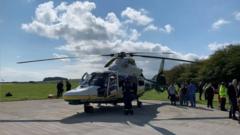
A five-year contract for air ambulance services sounds like a victory for regional stability. On paper, these multi-million dollar deals promise to bridge the gap between remote trauma victims and the specialized care that keeps them alive. But behind the press releases and the ribbon-cutting ceremonies lies a brutal economic reality. These fixed-term agreements are increasingly becoming a desperate gamble against rising fuel costs, a chronic shortage of specialized pilots, and a medical billing system that is fundamentally broken.
When a government or a hospital network signs a half-decade deal, they aren't just buying flight hours. They are offloading risk. The provider takes on the massive capital expenditure of maintaining a fleet of helicopters and fixed-wing aircraft, betting that the volume of calls and the reimbursement rates will keep them in the black. It is a high-stakes game where the margin for error is measured in minutes and cents.
The Illusion of Long Term Stability
The recent wave of five-year service agreements across the industry attempts to solve a problem that has plagued emergency aviation for decades: unpredictable funding. By locking in a provider for five years, local authorities hope to avoid the sudden service gaps that occur when smaller operators go bankrupt or when aging fleets are grounded for lack of parts.
However, the "stability" of a five-year term is often a mirage. The global supply chain for aviation components remains fragile. A single delay in a rotor blade shipment or a specialized engine seal can ground a multi-million dollar aircraft for weeks. When a provider is locked into a fixed-price contract, those maintenance spikes eat directly into the operational budget. This often leads to a quiet reduction in "readiness" that the public never sees. A backup helicopter might be sold off to cover debt, or staffing levels might be trimmed to the absolute minimum required by law.
The math rarely stays static for five years. Inflation, particularly in the aerospace sector, frequently outpaces the modest annual increases built into these contracts. What looked like a lucrative deal in year one can become a financial anchor by year four.
Why Specialized Pilots are Disappearing
You cannot run an air ambulance service without pilots who are willing to fly in the worst possible conditions. These aren't commercial airline pilots cruising at 35,000 feet on autopilot. These are aviators who have to navigate low-level terrain, often in the dark, and land on unlit highways or cramped hospital pads during storms.
The industry is facing a mass exodus. The major commercial airlines are poaching helicopter pilots at an unprecedented rate, offering higher pay, better benefits, and—most importantly—predictable schedules. An air ambulance pilot lives a life of "on-call" stress that wears down even the most seasoned veterans.
When a service provider signs a five-year deal, they are essentially promising that they can retain a workforce that is being actively hunted by competitors with deeper pockets. To keep these pilots, providers have to hike wages, which further thins the margins of the original contract. If the provider fails to keep up with the market rate for talent, the service quality doesn't just dip—it disappears. A helicopter without a pilot is just an expensive piece of lawn furniture.
The Broken Reimbursement Engine
The most significant threat to the survival of air ambulance services isn't mechanical; it's financial. The gap between what it costs to fly a mission and what insurance companies actually pay is a chasm.
Consider the "Surprise Billing" legislation that has taken hold in various jurisdictions. While designed to protect patients from astronomical out-of-network charges—often exceeding $50,000 for a single flight—the unintended consequence has been a collapse in the bargaining power of the air ambulance providers. Insurance companies now have a federally or state-mandated ceiling on what they have to pay.
- Fixed Costs: Hangar fees, insurance premiums, and 24/7 medical staffing exist regardless of whether the bird flies.
- Variable Costs: Fuel, oxygen, and specialized trauma medications fluctuate wildly.
- The Collection Gap: Many flights are performed for patients with no insurance or for those on government plans that pay pennies on the dollar for the actual cost of the flight.
In this environment, a five-year contract can become a suicide pact. If a provider cannot collect enough from private insurers to subsidize the cost of "charity" or government-reimbursed flights, the entire operation becomes a loss leader that no amount of efficiency can fix.
The Equipment Arms Race
Medical technology moves faster than aviation procurement. A helicopter purchased today is expected to be in service for twenty years, but the medical equipment inside—ventilators, cardiac monitors, and blood-clotting tech—needs to be updated every three to five years to remain at the standard of care.
A five-year contract often fails to account for the "medicalization" costs. Outfitting a cabin for a specific type of neonatal transport or high-level cardiac support requires specialized airframe modifications. These aren't just plug-and-play upgrades. They require certification from aviation authorities, which is a slow and expensive process.
Providers often find themselves stuck with "legacy" medical setups because the contract doesn't provide the capital for mid-term upgrades. This creates a two-tier system of care where patients in regions with newer contracts receive significantly better outcomes than those in the final years of an old agreement.
The Strategy of the Private Equity Takeover
It is no coincidence that the air ambulance industry has seen a massive influx of private equity investment. These firms specialize in consolidating small, family-run flight services into massive national entities. Their goal is to win these five-year contracts through sheer scale.
By centralizing maintenance and bulk-buying fuel, these conglomerates can underbid local operators. But this efficiency comes at a cost to the community. When a local operator runs the service, they have a vested interest in the region. When a distant corporate board runs it, the decision to "temporarily" shutter a base due to low volume is a cold calculation of EBTIDA rather than public safety.
The "hub and spoke" model favored by these large firms often increases response times for the most rural areas. They position aircraft where the highest volume of insured patients exists, leaving the "long-tail" rural communities waiting longer for a bird to arrive from a distant base.
Accountability in the Fine Print
If you want to know if a five-year deal is actually a good one, don't look at the photos of the new helicopters. Look at the performance penalties.
A truly hard-hitting contract includes "liquidated damages" for every minute a service is unavailable. If the provider's primary aircraft is down for maintenance and they don't have a backup on the pad within thirty minutes, they should be fined. Without these penalties, the five-year deal is simply a guaranteed revenue stream for the provider with no real incentive to maintain 100% readiness.
Most contracts are surprisingly toothless in this regard. They allow for "allowable downtime," which providers often exploit to save on staffing costs during slow periods. An investigative look at flight logs often reveals that "mechanical issues" are sometimes a convenient excuse for a lack of available crew.
The Role of the Fixed Wing Bridge
While helicopters get all the glory, the real workhorse of a sustainable five-year plan is often the fixed-wing aircraft. These planes are significantly cheaper to operate over long distances and can fly in weather that grounds a helicopter.
Smart regions are beginning to move toward a hybrid model. They use helicopters for the "scene calls"—picking someone up from a car wreck—but rely on fixed-wing planes for "inter-facility transfers" between rural hospitals and urban trauma centers. This preserves the expensive "cycles" on the helicopter engines and reduces the overall cost of the contract. However, many five-year deals are still written with a helicopter-centric mindset, ignoring the massive cost savings of a diversified fleet.
Why Local Governments Keep Making the Same Mistakes
The people negotiating these deals are often politicians or hospital administrators, not aviation experts. They are easily swayed by the "shiny object" syndrome—the promise of a brand-new fleet.
What they fail to ask are the hard questions about the provider's balance sheet. A provider with high debt-to-equity ratios is a ticking time bomb. If the provider's parent company decides to restructure or file for bankruptcy three years into a five-year deal, the local government has zero leverage. They are left with a grounded fleet and a legal battle while their citizens wait for help that isn't coming.
The focus must shift from "How much does this cost per year?" to "What is the cost of the provider failing in year three?" True due diligence requires an audit of the provider's maintenance facilities and a deep dive into their pilot retention rates. Anything less is just theater.
Rethinking the Model
The five-year deal is a relic of a more stable economic era. To survive, the industry needs to move toward "cost-plus" contracts or agreements that include automatic adjustments for fuel and labor markets.
We also have to acknowledge that air ambulance services are an essential public utility, like the fire department or the police. Expecting them to be profitable through insurance reimbursements alone is a fantasy that leads to corner-cutting and service failures.
If a community wants the security of a helicopter standing by 24/7, they have to be willing to pay for the "readiness" itself, not just the transport. This means a shift toward tax-subsidized models where the flight is "free" or low-cost for the resident, funded by a small monthly levy. This removes the predatory billing practices and gives the provider the steady income they need to maintain the fleet properly.
Stop looking at the length of the contract and start looking at the mechanics of the funding. A five-year deal is only as strong as the provider's ability to weather a global recession, a pilot strike, and a spike in jet fuel prices simultaneously. Most cannot.
The next time a local official brags about securing a long-term air ambulance deal, ask to see the backup plan. Ask what happens when the provider realizes they can’t make the numbers work in year three. The answer is usually a deafening silence.