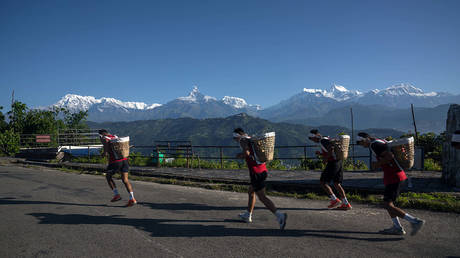
The air at 18,000 feet doesn't just feel thin. It feels sharp. Every breath is a conscious effort, a mechanical pull against a sky that wants to keep its oxygen for itself. For a trekker winding through the Khumbu Valley, a simple headache isn't just a nuisance. It is a warning. It is the first note in a symphony of physiological collapse known as Acute Mountain Sickness (AMS).
In this fragile state, you are not a consumer. You are a soul in survival mode. You look to your guide, the person you have paid thousands of dollars to keep you alive, and you trust them implicitly. But in the shadowed corners of the Himalayas, that trust has been weaponized. A massive, multi-million-dollar fraud has transformed the life-saving roar of a helicopter turbine into the ringing of a cash register.
The scam is elegant in its cruelty. It doesn't rely on shadows or dark alleys. It happens in broad daylight, under the spinning rotors of some of the world's most sophisticated machinery, fueled by a toxic cocktail of kickbacks, unnecessary evacuations, and forged medical bills.
The Anatomy of a Forced Descent
Consider a hypothetical traveler named Elias. He is forty-two, a fit accountant from Berlin who spent three years saving for his dream trek to Everest Base Camp. On day six, near Dingboche, Elias feels a dull throb behind his eyes. He mentions it to his guide, expecting a suggestion to rest or drink more water.
Instead, the atmosphere shifts. The guide’s face turns grave. He tells Elias that his lungs are likely filling with fluid. He speaks of "HAPE," the high-altitude pulmonary edema that kills. There is no time for a slow descent, the guide insists. A helicopter must be called immediately.
Elias is terrified. He doesn't know that his guide has already calculated his cut.
Behind the scenes, a three-way handshake occurs between the trekking agency, the private helicopter company, and a specific clinic in Kathmandu. The guide receives a "referral fee"—sometimes as much as $500—just for making the call. The helicopter company charges the insurance provider $5,000 for a flight that should cost half that. The clinic then inflates the bill with unnecessary tests and an overnight stay for a "patient" who simply needed a lower altitude and a liter of water.
This isn't a theory. Investigations by the Nepali government and international insurers have revealed a systemic rot where guides were allegedly coached to pressure hikers into evacuations. In some instances, it was reported that guides went as far as putting baking soda in a trekker’s food to induce diarrhea or nausea, ensuring a "medical emergency" that would satisfy an insurance adjuster.
The Invisible Stakes of a Paper Trail
Insurance is a game of risk and pooled resources. When a rescue is genuine, it is a miracle of modern logistics. Pilots fly at the absolute ceiling of their aircraft’s capabilities, navigating unpredictable winds and jagged peaks to pluck a dying person from the edge of the world.
When the rescue is a fraud, it is a parasite.
The global insurance industry noticed the spike. They saw that Nepal—a country with a static number of trekkers—suddenly had a vertical climb in emergency evacuations. The math didn't add up. Why were so many healthy, young hikers suddenly failing to breathe?
The consequence for the traveler isn't just a ruined vacation. It is the slow poisoning of the entire region’s reputation. If insurance companies cannot verify the legitimacy of a claim, they do one of two things: they skyrocket the premiums, or they stop offering coverage altogether.
For the honest Sherpa, the ethical tea-house owner, and the legitimate rescue pilot, this is a death sentence. They rely on the steady flow of tourism. If the Himalayas become "uninsurable," the trail goes cold. The fraud of a few hundred greedy middlemen threatens the livelihoods of thousands of mountain workers who actually respect the peaks they call home.
The Hospital as a Holding Cell
The deception doesn't end when the helicopter touches down on the helipad in Kathmandu. For many, the second act of the scam begins in the sterile halls of private hospitals.
In these facilities, the "patient" is often treated as a captive revenue stream. They are subjected to a battery of blood tests, X-rays, and MRIs that have nothing to do with altitude sickness. The goal is to create a thick dossier of paperwork. This paper trail is the shield the fraudsters use against the insurance investigators.
"We had to do it," the hospital says, pointing to a stack of charts. "We had to rule out everything."
Meanwhile, the trekker is often kept in a state of confusion. They are told they cannot leave until the insurance company "guarantees" payment. In reality, the hospital is waiting to see how much they can squeeze out of the policy before letting the guest go. It is a high-altitude kidnapping rebranded as medical care.
The Toll on the Pilots
There is a human element often ignored in the headlines about "scams" and "kickbacks": the pilots.
The men and women flying these missions are some of the most skilled aviators on the planet. They operate in the "dead man’s curve," where an engine failure means certain disaster because there is no room to glide. Every takeoff and landing at high altitude is a calculated gamble with gravity.
When a pilot is called for a "life-critical" evacuation that turns out to be a hiker with a mild hangover or a guide looking for a payday, it is more than just an annoyance. It is a waste of a finite resource. A pilot flying a fake rescue in one valley might be unavailable for a real heart attack or a broken femur in the next.
The fatigue is real. The mechanical wear on the helicopters is real. By turning these machines into taxis for profit, the scammers are essentially gambling with the lives of the pilots and the people who will actually need them tomorrow.
The Great Cleansing
The exposure of these rackets has led to a tense standoff between the Nepali government and the international community. For years, the official response was muted, buried under layers of bureaucracy and the influence of powerful business interests who owned both the agencies and the helicopters.
But the pressure became too great to ignore.
Insurers issued ultimatums. They demanded a centralized "dispatch" system where a neutral medical professional—not a guide with a commission—decides if a flight is necessary. They demanded transparent pricing. Most importantly, they began blacklisting agencies and clinics suspected of being part of the "scam circle."
For the traveler, this means the era of the "free ride" is over. It also means that if you are truly in trouble, the system might actually work the way it was intended.
Navigating the Ethics of the Ascent
If you find yourself on those high, winding paths, the responsibility of the narrative shifts to you. It is a heavy burden to carry when your head is pounding and the air is thin.
The mountain demands honesty. It asks that you listen to your body, not the panicked whispers of someone looking at your insurance policy as a jackpot.
True safety in the Himalayas isn't found in a helicopter's rotors. It is found in the slow, agonizingly boring process of acclimatization. It is found in the guide who tells you to turn back and walk down on your own two feet because you’re not ready for the pass. It is found in the recognition that some things—like the integrity of a rescue and the sanctity of the climb—are worth more than a quick descent.
The scam is a symptom of a world that wants the summit without the struggle, and the profit without the risk. But the mountain has a way of stripping away the lies eventually.
You can fake a medical report. You can forge a bill. You can bribe a guide. But you cannot trick the altitude. When the wind howls and the clouds close in, the only thing that matters is the truth of your lungs and the strength of your resolve. Everything else is just noise, lost in the thin, unforgiving air.
The rotors will keep spinning, but the world is finally watching the price tag.