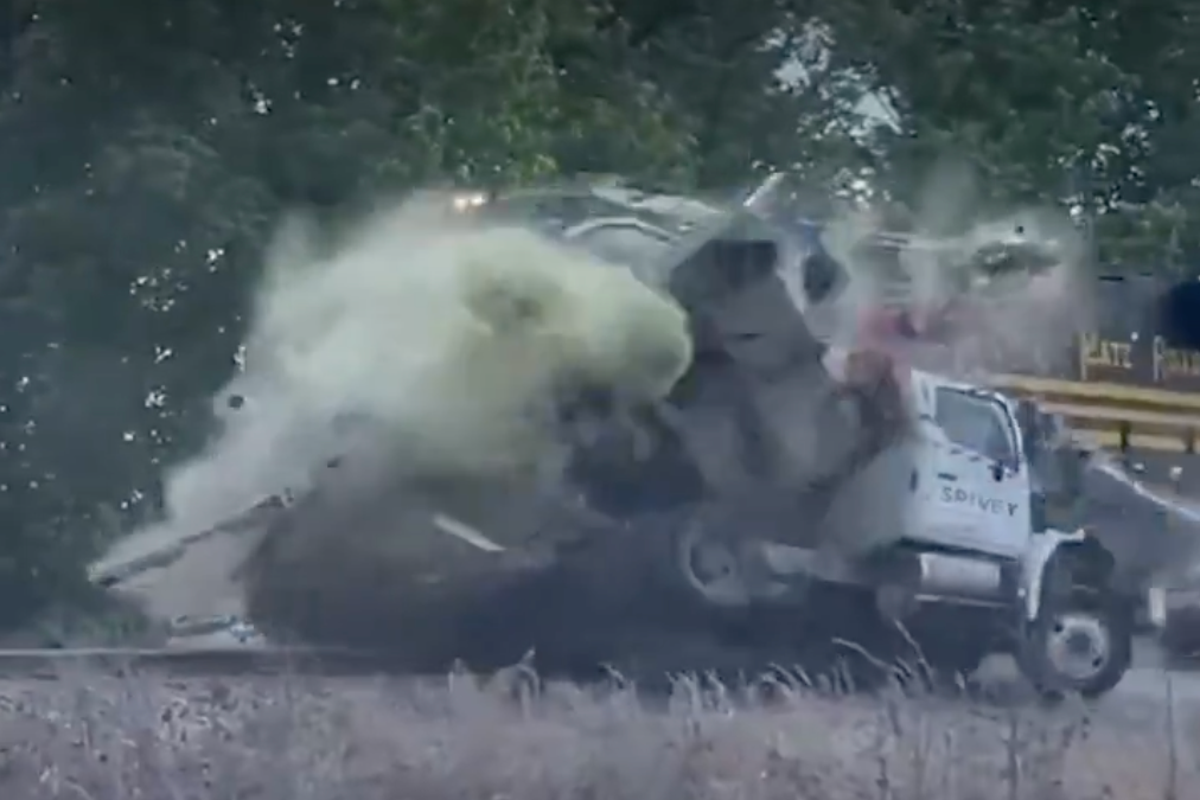
A train colliding with a stuck vehicle at a level crossing makes for a dramatic, viral video. When that vehicle happens to be a vacuum truck carrying thousands of gallons of liquid waste, the resulting eruption ensures the footage circles the globe within hours. But focusing entirely on the sensational explosion obscures the systemic infrastructure and regulatory failures that allow these incidents to happen. The real story is not the impact itself, but the predictable sequence of engineering oversights, driver pressures, and outdated crossing designs that practically guarantee these collisions will continue to occur.
To understand why a sewage tank explodes upon impact, one must look at the physics of sealed vessels. These trucks operate under vacuum pressure to load waste, utilizing reinforced steel tanks designed to withstand internal negative pressure. However, they are not engineered to survive the immense kinetic energy delivered by a locomotive traveling at high speed. When the train strikes the tank, the structural integrity fails instantly. The sudden, violent compression of the contained liquid and trapped gases forces an immediate, explosive release of pressure outward.
The Low Clearance Trap
Most onlookers assume level crossing accidents are solely the fault of a reckless driver trying to beat the train. While operator error plays a role, the geometry of the road surface is frequently the primary culprit. Many rail crossings feature a raised profile, often referred to as a hump crossing or a high-profile crossing.
When a long-wheelbase vehicle or a low-clearance truck attempts to traverse these tracks, it faces a severe physical challenge. The apex of the crossing catches the undercarriage of the trailer or the low-hanging equipment of a specialized vacuum truck. The vehicle bottoms out. Its drive wheels lift slightly or lose traction on the uneven surface, rendering the truck immobile directly across the path of oncoming rail traffic.
Commercial drivers often lack real-time data regarding the exact vertical profile of local crossings. Standard navigation software rarely accounts for ground clearance hazards, leaving operators to rely on visual assessments that can be incredibly deceiving from the cab of a heavy vehicle. Once a truck is high-centered, the clock begins ticking down toward disaster.
Communication Gaps in the Emergency Chain
When a vehicle becomes stuck on the tracks, a frantic race against time begins. Every level crossing features a blue sign containing an emergency notification system number and a specific locator code. This sign connects callers directly to the railroad dispatcher, who holds the authority to halt oncoming trains.
Unfortunately, this critical safety mechanism fails more often than it succeeds.
- Drivers panic and attempt to free the vehicle rather than searching for the sign.
- Local emergency dispatchers sometimes struggle to coordinate with the specific railroad operator responsible for that track segment.
- Braking a freight train weighing thousands of tons requires significant distance, often more than a mile.
By the time the information flows from the stranded driver to the emergency operator, then to the railroad company, and finally to the locomotive engineer, the train has already passed the point of no return. The collision becomes mathematically inevitable long before the physical impact occurs.
The True Cost of Infrastructure Neglect
Fixing these dangerous crossings requires substantial capital investment, creating a persistent stalemate between local municipalities and private railroad corporations. Grading a road to eliminate a high-profile hump requires extensive earthwork, utility relocation, and prolonged traffic disruptions. Neither party wants to foot the bill alone.
Instead of proactive engineering solutions, the industry relies heavily on passive warning signs and reactive enforcement. This approach shifts the burden of safety entirely onto the vehicle operator while leaving the underlying hazard completely intact. It is a gamble played out thousands of times a day across the transportation network.
The spectacular failure of a waste tank under the wheels of a train is a graphic reminder of this vulnerability. As long as antiquated crossing geometries remain part of the transport grid, no amount of driver training will eliminate the risk. The solutions exist, the funding models do not, and the public continues to pay the price in shattered steel and disrupted lives. Each viral video is simply the predictable receipt of a long-standing infrastructure debt coming due.